

There isn’t one fleet safety platform that fits all landscaping companies. The right choice depends on your operation, workforce, vehicles, and safety priorities.
There is one throughline: The right fleet safety platform should help landscaping operations leaders move from case-by-case event handling to consistent and proactive safety management.
Why landscaping companies need more than GPS tracking for fleet safety
Vehicle tracking is a useful starting point for safety, but not the full picture. GPS can’t show whether a driver was following too closely, what happened immediately before a collision, or whether a manager followed up with coaching.
Landscaping operations need a clearer connection between what happens on the road and what happens next. The best fleet safety software connects several types of information:
| Data | How it adds context |
| Location and telematics | Shows where the vehicle was, how it was moving, and what was happening around an event |
| Driver behavior data | Helps identify patterns such as speeding, harsh braking, or other risky behaviors that may require attention |
| Safety-event video | Adds visual context that can help managers understand an incident and support drivers when they weren’t at fault |
| Incident data and reporting | Creates a record for investigation, documentation, and trend analysis across the company |
| Coaching workflows | Turn detected events into defined follow-up actions. |
With this context in one workflow, managers can see what happened right away and respond appropriately. Build on that foundation by looking for capabilities that turn connected safety data into a repeatable workflow.
5 capabilities to look for in the right fleet safety software
When comparing options for your landscaping fleet, prioritize capabilities that help you:
- Identify risk.
- Understand what happened.
- Coach drivers consistently.
- Document incidents.
- Scale without disruption.
1. Risk detection and event validation
Safety alerts are only useful when they help managers distinguish real risks from low-priority events. Look for event detection tools that explain why an event was flagged, validate the behavior, and help teams prioritize which drivers need follow-up.
Motive Driver Safety detects 20+ safety events, including mobile device use, unsafe lane changes, and close following. Teams can choose which behaviors to detect and set safety thresholds. Motive’s Event Validation Engine, EVE, validates safety events before they reach managers, helping remove false positives and focus attention on events that require follow-up.
2. Video and telematics context
Telematics alone isn’t enough to explain the context of a safety event. A driver’s hard-braking event could be unsafe driving, or it could be an appropriate reaction to an animal crossing the road.
Video connected to location, speed, trip history, and other telematics data helps managers reconstruct the circumstances around an event. That context gives managers a stronger basis for coaching and more informed incident reviews.
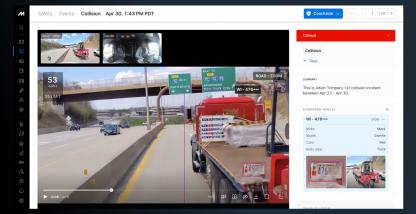
Motive’s AI Dashcam Plus provides HD event footage, including video that shows what happened before and after an event. When reviewed alongside telematics data, that footage gives managers more context for coaching.
3. Driver coaching and follow-up
Seasonal hiring and labor shortages can make it difficult for supervisors to reinforce the same expectations across every crew. And driver behavior changes are hard to track manually.
Robust driver coaching and follow-up tools should help managers move from a detected behavior to a repeatable workflow:
- Identify the behavior.
- Assign coaching.
- Document the conversation.
- Review whether the issue continues.
Motive’s Driver Coaching tools can:
- Alert the driver in-cab when unsafe behavior is detected.
- Deliver personalized AI Coach feedback in the Motive Driver App.
- Bring persistent behaviors into Coaching Sessions with the driver’s coachable events and history.
- Create a Safety Score to track driver improvement.
Together, these capabilities support changing driver behavior across the organization.
4. Incident response and safety reporting
After a safety incident, reconstructing what happened can take time, especially when information is spread across sources. Without standardized records and branch-level reporting, leaders may miss recurring risks across crews or locations.
Look for these features to support consistent incident response and reporting:
- Incident records
- Video and telematics review
- Standardized reports
- Trends by driver, vehicle, event type, location, or time period
Motive’s Safety Hub consolidates safety insights, event reviews, and performance tracking. Safety Scores and coaching reports help managers review behaviors and performance over time. Combined with incident video and Accident Management, these tools help teams identify recurring issues.
5. Operational fit and scalability
A safety process that works for one branch may not work across the whole company, especially with seasonal hiring, branch openings, and business changes.
The goal isn’t for every branch to create its own safety process. Look for software that helps leaders define standard workflows, apply them consistently, and make controlled adjustments when local requirements differ.
When comparing vendors, evaluate support for:
- Standardized event thresholds and coaching steps
- Shared policies, user permissions, and approval roles
- Centralized reporting with branch or location views
- Onboarding and training
- Language support
- Mobile access
- Installation and rollout requirements
- Integrations
- Ongoing administration and support
A centralized platform can reduce handoffs between systems and give safety leaders one place to manage events, coaching, reporting, and performance trends.
Safety Hub gives safety leaders a centralized view of fleet safety performance. Motive In-Cab Alerts support English, French, and Spanish, helping multilingual teams apply consistent standards as operations grow.
Questions landscaping teams should ask during a fleet safety software evaluation
Use the questions below to understand how each platform delivers those capabilities.
| Category | Questions to ask | Why it matters |
| Risk detection and event validation | What types of unsafe and safe behaviors can the platform identify? How does it determine whether an event requires attention? How does the system validate an event is real and not a false signal? Can managers see why an event was flagged? | Clear validation can help teams focus on meaningful risks instead of inconsistent or low-priority alerts. |
| Video and telematics context | Can managers review video, trip history, location, and vehicle data together when investigating a safety event? Can they see what happened before, during, and after an event? | The platform should make it easy to understand an event without moving between disconnected systems. |
| Coaching and follow-up | What happens after an event is detected? How do managers see whether the behavior is improving or worsening over time? | Useful coaching features should support a full workflow with follow-up, not just identify the problem. |
| Incident response and reporting | When a collision or safety event occurs, what is the post-event workflow like? How do teams preserve evidence and document what happened? How do managers identify patterns across drivers, vehicles, branches, event types, and time periods? How do they see if a driver’s behavior is worsening or improving after coaching? | Reporting should help leaders go beyond data collection to decide where follow-up is needed. |
| Seasonal and multilingual support | How does the platform support seasonal onboarding and multilingual teams? How does it support new or temporary employees? Can it provide safety guidance in the languages crews use? What tools are in place to make safety standards consistent across our locations? | Features should support safety leaders as they manage a changing workforce without adding extensive manual administration. |
| Deployment and operational impact | What is the installation time? What are the hardware requirements? What integrations do you provide? What is user setup like? What time and staff would we need to dedicate to ongoing administration? What operational measures are we able to track (such as coaching completion, recurring risk behaviors, incident response time, or time spent on manual reporting)? | The right platform should fit into your existing landscaping operations workflows and provide enough flexibility to grow. |
The right platform makes safety management repeatable
The right fleet safety software for landscaping companies isn’t necessarily the platform with the longest feature list. It’s the one that helps your team accurately identify risk, respond consistently as the workforce changes, and build a standardized safety process that can grow with your operation.
Frequently asked questions
How much administrative work does fleet safety software require?
The right fleet safety software shouldn’t increase administrative work for a landscaping company. Instead, features like validated safety alerts, configurable event detection thresholds, centralized event review, automated coaching, mobile access, and reports that show follow-up can help reduce manual work.
How can landscaping companies introduce fleet safety software without losing crew trust?
A fleet safety software rollout should explain that cameras and alerts are meant to improve the crew’s safety. Explain what events trigger video, who can access it, how footage is used, how teams respond to safety events, and what privacy settings apply. Pair clear policies with consistent coaching and recognition for safe behavior so drivers understand that the program supports them.
How long does it take landscaping fleets to implement fleet safety software?
Implementation time varies by vendor, fleet size, hardware, number of branches, and required integrations. Before choosing a platform, ask how long installation takes, if vehicles are out of commission during installation, what training is included, and how rollout support works. Consider a vendor that offers phased deployment to avoid disrupting seasonal operations.
How can a landscaping company measure whether fleet safety software is working?
Measure how consistently the safety workflow is being used and whether driver behavior is changing. Track process measures such as coaching completion, incident response time, and time spent on manual reporting. Use Safety Score as a high-level indicator, not a diagnosis. Then review behavior trends by driver, vehicle, branch, and event type to understand what changed and whether coaching is working.