


Chemical exposure and run-ins with equipment are common risks in field service, but the potential for vehicle-related accidents deserves just as much attention. Services like electrical repair, pest control, and landscaping keep homes safe, clean, and green. These professions are also more dangerous than many realize. Every day, field service workers face electrocution, chemical exposure, slips and falls, and the traffic hazards that come with a job spent on the road.
The latest Bureau of Labor Statistics, summarized by the National Safety Council, fatality data shows the danger has not gone away. In 2024, 437 workers in installation, maintenance, and repair workers died from on-the-job injuries — the third most deadly line of work behind transportation and construction. Grounds maintenance work is moving in the wrong direction: 356 grounds cleaning and maintenance workers lost their lives in 2024, up from 337 the year before.
Transportation risks in field service lurk in plain sight
The hazards above are real, and transportation incidents pose a bigger threat in field service than many operators expect. Driving between jobs all day exposes technicians to the single deadliest category of workplace event in the country.
Transportation incidents were the most freuent type of fatal work event in the United States in 2024, accounting for about 38% of all occupational fatalities, according to the U.S. Bureau of Labor Statistics’ Census of Fatal Occupational Injuries. The category included 1,937 fatal incidents. Overall, 5,070 fatal work injuries were recorded in 2024, down 4.0% from 5,283 in 2023. BLS also reported that a worker died from a work-related injury every 104 minutes. For field service organizations, these findings reinforce the need to treat travel between jobs as a core safety consideration.
The category included 1,937 fatal incidents. Overall, 5,070 fatal work injuries were recorded in 2024, down 4.0% from 5,283 in 2023. BLS also reported that a worker died from a work-related injury every 104 minutes. For field service organizations, these findings reinforce the need to treat travel between jobs as a core safety consideration.
Key takeaways:
- Field service professions are among the most deadly, with installation, maintenance, and repair work ranking third in fatalities.
- Transportation incidents remain the leading cause of workplace death, accounting for roughly 38% of all fatalities.
- The overall fatal injury rate is edging down, from 3.5 to 3.3 per 100,000 workers, as better safety tools reach the fleets that invest in them.
- While some businesses view safety as an added expense, the costs of inaction run far higher. Fleets that use AI-enabled platforms report a decline in unsafe driving behaviors, leading to better performance and lower costs.
The costs of inaction
Some businesses believe that investing in a driver safety program is too costly in the face of so many other expenses. Research shows the opposite. Costs add up faster without a safety program in place.
A single serious collision can trigger an insurance premium spike, a workers’ compensation claim, a nuclear verdict in litigation, vehicle downtime, and the loss of an experienced crew member who cannot easily be replaced. As accidents rise, insurance follows: premium costs per mile have climbed 47% over the last decade as lawsuits and nuclear verdicts have soared. For a field service operation running on tight margins, one bad incident can erase a year of profit.
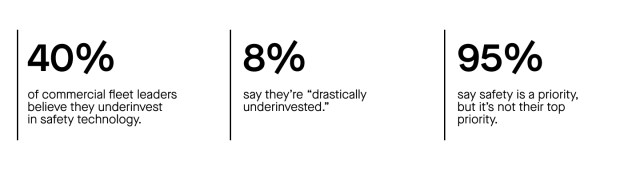
The priority is clear even if the investment sometimes lags. In Motive’s 2026 field services research, 84% of field services respondents said safety and accident prevention was one of their top priorities. For organizations looking to turn that priority into measurable results, the gap between safety goals and the tools available on the ground represents an opportunity to reduce costs.
Leveraging AI for better fleet safety
With the help of artificial intelligence, field service businesses can protect workers and prevent these costs. Modern, accurate AI safety systems have moved from passive recording to active prevention. Instead of only capturing an incident after it happens, they detect risky behaviors as they occur and coach the driver in the moment, before a near-miss becomes a crash.
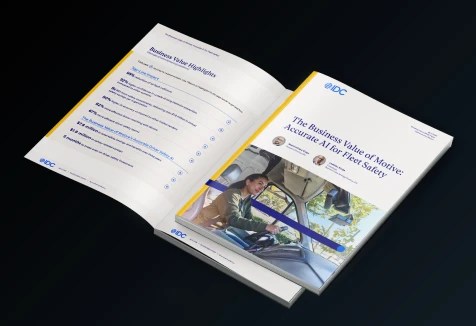
The measured results are significant. An independent 2026 IDC Business Value study, based on interviews with six organizations using Motive’s AI-powered safety solutions, found an average 95% reduction in at-fault collisions. IDC’s three-year financial model, based on customer-reported costs and benefits, estimated an average eightfold return on safety investment, and a five-month payback.
The interviewed organizations also reported 50% higher median AI accuracy than other trialed vendors and 82% more effective driver coaching. Additionally, Motive’s internal analysis estimates an average 80% reduction in collisions during the first year among fleets with at least 150 active monthly vehicles, at least 90% of which had dual-facing AI Dashcams for at least 12 months.
See how our AI can benefit your business
AI is changing the way field services operate. The arrival of AI in field service has made processes faster and easier, improving the daily experience for both technicians and customers. As you weigh its impact on productivity, do not overlook its potential to improve safety performance on the road.
Davey Tree, which runs one of the larger tree-service fleets in the country, reported a 93% improvement in miles driven per safety event as it rolled out Motive’s AI-powered platform. That represents a substantial increase in the distance traveled between safety events. Hawx Smart Pest Control reported an 88% decrease in cellphone use during the first six months of its Motive program and $216,000 in annual insurance savings after qualifying for its maximum monthly discount.
AI is becoming an important part of a world-class safety program, and findings from the 2026 IDC study show why:
- Organizations interviewed reported an average 95% reduction in at-fault collisions after adopting Motive’s AI-powered safety solutions.
- They reported 82% more effective driver coaching.
- Motive AI showed 50% higher median accuracy than other trialed vendors.
- The organizations achieved an average eightfold return on investment, with a five-month payback based on customer-reported costs and benefits.
At Motive, we build technology that empowers safety leaders to make a real impact. If you are interested in how Motive can help you chart a safer course, book a walkthrough or review the independent IDC study on Motive’s safety ROI for the full results.
Frequently asked questions
How dangerous is field service work in 2026?
Field service remains high-risk because it combines heavy driving with physical labor at uncontrolled job sites. In 2024, transportation incidents caused about 38% of all 5,070 U.S. workplace fatalities, and installation, maintenance, and repair occupations recorded 437 deaths.
Is field service getting safer?
For fleets that invest in modern safety tools, yes. The overall U.S. fatal injury rate fell from 3.5 to 3.3 per 100,000 workers, and fleets using AI-powered safety systems have seen up to a 95% reduction in at-fault collisions.
What is the return on investment for fleet safety technology?
An independent 2026 IDC study found Motive customers averaged an eightfold return on investment and a five-month payback, alongside a 95% reduction in at-fault collisions.
How does AI reduce field service accidents?
AI safety systems detect risky behaviors such as distracted or drowsy driving as they happen and coach the driver in real time, rather than only recording an incident after the fact. This prevention approach has helped fleets cut cell phone use behind the wheel and lower collision rates substantially.