



The freight recession finally broke this year and rates hit levels the industry had never seen. Then fuel prices soared. At nearly $6 a gallon, the gap between what a truck is reimbursed and what it actually burns will decide your year.
On Friday, September 4, 2026, the national average price of diesel reached $5.85 a gallon, according to AAA. That beat the previous record of $5.816 set on June 19, 2022. On February 27, the day before the conflict with Iran began, the national average was $3.76. One year ago it was $3.71.
A truck running 125,000 miles a year at 6.5 miles per gallon burns 19,231 gallons. At February’s price, the annual fuel bill was $72,308. Today it’s $112,500. Same truck, same lane, same driver, $40k more leaving the account.
How we got here, and why record oil production didn’t save us
The Strait of Hormuz closure led to a refining problem for the United States, which is distinct from a crude oil problem. The country produced 13.6 million barrels of crude per day in 2025, an all-time record according to the EIA, but diesel has to be refined. The United States hasn’t built a major new greenfield refinery since 1977. Refineries that went down during COVID never fully came back, and the ones running sit near capacity. When Iran closed the strait in early March, roughly 20 million barrels a day came off the global market, which MacroEdge Research measured as the largest supply disruption on record. The 1978 Iranian Revolution took out 5.6 million barrels a day. The 1973 embargo took out 4.4 million.
Crude trades globally, so refiner input costs rose regardless of where the barrels originated. Goldman Sachs noted price increases for refined products have outrun increases in crude itself, which means the crack spread is widening. The EIA reported in August that oil stockpiles were drawing down quickly with Hormuz still constrained, and projected diesel easing to $4.86 by the end of the year.
The end of the freight recession and the cruel timing of Strait closure
The freight recession ran from roughly 2022 through 2025, the longest on record. Carriers spent four years watching rates bleed out. Then it eased. Truckload spot rates hit an all-time high of $3.83 per mile in early June 2026, confirmed by the FreightWaves SONAR National Truckload Index at a reading of 383, topping the COVID boom peak of roughly $3.50 to $3.60. Tender rejections reached 17.55 percent in June, the highest since 2022, meaning carriers were turning down contract freight because spot paid better. Uber Freight projected spot rates 20 to 25 percent above prior-year levels through the rest of the year. The Cass Truckload Linehaul Index, which strips fuel out entirely, sat at 149.4 in June, up 5.5 percent year over year. The recovery is real. A meaningful share of the record-setting number is fuel money passing through the account on its way to a truck stop.
The number that decides how successful your year will be
At $5.85 a gallon and 6.5 miles per gallon, fuel costs 90 cents per mile. At 7.0 mpg, it costs 83.6 cents. At 7.5 mpg, it costs 78 cents.
DAT reported the average van fuel surcharge jumped from 41 cents to 61 cents per mile in March 2026, the highest since late 2022 and roughly 50 percent above the 2025 baseline of about 40 cents. Set 61 cents against 90 cents of actual burn and the uncovered portion is 29 cents a mile, which on 125,000 miles is $36,250 per truck that has to come out of linehaul.
Spot freight often carries no separate surcharge line. Fuel is baked into the all-in rate, so when diesel moves mid-week, the carrier absorbs it until the next load books. Run a load with 76 cents per mile of fuel-surcharge compensation against 70 cents per mile of actual fuel cost and you’re ahead by six cents. That spread comes from two things: what you negotiate, and what you pay at the pump.
Every tenth of a mile per gallon is worth $1,705
At 6.5 mpg, that truck burns 19,231 gallons a year. At 6.6 mpg it burns 18,939. The difference is 291 gallons, or $1,705 per truck per year at today’s price. In 2025, at $3.71 diesel, the same tenth was worth $1,081.
Here are 8 things to understand when you’re thinking about your fuel costs:
1. Know your actual baseline before you change anything
Most fleets operate on a fuel number assembled from receipts and odometer readings, a lagging picture with no driver or vehicle attribution. Motive’s Fuel Hub pulls fuel consumption, MPG, moving MPG, idle time, and fuel cost by driver, by vehicle, and at the fleet level over any date range you choose, and benchmarks it against Motive’s network of more than 700,000 vehicles. The Fuel Intelligence Hub, which Motive launched on May 25, 2026, adds trend graphs, top- and bottom-performer views, and alerts in a single dashboard.
A 6.4 mpg average means nothing on its own. A 6.4 average against a network of comparable vehicle class, make, model, and fuel type tells you whether you have a spec problem, a lane problem, or a driver problem, and those three have completely different fixes.
2. Idle is the most expensive thing your trucks do while parked
A diesel engine at idle burns roughly a gallon an hour. Two hours a day across 250 working days is 500 gallons per truck, or $2,925 a year at $5.85. Across 50 trucks, that’s $146,250 a year in fuel that moves no freight.
Motive’s telematics run rules-based idle thresholds with alerts and reports, and PTO monitoring separates productive idle from unnecessary idle, which is the distinction that makes the data usable for a fleet running reefers, cranes, or lift gates. Without that separation, the report just says the PTO drivers are the worst offenders, and they’re not.
“Reduce idling” is a policy nobody acts on. “Your idle is averaging 2.8 hours a day, the fleet average is 1.1, and at today’s price that difference is costing $164 a week” is specific enough for a driver to respond to. For over-the-road drivers, an APU removes the cab-comfort argument entirely. In my experience, a Thermo King TriPac runs $8,000 to $12,000 installed, and at $5.85 diesel, the payback window is well inside a year for a truck idling meaningfully.
3. Stop paying the convenience premium at the pump
A 30-cent spread between two truck stops three miles apart is $45 on a 150-gallon fill. Twenty trucks fueling four times a week is 4,160 fills a year, which is $187,200 in cost that has nothing to do with miles run or freight hauled. A driver coming off a 600-mile day isn’t running price comparisons, and shouldn’t have to. The Motive Card monitors diesel prices at locations along the active route and flags cheaper options ahead.
4. What your fuel card costs you
Fuel card fees seldom come up when you’re being pitched the card; they generally come up on the statement. The costly ones tend to follow the same pattern: fees the customer never clearly agreed to, add-on programs the account was enrolled in by default, and per-gallon savings that come in under what the sales pitch promised. None of them looks like much on one invoice. Across a year and a fleet, they can wipe out the discount that sold the card in the first place.
A card that takes 8 cents off a gallon is worth $12 on a 150-gallon fill. On the 19,231 gallons the 125,000-mile truck above burns in a year, it’s worth $1,538; across 20 trucks, it’s $30,770. One major provider’s current card agreement lists a one-time $50 setup fee and, on its SmartFleet package, $8 per card per month. For 20 trucks, that’s $1,970 in the first year, about 6 percent of the promised discount, and it’s printed in the contract where you can read it.
That’s the fee you can see. The expensive ones are fees you didn’t see when you signed and discounts that come in under the sales pitch. At $5.85 diesel, 8 cents is 1.4 percent of the pump price. A discount that runs 2 cents short of the promise costs that 20-truck fleet $7,692 a year, almost four times the card fees.
Late fees are the other place the bill grows. On one major provider’s charge account, a payment that isn’t in by 11:59 p.m. Eastern on the due date carries a fee of $150 or 13.99 percent of the past-due amount, whichever is greater, plus interest at the Wall Street Journal prime rate plus 4 percent until it’s paid. On a $10,000 invoice, that’s $1,399 before interest. That fee lands hardest on the carrier waiting 30 to 45 days on broker pay while fronting $112,500 a year in fuel per truck. Pull your statements and check for late fees on payments you sent on time, or on payments delayed by the provider’s processing. It happens, and it’s always worth reviewing and disputing.
Every fuel card has a price, including the Motive Card, which charges a monthly fee per active card. Before you sign or renew with any provider, get every fee in writing along with the billing cycle when it first shows up, and ask which add-on programs the account is enrolled in by default. An add-on switched on at setup keeps billing every month until somebody turns it off. Then pull three months of statements and check the discount you received at the pump against the discount you were quoted, location by location, since a deep rate at a chain your drivers rarely visit is worth less than a shallower rate where they fuel every week. The Motive Card publishes its fees before you sign and flags drivers who fueled at a more expensive pump on their route.
5. Fuel fraud is a line item, not an edge case
Most fuel fraud isn’t dramatic theft. It’s transactions at locations the truck wasn’t near, quantities exceeding tank capacity, and purchases on routes the driver wasn’t running. The Motive Card ties every transaction to the vehicle’s GPS position, driver assignment, and rated tank capacity, auto-declines location and fuel-level mismatches, and reconciles automatically. Card controls include per-transaction unlock, spending limits, and location restrictions, and Motive includes a $250,000 fraud protection guarantee with a subscription. At $3.71 diesel, a 10 percent leak on a 20-truck fleet was roughly $71,000 a year. At $5.85, it’s $112,000.
6. Maintenance shows up on the fuel bill before it shows up in the shop
A 10-pound drop in tire pressure across 18 tires raises fuel consumption by about half a percent. Misalignment, clogged air filters, dirty injectors, and worn belts each add fractions of a percent, and together they can run 5 to 8 percent of fuel spend, which on that 125,000-mile truck is $5,600 to $9,000 a year at current prices.
ATRI found that repair and maintenance cost per mile dipped slightly in 2024, the first decline since 2020, and that smaller fleets deferred standard maintenance through the freight recession. Those four years of deferral costs are now combined with diesel at nearly $6/gallon.
Motive’s recent research with FreightWaves Research found 80 percent of fleet professionals ranked rising maintenance and repair costs as their top operational challenge, ahead of driver recruitment at 60 percent and fuel cost management at 50 percent, while only 13 percent described their systems as integrated enough to share data automatically.
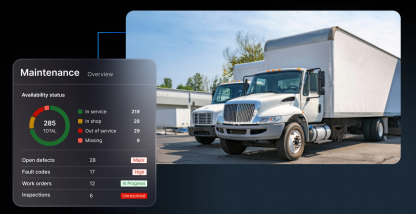
Motive Maintenance turns fault codes and inspection defects captured in the Motive Driver App into digital work orders, translates those fault codes into plain language so the technician has context before the truck reaches the bay, and uses AI invoice scanning to pull repair costs straight off the shop invoice. It combines that repair spend with fuel spend to produce a true operating cost per vehicle, the number that tells you whether a specific truck is still earning its keep.
7. The driver is still the biggest lever
Speed, throttle input, braking, and following distance move fuel economy more than any aerodynamics package a fleet can bolt on. Motive’s AI normalizes for road profile, vehicle type, traffic, and weather, which answers the objection every driver raises when a fuel scorecard lands in front of him: that his lanes are harder. Take that objection off the table and the coaching conversation becomes possible. Motive reports that fleets pairing ECM-connected telematics with Fuel Hub see fuel savings up to 13 percent, and that adding Spend Management and the Motive Card surfaces up to 5 percent more.
Put fuel economy in the driver performance review next to the safety score. A driver sitting in the bottom quartile on MPG whose behavior data shows aggressive throttle and brake inputs is roughly $1,700 per tenth of a point, every year, on that seat.
8. IFTA is a recovery opportunity, not just a filing
Fuel and mileage data captured for IFTA reporting is the same data that tells you where you’re buying fuel in high-tax jurisdictions when a lower-tax option sits on the route. Motive’s Fuel and IFTA settings automatically capture mileage and fuel records. Fleets that file quarterly from spreadsheets usually file accurately but buy inefficiently.
An honest take on alternative fuels
Propane autogas is a light and medium-duty play, and I ran it on several of my own trucks with gaseous-prep engines. In my experience, bi-fuel conversions run roughly $3,000 to $6,000 per vehicle, the fuel typically prices 30 to 50 percent below diesel and gasoline, and the federal alternative fuel credit pays 50 cents per gasoline gallon equivalent, roughly 37 cents per gallon of propane. Ohio’s association is offering $4,000 per vehicle up to $16,000 through December 31, 2026, and Michigan’s runs $3,000 up to $6,000 on the same calendar. Roughly 90 percent of U.S. propane supply is produced domestically.
Class 8 over-the-road linehaul are usually not a great fit for alternative fuels yet. Refueling and charging stations need to sit inside the daily route radius, or downtime will erase your fuel savings. In my experience, building that location-dependent infrastructure for a small operation can cost $20,000 to $60,000, and more than $100,000 for a larger operation. These vehicles generally travel less distance on the same tank seize than diesel trucks too.
Alternative fuels may make more sense for last-mile, regional medium-duty, school buses, municipal fleets, and return-to-base vocational work. Those operators should run the numbers before choosing their next vehicle. Operations with coast-to-coast reefers, on the other hand, would get more value spending that hour reviewing their idle time.
What happens next
The EIA projected in August that diesel would ease to $4.85 by year-end, but in their most recent September Short Term Economic Outlook, that projection has increased to $5.07. That forecast depends entirely on the Strait of Hormuz, a 21-mile channel that no fleet manager in America influences.
The spike will likely ease. Refining margins should normalize, and when conflicts end, prices come down. Rates usually normalize with them, and when the fuel surcharge shrinks back toward 40 cents a mile, the carriers still standing will be the ones whose linehaul covered their costs, not the ones whose surcharge did.
Every tenth of a mile per gallon is worth $1,705 a truck this year. Implementing the systems that help you consistently find those tenths of a mile costs a lot less than that, and will be an investment in your business long after this year.