


At Motive, some of the most complex engineering and product challenges happen where massive, physical operational data meets real-time AI. Translating millions of daily data points from moving trucks, heavy equipment, and active jobsites into immediate, intelligent action is what keeps businesses safe, productive, and profitable.
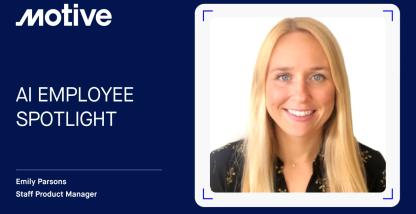
This spotlight features Emily Parsons, Staff Product Manager on our AI Platform team. Operating horizontally across safety, compliance, maintenance, and spend management, their team builds the intelligence layer that helps Motive customers transition from manual oversight to autonomous execution.
For businesses looking to modernize their physical operations—and for builders looking to solve high-stakes, real-world engineering challenges—here is a look inside how we are redefining what is possible at the intersection of AI and physical operations.
Shrinking the distance from data to decision
While many product teams dive deep into a single operational silo, the AI Platform team’s mandate is entirely horizontal. They build platform-wide intelligence that cuts across safety, compliance, maintenance, and dispatch so that data can be leveraged holistically.
For our customers, this means they don’t need to stitch together disconnected systems or hire their own data science teams. For candidates, it means the opportunity to build horizontal, highly scalable infrastructure that impacts every single corner of our product ecosystem.
The team’s work spans three tightly connected product pillars:
- Conversational Analytics: An analytics platform that customers can query in plain natural language.
- Agent Engine: A system that turns real-time fleet data into instant, automated workflows.
- Platform-Wide Assistant: An AI agent that navigates the product and executes multi-step actions on the customer’s behalf.
Our customers generate an enormous amount of operational data every day, and our job is to turn every bit of it into an advantage. Everything we build works toward the same outcome: shrinking the distance between what’s happening in a fleet and the decision or action it should drive.
Agents: Codifying the fleet workflow
A major milestone for the AI Platform team was the launch of Agents — an “if this, then that” engine built directly into the Motive Dashboard.
Traditionally, fleet managers manually chase repetitive patterns, from idling vehicles to critical engine fault codes. Agents allow teams to codify these workflows once and let the system handle the rest. Triggers can be built around driver attributes, vehicle status, geofences, and safety events, with actions ranging from SMS alerts to triggering in-cab audio coaching.
The Engineering Challenge: High-Volume Real-Time Events
To make this work, the engineering team had to solve massive scalability and reliability challenges that you only find when building for the physical economy:
- Event Volume: Evaluating trigger conditions against high-volume, real-time event streams across hundreds of thousands of active vehicles.
- Late-Arriving Data: Handling events that arrive out of order, in bursts, or from different sources at different cadences.
- Exact-Once Guarantees: Building strict deduplication and idempotency into action layers to guarantee that one real-world event produces exactly one action—preventing drivers from being spammed.
AI Answers 2.0: Conversational analytics at scale
Building on the success of their initial natural language querying tool, the team recently rebuilt and launched AI Answers 2.0, moving it to a significantly more powerful model to create a true conversational analyst.
Where the first version answered simple, static questions, AI Answers 2.0 introduces:
- Contextual Memory: Preserving full conversation history to support follow-up questions like “why did this spike last week?” or “what if I increase utilization by 5%?”
- Automatic Data Routing: Automatically matching queries to the correct underlying data models behind the scenes.
- Multi-Step Execution: Running complex data science calculations in a single turn, allowing managers to generate comprehensive reports in seconds without needing a SQL or data science background.
Taking AI to the Edge: Zero-latency location rules
Not all agents can wait on a cloud round-trip. For location-based behaviors—like changing how an AI Dashcam behaves the exact millisecond a vehicle enters or exits a high-security jobsite—relying on cellular networks is too slow and unreliable.
To solve this, the team moved the entire evaluation loop directly onto our edge hardware.
[Traditional Path] Device ──(Cellular Network)──> Cloud Rules ──(Cellular Network)──> Action on Device (Delayed)
[Edge AI Path] Device runs Local Geofence Polygons & Rules locally ──> Near-Instant Action (Offline Safe)
By pushing geofence polygons and agent rules directly down to the camera, the device continuously monitors its own position, adjusts its configuration locally within seconds of crossing a boundary, and reverts on exit—all with zero network dependency.
To execute this on the edge, the team solved several critical engineering hurdles:
- GPS Drift: Utilizing buffer zones so edge actions do not fire prematurely near a geofence border.
- Rule Syncing: Ensuring local, on-device rules remain perfectly in sync as customers dynamically update geofences in the cloud dashboard.
- Auditing: Maintaining a robust, local audit trail of every autonomous action the camera takes while offline.
By pushing geofence polygons and agent rules directly down to the camera, the device continuously monitors its own position, adjusts its configuration locally within seconds of crossing a boundary, and reverts on exit—all with zero network dependency.
To execute this on the edge, the team solved several critical engineering hurdles:
- GPS Drift: Utilizing buffer zones so edge actions do not fire prematurely near a geofence border.
- Rule Syncing: Ensuring local, on-device rules remain perfectly in sync as customers dynamically update geofences in the cloud dashboard.
- Auditing: Maintaining a robust, local audit trail of every autonomous action the camera takes while offline.
Partnering with our customers to build the future
While the AI Platform team moves exceptionally fast, our development is anchored by a rigorous customer feedback loop.
Because many of these AI capabilities have no industry playbook, we build with our customers, not just for them. Collaborative beta tests, prototype sessions, and deep-dive user research ensure that our technical roadmap solves real-world operational pain points.
For businesses partnering with Motive, this means you have a direct seat at the table in shaping the technology that runs your business. For candidates looking to join us, it means your code has a direct, visible thread to solving real-world customer problems.
Our work ships into the core product and touches nearly every customer, every day. If you’re an engineer or PM who wants to build AI that acts in the physical world, at real scale, with immediate and visible customer impact, this is the place to do it.
Looking ahead: Doing the work alongside the customer
The future of the AI Platform team is focused on transitioning from answering questions to actively executing labor-intensive workflows.
With the next iteration of the Motive Assistant, the goal is to shift from reactive assistance to proactive agency. Soon, the platform’s embedded assistant will be able to autonomously pull morning operational briefings, isolate which drivers require safety coaching, draft the personalized outreach, and trigger the appropriate training workflows with minimal prompting—giving fleet managers hours of their days back and helping businesses run safer, more efficient operations.
Ready to make an impact?
- Looking to modernize your operations? Schedule a demo to see how Motive’s AI-powered agents platform can transform your business.
- Looking to build the future of Physical AI? We are hiring builders, engineers, and product leads who want to solve real-world challenges at scale. Explore open roles on our Careers page.