


Organizations that run fleets have been recording incidents for years. The harder problem has always been what happens before and after: detecting risk early enough to act on it, seeing what’s happening around the entire vehicle, and surfacing the right evidence fast enough to actually resolve an incident.
At Vision 26, Motive expanded its AI safety stack with two new hardware platforms, AI Dashcam Plus and AI Omnicam Plus, alongside new AI-powered detections and Collision Evidence Capture1. Together, they represent a meaningful shift in what fleets can prevent, see, and respond to from a single connected system.
Here’s what changed and why it matters operationally:
- Earlier detection. Collision avoidance models future trajectories in real time instead of relying on rule-based distance calculations, alerting drivers while there’s still time to act.
- Broader visibility. AI Omnicam Plus brings 360-degree, AI-powered awareness around the vehicle with real-time in-cab alerts for pedestrians and cyclists.
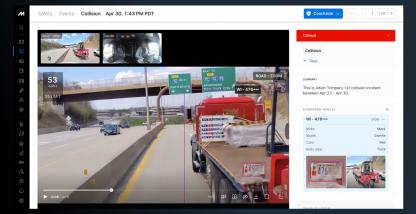
- Faster incident response. Collision Evidence Capture identifies license plates automatically at the moment of a collision, surfacing plate, make, model, and color without manual review.
- Simpler deployment. AI Dashcam Plus merges telematics and cameras into one device, cutting install time and reducing points of failure.
AI Dashcam Plus sets the new standard
AI Dashcam Plus combines the AI dashcam and vehicle gateway into a single device. That means one install, one cable system, and one point of management instead of two separate boxes on the windshield.
The hardware is meaningfully different from what came before. Built for edge AI, It runs on a Qualcomm AI Dragonwing™ QCS6490 processor with 3x more processing power, and enough capacity to run 30+ high-precision AI models on the device in real time. Two road-facing cameras, one wide-angle and one zoom, create stereo vision that measures depth, distance, and speed the way human eyes do, rather than estimating from a flat 2D image. And dual microphones with noise cancellation paired with a more powerful speaker enable live two-way communication that actually works in a loud truck cab.
New features for AI Dashcam Plus include Collision Avoidance, license plate recognition, and more.
How does Collision Avoidance change the way fleets prevent incidents?
Most forward collision warning systems on the road today run on rules: distance, speed, time to impact, calculated frame by frame. The alert fires only once a vehicle is already locked in front of the driver, wasting the seconds that matter most.
Collision avoidance, coming to AI Dashcam Plus later this year, takes a fundamentally different approach. Instead of measuring distance frame by frame, the system models how every object in the scene is moving through space and projects multiple possible future trajectories in real time. It reasons about vehicles, cyclists, animals, and pedestrians, and alerts earlier, while there’s still time for the driver to respond.
In low-visibility conditions, the difference is especially stark. A deer entering a lane in pitch darkness or a cyclist emerging from a blind spot are the moments where a human eye might miss but the system can detect. Collision avoidance will prevent more collisions than anything we’ve ever built.
Smarter detections build driver trust, not just longer alert lists
Today, AI Dashcam Plus can support an expanded range of detection capabilities, designed to spot more unsafe behaviors in real time with higher accuracy and less latency. But detection count alone was never the point. Every false alert chips away at driver trust, and without trust, drivers stop paying attention to the system entirely.
That’s the logic behind AI-powered speed sign detection. Speed limits change constantly, from temporary construction zones to permanent updates on everyday roads. Most systems rely on map databases to determine the posted limit, and those databases can be outdated, delayed, or flat-out wrong. The result: drivers doing the right thing get flagged for speeding.
Speed sign detection reads the signs directly off the road using computer vision. Drivers are only alerted when they’re actually speeding, and every event includes the captured sign so managers can see exactly what the camera saw. Fewer false alerts, stronger coaching conversations, and a foundation for detecting additional road signs, from construction zones to school zones, in the future.
The broader principle here is important for any fleet evaluating safety technology: better AI should produce higher-quality signals, not just a longer feature list.
How does AI Omnicam Plus expand visibility around the vehicle?
AI Dashcam Plus covers what’s happening inside and ahead of the vehicle. AI Omnicam Plus will extend that to everything around it.
Many accidents with injuries involve sideswipes and rear-end collisions, many of which happen outside the driver’s line of sight: blind spots, lane changes, turns, and backing maneuvers. AI Omnicam Plus is a 360-degree camera system built on the same AI Dashcam Plus platform, powered by the same powerful Qualcomm processor. It supports four HD camera inputs, has built-in LTE connectivity so it can operate as a standalone system, and includes a live in-cab display.
Drivers see what’s happening around the vehicle in real time. Left and right views activate with turn signals. The rear view appears while reversing. And the AI layer continuously monitors for pedestrians and cyclists, giving drivers audio and visual alerts whenever a vulnerable road user enters a risk zone.
For fleets operating large vehicles in dense urban environments or anywhere with heavy pedestrian traffic, this is a significant expansion of what real-time safety awareness looks like from the driver’s seat.
How does Collision Evidence Capture help fleets respond to incidents faster?
Prevention is always the goal, but when incidents do happen, the speed and quality of the response matters. Nearly one in seven collisions on US roads is a hit-and-run, and that number keeps climbing. Fleets often have the footage but can’t make out the plate, which means the insurance claim stalls, the driver takes the blame, and the cost falls on the fleet.
Collision Evidence Capture solves this with the zoom lens built into AI Dashcam Plus. The moment a collision occurs, the system captures the license plate and automatically surfaces the plate number, make, model, and color. Footage processes on the device, and it’s built for real-world conditions at highway speeds, day or night, in rain or snow.
A wide-angle lens simply doesn’t have enough pixels per degree of field of view to resolve a license plate when you crop in, but the dedicated zoom lens captures that detail natively, the same principle behind binoculars. Paired with AI models trained to find and sharpen plates across varying light, weather, and speed conditions, the result is usable evidence at the moment it matters most.
What Liberty Coca-Cola is seeing with AI Dashcam Plus
Liberty Coca-Cola Beverages operates one of the largest fleets on the East Coast, running 24-hour transportation operations across the Philadelphia and New York metro areas. They were among the first to roll out AI Dashcam Plus, and their experience makes the case for its extensive capabilities.
On deployment, the simpler cable system and slimmer profile helped them cut expected install time from one hour to 30 minutes, a meaningful difference at their scale.
On claims, the dual-camera setup has changed how they handle fraudulent charges and hit-and-run situations. The wide-angle lens captures the full scene, including potential witnesses, while the zoom lens captures license plate information, vehicle details, and even what the other driver was doing at the time of the incident. As fleet safety manager Cesar Rodriguez put it: they can now go after a claim with the evidence they need.
As for driver behavior, the switch to Motive surfaced an immediate spike in events that weren’t being captured before. Rodriguez and his team had assumed speeding was the primary issue, but with more accurate detection, they discovered the root cause was actually distraction: drivers on cell phones, adjusting GPS, or eating. Seeing those events clearly has allowed them to coach more effectively and build a safety culture where drivers check their scores daily and compete for recognition at the company’s annual Safety Rodeo.
Key takeaways
The standard approach to fleet safety has been built on separate tools: a telematics device for fleet management, a dashcam for safety, maybe an exterior camera system bolted on separately. That model made sense when dashcams were optional. Today, they’re essential, and the fragmentation that comes with managing them as standalone systems creates its own operational drag.
The updated Motive suite at Vision 26 represents a shift toward safety as an integrated layer of the platform rather than a collection of individual devices. AI Dashcam Plus merges telematics and cameras into one device. AI Omnicam Plus is built on the same platform and processor, extending the same AI to the full perimeter of the vehicle. Collision avoidance, speed sign detection, and Collision Evidence Capture all run on the edge, on the device in real time, because the hardware was designed with enough processing power to support models that haven’t been built yet.
That last point is easy to overlook, but it may be the most important one for anyone making a hardware decision right now. The AI Dashcam Plus is built to cover more than today’s feature list. It’s built to evolve with your operation through over-the-air updates, without ripping hardware out of trucks every couple of years.
For fleets dealing with too many disconnected tools and too much manual work, it’s worth investing in better safety outcomes with a system where detection, visibility, evidence, and response all work together, not from adding another standalone device to the windshield.
See the new AI safety stack in action. Talk to Motive about AI Dashcam Plus and AI Omnicam Plus to see how they can help your organization prevent more collisions and resolve incidents faster.
- Motive Collision Evidence Capture is not available in AR, NH, ME. ↩︎