


AI is no longer in the pilot phase for fleet management. Fleet managers can use AI to automate daily tasks, such as pulling reports, sending alerts, and checking driver status. But as with all AI investments right now, there’s still the risk of spending a lot on half-baked products or a feature that won’t provide practical value.
To avoid this trap, look for practical, proven tools built for organizations like yours — such as fleet AI assistants, AI-powered hardware for the cab, and the ability to automate workflows — that will create immediate ROI.
In this article, you’ll discover the top 5 AI fleet management trends for 2026 and the value these new technologies can deliver.
What is the role of AI in effective fleet operations?
AI is raising the bar for how much fleet managers can accomplish in a day. The power of AI isn’t limited to pilots or test cases anymore — you can find it deeply integrated in fleet software, helping teams accomplish practical tasks.
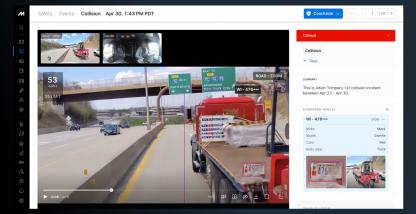
For example, fleet managers will soon be able to use an AI assistant like Motive Atlas to generate reports, check a driver’s eligibility status, or send alerts (such as when a vehicle is idling longer than allowed). Atlas will work on the road too. If a driver starts using their mobile phone, an AI dash cam will sense it and warn the driver with lights and sound, capturing video for manager review and coaching.
The ROI that Motive customers have seen from using Motive includes:
- Since 20231, the Motive AI Dashcam is estimated to have helped prevent more than 170,000 accidents and saved 1,500 lives. On average, customers have reduced collisions by 80%2 and accident-related costs by 63%3.
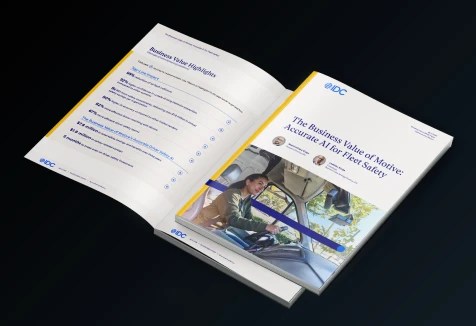
- In an IDC Business Value White Paper sponsored by Motive, interviewed organizations using Motive’s AI-powered driver safety solutions reported an average 95% reduction in at-fault collisions.
- Across those six interviewed organizations, IDC found over 8x ROI, $1.8 million in annual safety-related savings per organization, and a five-month payback period.
Next, let’s explore the specific AI trends in fleet management that organizations will see in 2026.
5 AI fleet management trends to watch in 2026 for real operational ROI
Consider these five trends for impacts of AI adoption in fleet management — from workflow efficiency to safer driving — with examples of ROI.
1. AI Assistants: For taking action quickly.
Fleet AI assistants can increasingly remove manual hurdles for fleet managers. These AI assistants form a conversational layer that’s embedded in fleet software. Consider these use cases that provide practical ROI:
- Safely provide fleet data context to public LLMs. Managers can generate fast, accurate reports using services like Claude and ChatGPT instead of manually compiling and analyzing data.
- Check driver document status and upcoming expirations. Managers avoid delays and noncompliance rather than continually reviewing documents by hand.
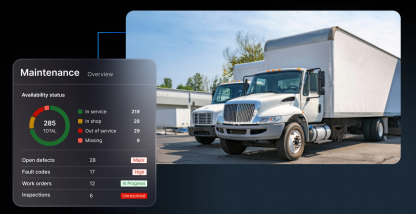
- Notify safety managers with plain language explanations when vehicle fault codes appear. They can make quick decisions about service instead of waiting to hear from a driver and then sorting through confusing fault code data.
2. Computer vision: for automating visual tasks
With computer vision, fleet managers can automate visual tasks consistently, instantly, and at scale. Computer vision technology uses cameras and AI to detect operational conditions in the field. Consider these examples where it provides ROI for organizations with fleets:
- Waste overage detection. Computer vision can spot an overfilled container, classify overage severity, and help operators resolve the problem with customers. Motive’s AI-powered Overage Detection can detect up to 10x more overage events than a human operator, which translates to $2 million in potential annual revenue4 for a waste operation with 100 trucks.
- Reduced worksite injuries. Computer vision can alert managers if workers aren’t wearing personal protective equipment or practicing safety protocols with machinery or hazardous materials.
- Service verification. Organizations can use computer vision to capture timestamped visual proof of service. This helps operators verify pickup occurrence and quickly resolve customer disputes.
3. Agentic AI: for executing autonomous workflows.
In 2026, fleet managers will increasingly be able to rely on agentic AI to support operations. Agentic AI systems can decide, act, and adapt on their own, based on preset boundaries and datasets. Agentic AI makes it possible for fleet managers to reduce manual oversight and automatically accomplish tasks like scheduling coaching sessions or escalating issues.
For example, Motive Agents uses AI to automate manual processes. Once a team has set up an agent, the product can accomplish tasks like alerting drivers before they violate HOS rules, assigning safety training, or disabling a camera in a restricted geofence. These agents make it easier for fleet managers to stay on top of small urgent tasks that build up.
4. AI cameras: for safer driving.
Fleet-powered organizations will be able to increase driver safety with AI in 2026. AI dash cam technology enables real-time safety event detection and targeted coaching, which leads to safer driving behaviors.
With real-time alerts, organizations can reduce risk in the moment; with in-person and automated AI coaching, teams can reduce repeat behavior over time; and with fewer risky driving behaviors, organizations can realize fewer collisions and claims and better insurance outcomes.
Look for a fleet operations platform that provides measurable outcomes like these:
- Reduced collisions
- Insurance premium savings
- Quick time-to-value
For example, with Motive, FusionSite Services found that accurate detection plus automated and in-person coaching helped them change driver habits and cut insurance claims by 98%.Real-time alerts let managers coach drivers while the situation was still fresh.
5. Unified fleet operations platforms: for compounding AI’s value
AI’s value will likely increase as fleet-based organizations consolidate siloed systems. Bringing safety, fleet, and compliance data into one system means that teams can start applying AI to gain more cross-functional efficiencies.
A software environment that integrates all major fleet management functions gives AI access to a single data layer. The more operational context AI can access in a single system, the more complete and useful its answers become.
With one integrated operations platform, a fleet manager could use AI to detect risky driving, draft a personalized message about the event, and assign driver training from the same platform — instead of bouncing between separate camera, telematics, and training tools.
How can organizations strategically deploy AI in fleet management to get to faster ROI?
What areas should fleet managers focus on applying AI first to get the most value? We recommend these best practices:
- Address high-cost, high-frequency problems first, such as safety and other workflows where AI can prevent risk in real time.
- From there, apply AI to repetitive tasks. Shift from simple alerts to agentic automation, so AI is not only identifying issues but also helping automate the manual work that follows.
- Start using conversational AI to get plain language insights that make complex fleet data immediately useful.
As your organization selects a vendor, look for platforms that will help you unify your data, keep workflow disruption to a minimum, and provide transparent, explainable AI models.
How AI transforms physical fleet management
Fleet managers can use AI in almost every part of their daily work, from using it to prioritize the morning to creating an evidence-based pitch for a lower insurance premium. With Motive’s Integrated Operations Platform, fleet managers have access to the power of measurable, value-delivering AI across their daily tasks.
See the Motive Platform in action in this on-demand demo video.
Frequently Asked Questions
How does AI reduce fleet operating costs within the first year?
AI can help reduce fleet operating costs within the first year by preventing expensive safety incidents, automating manual work, and helping teams act faster from one unified platform.
How do AI fleet platforms integrate with existing telematics and ELD systems?
AI fleet platforms should integrate with existing telematics and ELD systems during the transition to their platform, so the organization can keep operations running while data is consolidated into one platform. That unified data layer gives AI the full operational context needed to deliver more complete insights, automation, and the most ROI.
Can we still benefit from AI if we have an older fleet?
Yes. Fleets with older equipment can still benefit from AI by upgrading their technology stack in phases. Bennett, for example, currently operates at roughly 90% ELD compliance, with the remaining exempt older equipment still on paper logs. They’re using a modular approach to add newer capabilities from partners like Motive into their broader tech stack.
- Since January 1, 2023, based on internal Company estimates ↩︎
- Based on an internal study of customers with 150 or more active monthly vehicles and at least 90% AI Dashcam adoption for at least 12 months. ↩︎
- Results are calculated based on customer responses, management estimates, and internal data. ↩︎
- Based on internal estimates and calculations, potential annual revenue of $2M assumes a 100-truck fleet detecting 4 daily overages per truck, with adjustments for projected enforcement and behavior decay rates. Actual results may vary. ↩︎