


Across the physical economy, the people who run fleets and field operations require safer, more productive, and more profitable operations. However, progress is consistently blocked by fragmented systems and tedious manual workflows that take up valuable time.
Motive’s Vision 26 customer conference focused on how operations can overcome these hurdles by moving away from isolated tools and embracing deep integration and automation.
New AI-powered tools solve critical problems by creating a single, unified view of your fleet and automatically handling repetitive tasks. This shift ensures that your products work together seamlessly, freeing your team to focus exclusively on the urgent issues that demand human attention.
Here’s a look at the key trends from Vision 26 and what they mean for the future of physical operations.
One device, more insight: the new standard for fleet safety
For years, most fleet-based organizations have relied on a telematics device for fleet management and a separate dash cam for driver safety. That made sense in a world where dash cams were optional, but today they’re essential.
Next-generation edge products such as the AI Dashcam Plus bring telematics and cameras together in a single unified device. That means faster installation, one point of failure instead of two, and a horizontal profile that looks great in the vehicle and doesn’t block the driver’s view.
The hardware works alongside advanced AI to identify unsafe driving behavior and deliver real-time alerts directly to drivers. With this kind of integration, teams can gain greater visibility, faster response times, and the ability to prevent more collisions on the road.
“The AI Dashcam Plus isn’t just another dash cam, but a new platform enabling the next leap in driver safety.
Collision avoidance features model how objects move through space to deliver earlier alerts
Traditional collision-warning systems were built to run on rules like distance, speed, and time-to-hit — usually based on the vehicle ahead — and trigger alerts when distance or speed crossed a threshold. On today’s roads, the riskiest moments tend to unfold in complex scenes, with vehicles, cyclists, pedestrians, and animals all moving at once.
The new generation of collision avoidance models on the AI Dashcam Plus goes beyond simply seeing a vehicle and warning a driver. It models how every object in a scene is moving through space in real time, then reasons about multiple future paths to find the ones that put the driver at risk. This is made possible by human-like depth perception enabled by two road-facing lenses and a powerful new Qualcomm processor.
“This isn’t just a better forward collision warning model. It’s a new approach to predicting collisions.
By instantly predicting dangerous trajectories, tools like the AI Dashcam Plus can deliver split-second alerts at critical moments, giving drivers the precious time they need to react and prevent a collision.
Collision Evidence Capture turns video footage into proof
Even the best collision-avoidance systems can’t prevent every incident. Hit-and-runs, sideswipes, theft, and vandalism still happen. When they do, missing details can stall claims, increase costs, and lead to false claims and litigation.
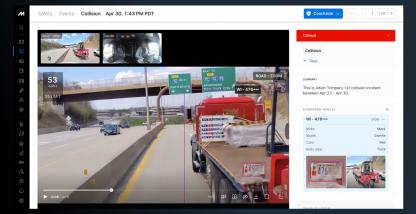
Tools like Collision Evidence Capture1 are changing that. By using a high-resolution zoom lens, Collision Evidence Capture can clearly identify license plate numbers, even at a distance. And when an incident occurs, it can automatically surface those numbers — along with the state, make, model, color, and body style of the vehicle.
“We’re able to zoom into the scene, capture license plate information, and look into the vehicle to see if there’s any potential distractions or malpractice from the driver.
And when the incident is a hit-and-run or theft, teams get the critical evidence they need to resolve incidents faster, reduce liability, and protect drivers. Built for real-world conditions, tools like Collision Evidence Capture work across multiple lanes, at highway speeds, day or night — even in challenging conditions like rain or snow. And that puts more power in customers’ hands.
360-degree coverage becomes real-time awareness, not just visibility
Many serious collisions happen in blind spots, during lane changes, or while turning or backing up. That’s why organizations with fleets are moving toward 360-degree camera systems that bring the full surroundings of the vehicle into view.
Today, tools like the AI Omnicam give managers 360-degree visibility around the vehicle. But what if you could bring that same visibility directly into the vehicle with real-time alerts and awareness for your drivers?
That’s where AI is headed. With Motive’s latest 360-degree camera system, the AI Omnicam Plus, drivers will get a live in-cab view of everything happening around them, with real-time audio and visual alerts highlighting pedestrians, cyclists, and vehicles nearby.
Drivers will be able to monitor blind spots across multiple connected camera feeds, drawing awareness to risks as they enter the vehicle’s surroundings. The result: Drivers can see more, trust what they’re seeing, and make safer decisions in real time.
Coaching is always-on, personalized, and emphasizes positive recognition
Safety leaders face growing pressure to chase down every risk, keep drivers engaged, and make sense of endless data. Tools like AI Coach and Motive’s expanded avatar library help make coaching more human and more scalable.
Safety managers can use standard or fully customized avatars and assign them to specific drivers or groups. Each session starts with positive reinforcement, then highlights the top three coachable behaviors for that driver. Beyond safety, you can use AI Coach to help drivers improve compliance, unproductive idling, and spend behaviors.
When a driver has a clean week with no events, AI Coach can proactively reach out to congratulate them. Top performers feel recognized rather than monitored, and coaching stays aligned with written policies.
Driver rewards programs built on positivity can turn everyday performance into automatic incentives. Organizations can create data-driven programs focused on important behaviors, setting up challenges around safety, unproductive idling and other issues. For Motive customers specifically, drivers receive automatic, real-money rewards instantly deposited onto a prepaid Motive Card, reinforcing positive behaviors the moment they happen.
AI assistants take action across operations so teams can focus on what matters
Managing physical operations often means constantly switching between systems, chasing down information, and manually triggering tasks. AI assistants are emerging to close that gap. Atlas, Motive’s AI-powered assistant, is one example of how impactful these assistants can be.
Embedded across the Motive platform, Atlas can understand data and workflows, remember context over time, and turn complex questions into concrete actions. Use Atlas to prioritize what needs attention, identify emerging risks, and send targeted communications in seconds.
As Atlas moves directly into the cab, drivers will have a hands-free way to sign in, find fuel stops, and accomplish other tasks — without taking their eyes off the road.
AI-powered automations catch risks early and act on them instantly
Too many teams are stuck reacting to problems instead of preventing them. Leaders need systems that can spot issues early, decide what matters, and act before things escalate. AI-powered automations are emerging as a key way to shift fleet operations from reactive to proactive.
In the Motive platform, for example, Automations are embedded directly into existing workflows. Teams define conditions and actions once, then AI executes them in real time. Automations can help assign training when risky behaviors hit a threshold; alert drivers to impending hours-of-service limits; and much more. The result is a more proactive operation with less manual work and more time for strategic decisions.
Automating financial workflows turns everyday friction into a strategic advantage
Automations don’t stop at safety and compliance. For many organizations, some of the highest hidden costs live in back-office financial workflows that quietly slow teams down. New-driver onboarding is a prime example. In most organizations, someone is still tracking start dates in a spreadsheet, placing fleet card orders, and hoping the card arrives before the driver does.
When routine work like this fails, a driver starts day one with no way to fuel the truck — and the entire operation feels it. With Motive Card Automations, that flow will become a closed loop instead of a series of handoffs.
The moment a new driver is added in the Motive platform, Automations will create and assign their Motive Card and automatically load it with your company’s spend policies — all from the same place you manage drivers and vehicles.
Because a physical card still takes days to arrive, a digital card will be pushed to the driver’s phone so they can start fueling on day one. The card will then be available to use immediately. The driver taps their phone to pay, and they’re ready to go. If a card is lost or stolen, the same automated flow can issue a digital replacement so drivers keep moving, with virtually no downtime.
AI vision automates work in the field to make every job visible, verifiable, and profitable
Most stories focus on the office: reconciling transactions, processing paperwork, and routing tasks between teams. But in the physical economy, many of the most valuable signals live on the road and at the worksite, where drivers and crews notice issues that rarely make it into systems.
In waste services, for example, every overfilled container can represent billable revenue. Yet capturing that value often depends on a driver stopping the route, taking photos with a tablet, and filling out a form.
With AI-powered Overage Detection running on the Motive AI Dashcam Plus and AI Omnicam, organizations with fleets can automatically recognize a pickup, determine whether a container is overflowing, and generate an overage event with visual proof tied to that stop.
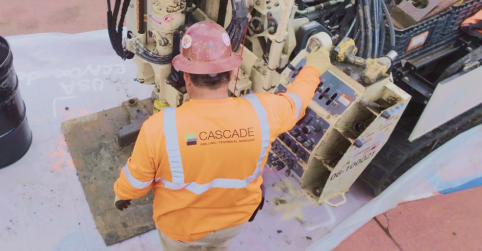
Once this kind of computer vision system is in place, it quickly extends beyond a single use case. The same models can flag recycling contamination, spot vegetation overgrowth near lines, detect potholes and downed street signs, or monitor worksite safety and PPE compliance — turning what vehicles already see into data that help solve operational problems.
The future of physical operations is here
Vision 26 made it clear that fleet-based organizations won’t win the next decade with point solutions and manual work. Leaders in the physical economy will be the ones who put a unified, AI-powered platform at the center of their operations — connecting safety, operations, and finance every chance they get.
As edge AI, computer vision models, coaching workflows, assistants, and automations keep maturing, the day-to-day work of running your operation will become more predictable, data-driven, and controlled. Start building on that foundation now so you’re ready for whatever the next wave of AI makes possible.
And if you really want to stay ahead, reserve your seat for Vision 27 and lock in the lowest rate for next year’s conference.
- Motive Collision Evidence Capture is not available in AR, NH, ME. ↩︎