

In Montgomery v. Caribe Transport II, LLC, decided 9-0 on May 14, 2026, the Supreme Court held that freight brokers can be sued under state law for negligently hiring an unsafe carrier.
Most of the industry read the decision as a liability story, and for brokers and shippers, it is, but buried in Associate Justice Brett Kavanaugh’s concurrence is the other half of the ruling: Brokers who can be held liable for ignoring poor safety records now have a powerful incentive to give their business to safe carriers. The Court created a market. For the first time, a carrier’s documented safety performance is a commercial asset that wins freight, and for fleets running telematics, most of that asset already exists and has never been shown to a customer.
Safety spending has historically been justified the same way:
- Fewer crashes
- Lower premiums,
- Better CSA scores.
All defense. Nobody ever pitched a dash cam program as a way to win loads because, before this year, that pitch wasn’t realistic. Cheaper was always the better option, at least on the front end of the transaction.
It is now very realistic, and the strategy is worth taking seriously because it is now more profitable than ever to be the most compliant fleet competing for the best freight and the best contracts. Carriers living with a conditional rating since 1982, because it was inconsequential, now need to look at that rating as a risk indicator and work toward a safety rating upgrade.
What changed?
Before Montgomery, a broker sued over a carrier it selected and filed a preemption motion; in the Seventh and Eleventh Circuits, that motion usually prevailed before discovery began. Nobody deposed the carrier rep. Nobody explained to a jury why the load went to a nine-truck carrier with a Conditional rating and three reportable crashes in five months, which is exactly who C.H. Robinson had tendered in the Montgomery facts. The FAAAA did the work.
That motion is gone, and something else went with it. Justice Kavanaugh’s concurrence flagged that the FAAAA mandates minimum insurance for carriers but not for brokers. Congress never built a financial backstop for broker liability because Congress never anticipated broker liability. Which means the exposure Montgomery created lands on balance sheets that were never structured to carry it, and the underwriters who insure those balance sheets are repricing the risk.
As a broker, you can only make the eventual selection defensible. Brokers will stop sorting carriers into price tiers and start sorting them into tiers of defensibility. At the top: carriers who can hand over documented safety performance that a defense lawyer can use. At the bottom: carriers whose entire file is a certificate of insurance and a W-9. The bottom tier does not get a rejection letter. Those carriers will just notice, over three or four quarters, that the good freight went somewhere else.
The record only tells half your story
The public data brokers use to vet a carrier is built to anticipate the likelihood failure. Crashes, violations, out-of-service rates, revocations. If you run a clean operation, the public record’s best case for you is silence, and silence is not evidence. There is no FMCSA database showing that your severe events are reviewed within a day, that your coaching actually changes behavior, or that your defect closure takes hours instead of weeks. The federal record can’t distinguish a carrier that manages safety from a carrier that has been lucky.
The only place that distinction exists is inside your own systems. If you run Motive, the evidence already exists, generated as a byproduct of running the operation:
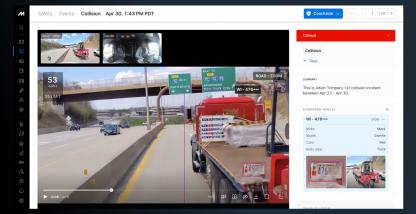
- Severe events, captured and handled. The AI Dashcam recorded the event, and your review log shows it was seen and acted on within a day, not discovered three years later in a deposition.
- Coaching that leaves a paper trail. The coaching workflow documents the assigned session, the completed session, and the driver’s acknowledgment, all attached. That is a behavior change you can prove, not just claim.
- Hours of service, clean by design. The ELD produced a clean record of duty status because the system makes it so, and the unassigned drive time report shows no one is hiding miles.
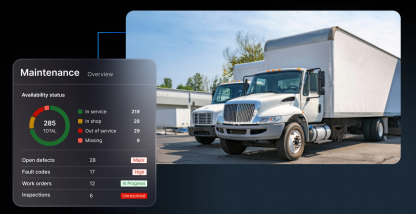
- Defects closed in hours, with timestamps. The inspection module holds your DVIR closures from write-up to repair, so closure discipline is a number, not an assertion.
- Twelve months of trend lines. Analytics tracks speeding, following distance, and hard braking per million miles, so improvement is a chart, not a memory.
Before now, nobody in your company has ever been asked to build your company’s marketing package based on how well they operate and how well they can articulate that risk-mitigated operation. But that’s what’s required now to sell yourselves as a risk-focused, safety-conscious fleet.
Steal the insurance submission model
Traditional underwriting solved this problem decades ago, and carriers should copy it.
When a commercial insurance agent takes a trucking account to market, they don’t send an application and hope. They build a submission package, and they market that carrier to the underwriters. That marketing package consists of loss runs, fleet schedule, driver list, safety program documentation, a narrative explaining the bad year and what changed after it, and increasingly, telematics reports showing behavior trends. Any agent worth their commission will tell you the package moves the rate because underwriters price in uncertainty, and the package removes it.
A broker’s carrier file after Montgomery is the same instrument with a different reader. The underwriter is a jury. The loss run is a crash report. The carrier who shows up with the package already built is pricing out the competitor who shows up with a COI.
So build it once and keep it alive. Motive can help you build your carrier risk profile and defensibility portfolio, and most of it is a reporting task rather than a project. Here is what goes in the package:
- Twelve months of event rates per million miles, trended. Quarter over quarter, not a single snapshot. A trend line is evidence of management; a snapshot is a coincidence.
- Coaching delivered and completed. Sessions assigned, sessions closed, driver acknowledgments attached.
- HOS violation rate and unassigned drive time. Both numbers, together. A low violation rate with high unassigned time raises the question you want to answer before anyone asks it.
- DVIR closure discipline. Average time from defect write-up to repair, with the timestamps to back it.
- Your OOS rates next to the national average. With your own explanation of any gap, written now, by you, instead of reconstructed in three years by someone billing against you.
- The bad quarter and what you did about it. A package with no bad numbers reads like a package hiding them. A documented response to a problem is stronger evidence of a working safety program than a suspiciously clean chart.
- A quarterly refresh, dated, with old versions kept. Three years of dated packages showing improvement are nearly impossible for opposing counsel to dispute.
Most of the underlying numbers export directly from the Motive Integrated Operations Platform, turning this from a project into a report you can run.
Then have sales send it before anyone asks. A package produced on-demand is in compliance. A package that arrives with the pitch is an advantage.
Prove you are you
Brokers are terrified right now of identity, and it comes before any safety question: whether the carrier under the load is the carrier on the paperwork.
Double brokering, hijacked DOT numbers, and cloned trucks running under another company’s markings have become the fastest-growing source of exposure in freight. A broker who unknowingly tendered to a ghost has no defense, because the safety data described a company that never touched the load. Post-Montgomery, identity verification is moving from fraud prevention into the vetting file itself.
Carriers who can prove asset identity jump the line. Can you prove you’ve had trucks on the road in the past 30, 90 or 180 days? Motive’s fraud detection, tracking, and Vehicle Gateway tie a specific unit to a specific load with GPS and timestamps. When you can tell a broker that the truck they booked is the truck that showed up, and show them the record, you have removed the single scariest unknown in their process. That is a sales conversation now, and it sets a fleet apart from most others playing catch-up.
One caveat
The same data that wins freight is discoverable if you ever end up in litigation, including the events nobody reviewed. A camera program you do not act on is not a safety program. Before you market the file, audit the loop: what share of severe events got reviewed, how fast, how many produced coaching, and whether the behavior changed. Motive’s coaching workflow makes that loop auditable end-to-end. Get it closed, sell it.
The fleets that were always right
It used to be that the market didn’t necessarily reward the fleets who were doing more than the minimum all along. The fleets that spent on cameras when nobody required them to do it, coached drivers when the market paid the same rate to the outfit that didn’t, or fixed the brakes the day the defect was written up — those fleets didn’t get paid more per mile than the market paid a carrier who was running dark or risky.
Montgomery ends that. A unanimous Supreme Court told every broker in America that the cost of ignoring safety evidence is a jury trial, and every broker’s counsel is translating that into carrier qualification standards as you read this. The demand curve for provable safety has arrived, fully formed, with a citation.
The carriers who invested before it was worth anything are about to be rewarded for their diligence and effort. The only question is whether your file is ready for the first broker who asks.
Need help marketing your fleet? See how Motive’s driver safety, coaching, and fraud detection products turn your operational data into evidence brokers can act on, or reach out to our team to start building your package.