


About these numbers: All figures are Motive estimates of the size of the addressable problem, not savings already realized, except where noted. Calculations are based on aggregated and de-identified Motive platform data from May 2025 through April 2026, scaled to the U.S. using published federal and industry benchmarks described in the methodology.
How much does it cost to continue the status quo? What opportunities could be missed by being slow or haphazard in deploying agentic technology across fleet operations?
In our recent ROI Report, top respondents said they spend the equivalent of 20 hours per week on manual work that could be automated. We wanted to understand the scope of the opportunity for the industry, and also the best ways we could help Motive fleets achieve efficiencies across the board.
And we found an enormous opportunity:
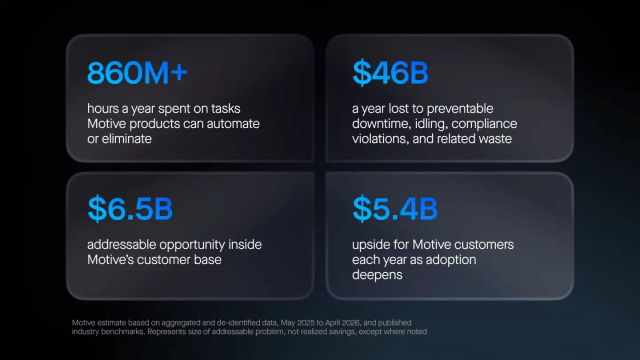
Organizations across the U.S. physical economy lose an estimated more than 860 million hours and $46 billion a year to manual work and preventable problems.
The losses come from drivers waiting at docks, engines idling, fault codes no one acts on, compliance violations that turn into back-office clean up, and myriad other small and repetitive occurrences that add up.
For organizations already running on Motive, there’s a path to recovering an estimated 180 million hours and $6.5 billion a year. This is the work Motive Agents is built to take on.
The numbers at a glance
- More than 860 million hours a year are spent on tasks that can be automated by Agents or eliminated, across the physical economy.
- $46 billion a year is lost to preventable downtime, idling, compliance violations, and related waste.
- About $6.5 billion and about 180 million hours of that opportunity exists today for Motive customers.
- Motive customers realize about $1 billion a year today in savings. The other $5.4 billion reflects upside as adoption deepens.
The five major problems
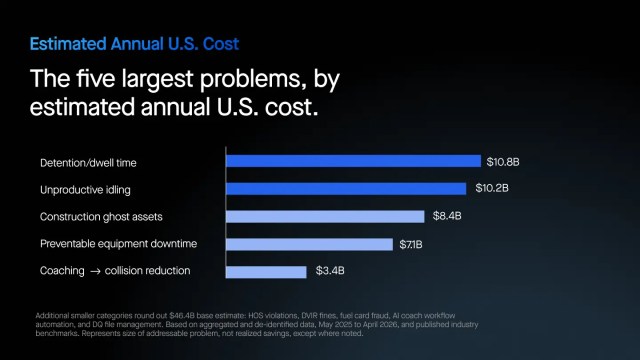
The five largest categories in the estimate, ranked by estimated annual U.S. cost, give us a sense of the types of issues. Across all of these areas, Agents can automate alerts, analysis, and real-time decision-making to maximize time and dollar savings.
| Problem | Estimated annual U.S. cost | Solutions |
| Detention/dwell time at shipper-receiver | $10.8 billion | Smart Load + Geofences |
| Unproductive idling (fuel waste) | $10.2 billion | Idle alerts + driver coaching |
| Construction ghost assets (lost/idle equipment) | $8.4 billion | Equipment Monitoring |
| Preventable equipment downtime (ignored fault codes) | $7.1 billion | Vehicle Gateway fault code alerts |
| Collision reduction | $3.4 billion | AI Dashcam + AI Coach |
Five smaller categories round out the total: hours-of-service (HOS) violations, driver vehicle inspection report (DVIR) fines, fuel card fraud, AI Coach workflow automation, and driver qualification (DQ) file management through AI Documents.
What these numbers mean for your organization
The costliest problems happen between the alert and the response
Most of these costs don’t come from missing data alone. Think of these common scenarios: a critical fault code shows up on the dashboard, but no one informs the driver. Or a driver runs up against an HOS limit, and dispatch only hears about it after the violation. Maybe a truck idles at a stop for 40 minutes and the first place it shows up is the fuel report.
In each case, the response depends on someone seeing the problem within a reasonable time, but managers can only work so many alerts in a day. Agents provide an opportunity to send alerts before HOS limits are reached or in real-time while trucks are idling longer than policy allows — and even take the next step before a manager needs to action the alert.
Waiting and idling are bigger problems than they appear
Detention ($10.8 billion in costs to the U.S. physical economy) and unproductive idling ($10.2 billion) together account for about $21 billion of the estimate. Both build slowly. Twenty minutes at a dock. A long lunch with the engine running. Neither are likely to show up as an easily identifiable line item, so neither gets addressed like a specific cost.
Our analysis took the most conservative possible approach to calculating detention figures — in reality they could be much higher. ATRI studies over the past few years estimated anywhere between 117 and 124 hours of average detention per driver per year, and our calculated costs only took the driver wages into account. If we add in the revenue the parked truck could have earned, the number grows. For instance, our aggregated geofence data for active transportation and logistics drivers shows a median of about 514 hours in detention annually across 93,000 drivers.
Every violation costs hours, not just the fine
An HOS violation can result in a fine, but it also leads to back-office time to correct logs and document what happened. That additional time in manager and back-office follow-up rarely gets counted into costs.
Additional savings depend on follow-through
By our estimate, Motive fleets capture about 16% of their addressable opportunity today. The other 84% is possible savings that can be gained as fleet leaders adopt more features and use them more effectively.
What to do next
1. Find your biggest cost.
You don’t need to fix all your problems at once. Start with the one that costs you the most. Pull the last 90 days of data from the Motive Dashboard for idle hours, fault codes, and HOS violations. The largest number is your starting point and your baseline.
2. Put an Agent on it
Agents, powered by Motive AI, run inside the Motive Dashboard. You set a trigger and an action once, and the agent responds every time the trigger fires, even when a manager isn’t at a screen. Here’s where to start for each problem.
| If your biggest cost is… | Start with an agent that… |
| Unproductive idling | Plays an in-cab alert through AI Dashcam Plus asking the driver to shut off the engine, and notifies a manager when idling passes your threshold. |
| Equipment downtime | Has Atlas call the driver in the cab when a critical fault code appears, with instructions to pull over safely. |
| HOS violations | Warns the driver before a violation and alerts dispatch at the same time. |
| Risky driving or fatigue | Alerts the driver when repeated fatigue is detected, notifies the safety manager, and assigns training when risky behavior passes a threshold. |
| Detention | Detention starts with geofences. Set them at your most frequent shipper and receiver sites to record arrival and departure times. |
3. Start from a template
Start from a prebuilt template for idling, fault codes, fatigue, and more, then tailor it to your workflow. One agent can combine multiple triggers and actions, so a single setup does the work of several separate workflows.
More is on the way. In 2027, you’ll be able to describe an agent in your own words and let AI build the triggers and actions. Also in 2027, a library of Motive-built Agents will be ready to run with no configuration. In the future, teams will be able to set an outcome, like fewer collisions or lower operating costs, and let Agents determine the path.
4. Measure, then add the next one
After 90 days, compare results against your baseline. Then pick the next most expensive problem and repeat.
Customers often find uses Motive didn’t plan for. Xylem Kendall Infrastructure Group (XKIG), which runs about 8,000 pieces of equipment across 44 states, built an agent that plays an in-cab voice message when a vehicle enters a wildfire risk zone. The message reminds drivers of the company’s policies for that area.
Further reading:
- Motive launches AI-powered Agents, transforming fleet operations from reactive to proactive
- The hidden costs of manual operations for field service fleets
- 5 areas where fleet-based organizations get the most ROI from AI in 2026
Frequently asked questions
How much do preventable problems cost the physical economy?
Motive estimates that more than $45 billion and more than 860 million hours are lost every year to preventable downtime, idling, and compliance violations. The estimate is based on aggregated Motive platform data scaled to the U.S. using published industry benchmarks.
What are Agents powered by Motive AI?
Agents, powered by Motive AI, get your operation to the outcome you care about: fewer collisions, less downtime, lower cost per mile, and hours given back to your team every week.
Today, you define the conditions and the actions once, with full control over both, and Agents handle the rest. Agents watch your operations continuously and act the moment something meets your criteria, reaching the right person through email, SMS, or app alerts, and drivers directly through in-cab voice messages or voice agent outreach on AI Dashcam Plus.
In the future, you’ll be able to start from the goal itself: set an outcome in plain language, like fewer collisions, more on-time jobs, improved fuel economy, or lower maintenance costs, and let Agents determine the path. Agents will run continuously across safety, compliance, maintenance, and dispatch, and improve over time as they learn from your operations and adapt as conditions change. You’ll also be able to choose from a library of Motive-built Agents, ready to run with no configuration required. This helps organizations save time, reduce costs, and prevent issues before they happen.
Where should I start with Motive Agents?
Start with the problem costing your operation the most. For many organizations that’s idling or fault codes. Use a Motive template, measure for 90 days, then add the next agent.
Methodology
These figures estimate the size of the problem Motive products can address, in hours per year spent on tasks that Motive products can automate or eliminate; and dollars per year lost to preventable downtime, idling, compliance violations, and related waste. They are not savings already realized, except for fuel card fraud blocked and AI Coach workflow savings. For each category, Motive calculated the underlying events, such as HOS violations, DVIRs, collisions, detention hours, and idle fuel, in aggregated platform data from May 2025 through April 2026. No personally identifiable information was used. Each count was valued with published benchmarks: wage rates from the Bureau of Labor Statistics, fines from FMCSA, collision costs from FMCSA and NHTSA, diesel consumption and prices from the EIA, detention research from ATRI, idling data from the EPA, and construction equipment values from the Association of Equipment Manufacturers. Results were then scaled to the U.S. using Motive’s share of national drivers and carriers from the FMCSA Pocket Guide, trucks from the Bureau of Transportation Statistics, and truck miles from the Federal Highway Administration.
Several inputs are internal-best estimates based on customer conversations and internal subject-matter expert experience, not published figures. They include 5 hours of back-office work per HOS violation, 3% of HOS violations caught at roadside inspection, and 0.5 critical fault codes per truck per year that escalate to preventable downtime. The roughly $1 billion in realized savings multiplies each category’s addressable opportunity by a feature adoption rate, based on aggregated product usage, and by an estimated effectiveness rate. The effectiveness rates are reasonable assumptions. Because of these assumptions, the U.S. figures could range from about 520 million to 1.30 billion hours and from $27.8 billion to $69.5 billion a year, around base estimates of 866 million hours and $46.4 billion. These figures are not a forecast of what any organization will save with Motive or Motive Agents.