

Operation Safe Driver Week reminds us that the safest fleets don’t become so by chance. They evolve through targeted coaching, clear expectations, and by connecting safe choices to getting drivers home safely to the people they love.
For Safe Driver Week, Motive customers share how they’re building stronger safety cultures every day, whether that’s through AI-powered coaching, frontline leadership, or rewarding drivers for safe performance. Their stories show how technology, trust, and accountability can help create safer, more confident drivers.
1. To shape driver behavior, personalize the safety message
Real change often starts with what matters most in a driver’s life. You can usually see it in the details around them — framed photos, reminders of home, drawings from their children.
“When I was on a Zoom call, I’d look at what was in the background,” says Rodney Fetters, fleet director at SPATCO Energy Solutions, a petroleum field services company. “It was often pictures of their kids, their families. That’s why they show up to work — for their families.”
Find out what means the most to your drivers and bring those people and moments into your coaching conversations. When you connect everyday safety choices with the lives and relationships your drivers hold dear, those choices feel personal instead of abstract.
“There are things you can do to get drivers to think in a different way,” Fetters says. “What do they care about the most? And how do you make them believe that in their day to day?” Make that your focus.
“When you connect everyday safety choices with the lives and relationships your drivers hold dear, those choices feel personal instead of abstract.
2. Lead with ‘compassionate accountability’
Strong operational leadership is the foundation of consistency and accountability across an organization. At CoolSys, a leading provider of HVAC services, branch leaders work closest to drivers, which puts them in the best position to influence driving behavior day to day. By empowering these leaders as coaches, you can influence performance in the field.
“We empower them, we train them, we give them the tools,” says Shawn Martinez, director of Environmental, Health, and Safety at CoolSys. “We do everything we can to have them do what’s necessary. Because they are the ones with the relationship with the drivers.”
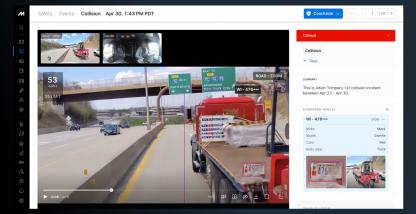
CoolSys uses the Motive AI Dashcam and data from the Motive dashboard to proactively prevent safety incidents and pinpoint gaps in their program.
“And when those gaps exist, we step in, not as the sheriff but as a partner,” Martinez says. “We train our coaches to demonstrate transformational style leadership, to balance firmness with empathy. Our leaders achieve this by being tough on the problem, taking it seriously, and at the same time, supporting the driver as much as possible.”
CoolSys trains leaders to see coaching as an opportunity to build trust with drivers, not instill fear. “And when leaders sincerely care about their employees, about their growth and success, accountability feels less like enforcement and more like leadership,” Martinez says.
“We train our coaches to demonstrate transformational style leadership, to balance firmness with empathy.
3. Scale personalized coaching with AI avatars like AI Coach
Before the team at Bennett Family of Companies worked with an AI avatar like Motive’s AI Coach, coaching was difficult to scale and largely event-based. Telematics events just flowed into the queue, and managers used driver Safety Scores to prioritize which events to review first. Safety managers lost a lot of time drowning in data instead of connecting with drivers.
“It was kind of a helpless feeling, because you knew you were only touching about 5% to 10% of your fleet,” says Jared Whitson, senior director of safety and compliance at Bennett.
With AI Coach, Bennett can easily tackle all their event-based coaching sessions without a manager’s involvement. “If it’s just event based, if their Safety Scores are 92 out of 100 and they had some safety events that week, then we’ll let the AI Coach completely handle that,” Whitson says.
When AI Coach “handles” those events, the AI avatar delivers personalized, AI-generated coaching videos at scale. Drivers get timely, specific feedback, while Bennett’s safety team focuses exclusively on the most serious issues that require a live intervention.
“From a coverage aspect, it’s about being able to get the relevant coaching material out to 100% of your fleet,” Whitson says. “That allows you to reinvest your human resources and their time into major intervention points that require their attention.”
And Motive’s newly expanded avatar library and customized options give organizations more ways to personalize coaching, adding a “human element” to the process when you can’t be there yourself.
“When we started, our Safety Score was around 81 or 82 out of 100. That’s up to 89. And I would attribute a lot of that to launching this AI Coach.
4. Build a proactive safety culture to prevent incidents and bolster your bottom line
“The best accident is the one you don’t have,” says Peter Goldwasser, executive director at Together at Safer Roads. Collisions disrupt operations and directly affect your balance sheet through repairs, downtime, claims, and higher premiums.
“Ultimately, when you have a safety culture that’s focused on data, improving coaching, and making things happen, you’re lowering the likelihood of an incident happening,” Goldwasser says. “You’re stopping the problem at the source, and you see that manifest in lower premiums to the P and L.”
“The best accident is the one you don’t have.
Having a documented safety system matters. Insurers want to see clear evidence that you have a structured approach to reducing risk and improving safety performance. An effective system should include ongoing coaching, recognition for safe behavior, and, when necessary, consequences for violations of policies and procedures.
“Consequences aren’t fun to talk about, but they protect premiums and protect your brand,” Goldwasser says. “One serious incident can make a really big difference on that entire P and L for that year, especially for a smaller fleet.”
5. Recognize and reward drivers to build morale and strengthen culture
To build a stronger safety culture, and retain your best drivers, recognition should be part of the strategy.
For many organizations, one of the biggest mistakes is treating recognition as something that only comes from senior leadership or the safety department. That kind of visibility matters, but the more impactful recognition often happens much closer to the day-to-day work. When a frontline leader recognizes a driver for safe behavior, improvement, or consistency, it feels immediate, personal, and credible.
That same principle applies beyond drivers. Safety programs gain momentum when companies also recognize the coaches, supervisors, and managers who help reinforce the right behaviors. In many organizations, publicly celebrating leaders who are highly engaged in the program helps safe habits spread faster across teams. It turns safety from an individual expectation into a shared standard.
Just as importantly, strong safety cultures recognize progress as much as excellence. Not every driver will rank first in a branch or hit a perfect score right away. But when someone reduces an unsafe behavior and improves meaningfully, that progress deserves to be acknowledged.
“We want to show everyone on the team that you don’t have to be number one, you don’t have to be perfect. All you have to do is make an effort.
Conclusion
The strongest safety cultures make safety personal, coach in the moment, and reinforce the behaviors that lead to safer outcomes. When you pair safety leadership with accurate AI and a unified safety program, drivers feel supported, coaching is consistent, and every trip becomes an opportunity to protect people and performance.
See how Motive can strengthen your safety program
Ready to turn coaching into safer performance at scale? See how Motive’s Integrated Operations Platform brings Driver Safety, the Motive AI Dashcam, AI Coach, and Workforce Management together so you can deliver timely feedback, reduce risk, and build a safety culture your drivers trust. To see it in action, request a demo today.