


Fleet safety in 2026 is shifting from standalone tools to integrated, industry-specific AI. Legacy cameras and basic GPS tracking are giving way to connected systems that understand context, automate workflows, and help organizations with fleets prevent incidents before they happen.
For safety leaders, the question is how fast they can use AI-powered tools to modernize as predictive safety, automated compliance, and explainable decisions become standard across the industry.
This article outlines the seven AI trends reshaping fleet safety, and how they show up in real operations.
1. Agentic AI: from dashboards to workflows
Agentic AI systems are designed to pursue goals autonomously, not just answer prompts. In a fleet context, an AI “agent” does more than flag a harsh braking event. It can:
- Detect high-risk behaviors such as mobile phone use or unsafe following distance.
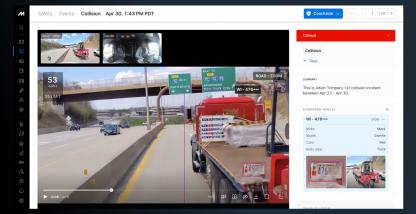
- Validate the event using multimodal signals like video, telematics, and context.
- Assign targeted coaching inside the driver app.
- Update the driver’s safety score and the fleet’s risk profile in the background.
This shifts safety teams from reviewing events one by one to managing exceptions and strategy. To maintain driver trust and accountability, these workflows should keep humans in the loop, with clear policies for when managers review, override, or escalate AI-driven recommendations.
2. Reasoning models for complex incident analysis
New reasoning models do more than help AI understand what happened. They also help shed light on why. Instead of simply flagging a lane departure, modern models can infer that a driver swerved to avoid an erratic cyclist, or that a sudden stop was caused by another vehicle cutting in.
By incorporating intent and context, these systems reduce false-positive fatigue, protect high-performing drivers from unfair penalties, and give fleets stronger evidence when reviewing incidents or disputes.
3. Multimodal AI for 360° risk visibility
Multimodal AI fuses video, audio, telematics, and other sensor data into a single model so fleets get a 360-degree view of risk. A system can:
- See the road and driver behavior.
- “Hear” engine health or mechanical anomalies.
- Sense G-force, speed, and location changes.
This sensory fusion links behaviors like distraction or fatigue with vehicle dynamics and environmental conditions, making it easier to spot high-risk routes, repeat patterns, and drivers who need early intervention.
4. Edge AI for real-time, in-cab alerts
High-stakes safety events unfold in milliseconds. Compact, on-device models can now run directly on vehicle hardware, delivering in-cab alerts in near real time — even in remote areas without reliable coverage.
By processing data at the edge, fleets can:
- Reduce dependence on cloud round-trips and network latency.
- Keep critical safety features active in low-connectivity “dead zones.”
- Lower ongoing data transfer and compute costs.
- Strengthen privacy by processing and discarding more data locally.
An edge-first approach is especially important for behaviors where moments matter, such as forward collision alerts or lane-swerving detection, while the cloud remains ideal for deeper analysis and reporting.
5. Vertical AI: industry-specific models win
General-purpose AI is powerful, but it is not tuned for the physics of heavy-duty vehicles, complex duty cycles, or commercial driver workflows. Vertical AI models trained on billions of miles of industry data can distinguish:
- Normal harsh braking in dense urban delivery from truly risky patterns.
- Route-specific risks like steep grades, bridge strikes, or congested interchanges.
- Nuances across long-haul, construction, field service, and more.
These domain-specific models tend to deliver more accurate detection and fewer false positives — critical when safety scores and coaching can affect driver careers.
6. Compute and pricing dynamics: safety for every fleet
As AI compute becomes more efficient and small models mature, advanced safety is no longer reserved for the largest enterprises. More efficient architectures and competitive pricing allow small and midsize fleets to deploy the same AI-powered dash cams, sensors, and workflows used by global logistics players.
This democratization of safety technology leads to:
- Higher baseline safety performance across the industry.
- A more level playing field on insurance and compliance.
- Faster time to value for fleets that previously could not justify heavy upfront investments.
7. Regulation and governance: the transparency era
Regulators and policymakers are increasingly focused on AI explainability. For fleet operators, it is no longer enough for a system to label a driver as fatigued or distracted — it must be able to show how it reached that conclusion.
Modern AI safety programs prioritize:
- Clear audit trails for every AI-triggered alert or coaching event.
- Granular data privacy controls aligned to labor and privacy laws.
- Human-in-the-loop guardrails so managers can review and challenge AI decisions.
Solution providers that can demonstrate transparent models, robust review processes, and driver-first privacy controls will be best positioned as governance expectations rise.
How Motive helps fleet operators lead in AI-powered safety
Motive is a unified AI-powered Integrated Operations Platform for physical operations that brings Driver Safety, Fleet Management, Equipment Monitoring, Spend Management, Workforce Management, and AI Vision together in one system so safety, operations, and finance teams can work from the same data.
By combining accurate AI with a single source of truth for drivers, vehicles, equipment, and spend, Motive gives organizations complete visibility and control and to help organizations significantly reduce manual work through automation.
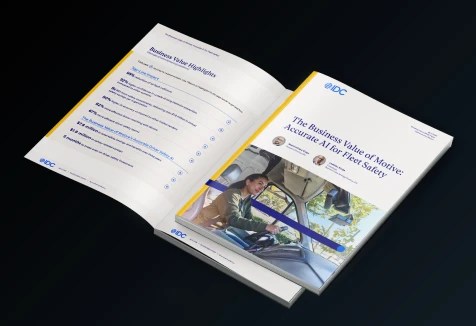
In a recent IDC Business Value white paper on Motive’s accurate AI for fleet safety, interviewed organizations also reported over 8x safety ROI and a five-month payback period.
Why fleet leaders choose Motive
- Accurate AI: Motive’s AI detects 20+ safety events — including mobile phone use, distraction, fatigue, unsafe following distance, and more — with up to 99% accuracy, while minimizing false positives that erode driver trust.
- Proven safety impact: Organizations that deploy the Motive AI Dashcam reduce collisions by up to 80% in their first year and see up to a 25% annual reduction in insurance costs, along with lower accident-related expenses.1
- Fast time to value: Organizations that deploy the Motive AI Dashcam recoup their initial investment within six months — with interviewed organizations reporting ROI up to 50% faster than previous providers.2
- Driver trust and experience: Motive’s safety program is designed to avoid punishing drivers for false positives, recognize positive driving, and provide clear, transparent safety scores and coaching experiences.
Ready to see the data? Talk to Motive to understand how our AI platform can help reduce collisions, lower insurance costs, and pay for itself in a matter of months.
1 – Estimated based on an internal study of fleets with 150+ active monthly vehicles, in which at least 90% of vehicles had dual-facing AI Dashcams for at least 12 months. Additional customer-reported outcomes include up to a 25% annual reduction in insurance costs and lower accident-related expenses.
2 – In the 2026 Motive ROI Report, respondents compared time-to-value against previous providers. IDC’s 2026 Business Value white paper on Motive also found a five-month payback period across six interviewed organizations.
Frequently Asked Questions
How is AI used to improve fleet safety in 2026?
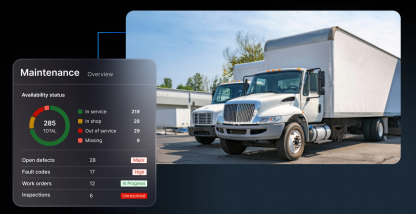
AI powers predictive maintenance, real-time driver monitoring, advanced event detection, and automated compliance workflows. Together, these capabilities help fleets identify risk earlier, intervene with targeted coaching, and reduce accidents, violations, and unplanned downtime.
What benefits do AI-driven driver monitoring and coaching provide?
AI-driven monitoring and coaching personalize feedback for each driver, surface the highest-risk behaviors first, and make it easier for safety teams to measure improvement. Fleets see fewer collisions, stronger safety culture, and better alignment between drivers and leadership.
How can fleets balance AI safety systems with driver privacy and trust?
Start with transparent programs that clearly explain what is captured, how it is used, and how it benefits drivers. Use privacy features such as driver-facing camera controls, configurable detection settings, and explainable safety scores — and recognize positive driving, not just negative events — to build trust over time.
Where is AI delivering the fastest return on investment in fleet operations?
Organizations with fleets typically see the fastest ROI in real-time safety monitoring, collision reduction, reduced accident-related costs, and insurance savings, followed by gains in fuel efficiency and maintenance uptime.
What practical steps can fleets take to implement AI-driven safety effectively?
Begin with high-ROI use cases like AI-powered video safety, select a partner with industry-specific models and a unified platform, and invest in training so safety, operations, and finance teams know how to use AI insights to improve processes — not just monitor activity.