

Keeping drivers can be difficult. Based on fall 2025 research by Conversion Interactive Agency and PDA, over half of truck drivers may currently be looking for a new job — the highest percentage of job-seeking drivers in over four years. Organizations trying to reduce driver turnover are often competing with other carriers for the same talent pool.
While safety incentive programs are not a cure-all, they can be a useful part of commercial truck driver retention strategies — especially when they help drivers feel supported, recognized, and treated fairly.
This article looks at how scorecards, coaching, and recognition can strengthen safety culture and help make your organization a place drivers want to stay.
The driver retention challenge in competitive trucking markets
Driver turnover is the rate at which organizations with fleets lose and replace drivers, expressed as a percentage over a given period. Replacing a single truck driver can cost around $12,799.
Rather than drivers leaving the industry for new careers, the American Trucking Associations argues that they leave for better driving jobs.
Turnover rates for trucking companies vary by type of firm, according to one study by the Institute of Labor Economics.
| Type | Definition | Average Annualized Turnover |
| Large truckload (TL) | Long-haul firms earning $30M+ a year | 92.7% |
| Small truckload (TL) | Long-haul firms earning < $30M a year | 77.6% |
| Private fleets | In-house long-distance transport for retailers/manufacturers | 15.0% |
| LTL linehaul | Long-haul “less-than-truckload” drivers | 11.8% |
Drivers, operators, and technicians are also in short supply across other industries:
- Construction. 77% of construction firms report that operators of cranes and heavy equipment are hard-to-fill positions.
- HVAC. The HVAC industry has a shortage of 110,000 technicians, and about 25,000 are leaving the workforce each year.
- Landscaping. 51% of landscape professionals in NALP survey data cited staffing issues as a top business challenge.
Core reasons why commercial drivers leave their companies
While pay is a reason for driver turnover, it’s not usually the main factor.
Consider these self-reported factors from a fall 2025 report about why truck drivers are job searching or would leave their job:
- Home time preferences. 58% of drivers look for new jobs to improve home time, and 61.3% would accept lower pay for a local position that offers more time at home.
- Pay and stability. 52.4% of drivers seek predictable pay, and 56.1% rank company stability as a top factor when choosing a new carrier.
- Respect and feedback. 25.7% of drivers look for new work because they feel disrespected, while nearly 70% do not feel they are consistently listened to by their carrier.
- Operational factors. 45.4% of drivers report that maintenance issues take a few days to resolve, and 43.2% are seeking better benefits like healthcare and retirement.
For long-haul carriers, where turnover ranges between 77% to nearly 93%, one study notes turnover may be tied to the structure of long-haul work. Because organizations want to move trucks efficiently and avoid empty loads, drivers end up having irregular work schedules, long weekly hours, and uncertain and limited home time.
Across industries, survey data indicates that the top three reasons employees voluntarily leave their jobs is because of a toxic or negative work environment (32.4%), poor company leadership (30.3%), and feeling unhappy with their manager or supervisor (27.7%).
Safety incentives as strategic retention tools
Safety incentives, which include rewards or recognition offered to drivers for meeting safe driving behaviors and milestones, can play a part in a driver retention strategy. When incentives are paired with a broader safety program that’s important to leadership, incentives encourage positive driving, demonstrate care by the organization for drivers’ well-being, and help create a culture of fleet safety.
Consider including these safety incentives in your holistic safety program:
- Financial and tangible rewards. Direct cash incentives, on-the-spot bonuses, and points systems that allow drivers to purchase items.
- Recognition. A banquet for safe drivers, a sign in the breakroom or announcement in the company portal, a commemorative vehicle wrap, or a rotating trophy for top performers.
- Company merchandise. Branded company merchandise and swag.
- Home time. Safest drivers receive more home time or days off.
How recognition and career pathways reinforce safe driving behaviors
Personal recognition and incentives for safe driving can be a motivator to stay with one company, especially if these incentives are tied to career progression.
See how these organizations have built safety incentives into their fleet safety programs:
- Crete Carrier and Shaffer Trucking. Almost 15% of their fleet has at least a million-mile safe driving award, which Vice President of Safety Matt DiVito says “reflects decades of safe driving and retention with Crete.” Their incentives range from certificates, pins, patches to commemorative plaques and 10 Years of Safe Driving rings.
- CoolSys. Their safety program is built on safety technology, like the Motive AI Dashcam, that enables real-time alerts and direct coaching, along with recognitions and incentives for positive driving milestones. Their Director of Environmental Health and Safety, Shawn Martinez, said, “We identify and reward those who do really well, like those who have a perfect driving record of 100. We also make sure to reward those who have improved significantly over time.” Incentives include gift cards and branded rewards, such as Carhartt items.
- HITT Contracting. Their safety program focuses on empowering each person on a jobsite with the authority and responsibility to speak up and stop work if they observe unsafe conditions. Every on-site team member plays an active role in safety by giving kudos to other teammates for safety, noting coachable moments, and making safety observations. HIIT has run friendly competitions to see which team could record the most observations and coachable moments.
- Prime Inc. Prime rewards drivers for safe driving by career progression — with awards starting at six months all the way up to 21 years of service. Awards start with a hat and end with $5,000 in cash, a leather jacket, decal, pin, and a 3-million mile plaque. Awardees are honored at an annual banquet.
These programs effectively combine tangible rewards with public recognition.
Designing reward-focused incentive programs that sustain engagement
Incentives should motivate long-term engagement rather than one time-achievements. To create engaging safety incentives, adopt these best practices:
- Start with simplicity and transparency. Use scorecards that track the safety behaviors most relevant to your operation, weighting them by actual risk and ensuring drivers understand how scores are calculated.
- Avoid “point fatigue.” Move beyond a single points system by mixing monthly, quarterly, and annual awards with behavior-specific recognition and longevity bonuses.
- Reward progress and performance. Motivate both top performers and those who show the most improvement.
- Adopt a “coach, not cop” approach. Emphasize individual progress over perfection to keep drivers engaged and reduce friction.
- Maintain visibility and trust. Provide drivers with self-coaching tools for real-time visibility into their performance. Regularly communicate the program’s overall impact.
- Use gamification. Create rotating safety challenges that drivers can get excited about.
Labor market pressures and the growing importance of non-wage benefits
As organizations compete for a continual shortage of drivers, operators, and technicians, a holistic benefits package, including safety incentives, can be a valuable recruitment and retention tool. Focus on offering a broad range of benefits beyond pay that align with drivers’ needs.
Safety incentives can also be built into your overall compensation structure. As new research comes out on how pay structure and incentives affect driving behaviors, organizations may be able to update their pay structures to improve both safety outcomes and retention.
Practical steps for fleet leaders to improve driver satisfaction and retention
Use this checklist to develop a culture that improves safety and retention:
- Communicate clearly and fix operational friction fast. Spell out pay rules, route expectations, and maintenance timelines in plain language, and adhere to those policies.
- Ask drivers for feedback. Where possible, make changes that address drivers’ needs or explain why changes can’t be made.
- Give drivers visibility. Let drivers see the same safety videos, scores, and trends managers use.
- Review and adapt. Revisit the program based on recurring complaints, unsafe-behavior trends, and what drivers say they need to succeed.
- Get drivers engaged. If you adopt new safety technology, involve drivers in trial runs. Show them how the technology protects their privacy while keeping them safe.
Using data-driven scorecards and transparent metrics to motivate drivers
A driver scorecard is an objective dashboard that shows each driver how they are performing against the safety and compliance metrics that matter most to your operation.
A practical driver scorecard might include:
- Speeding and close following to spot collision risk trends.
- Hard braking, hard acceleration, and hard cornering to identify aggressive driving patterns.
- Seat belt and mobile phone violations to reinforce core safety behaviors.
- Hours of service status to highlight fatigue and compliance risk.
- Coaching completion and improvement over time to reward progress, not just perfection.
- Positive driving milestones so drivers receive visible credit for safer habits, not just alerts when something goes wrong.
When drivers have concrete expectations and buy-in, they know what success looks like and can track their own improvement in real time. That combination of visibility, fairness, and recognition helps scorecards make drivers feel supported, respected, and more likely to stay.
How Motive’s platform supports retention through safety scorecards and recognition features
Motive helps organizations engage drivers in safety by combining automated scorecards, coaching workflows, and recognition tools in one integrated platform.
- Safety scores. Motive Safety Score gives organizations a customizable, evidence-based way to evaluate driver risk. The score is tied to behavior trends instead of one-off incidents so managers can use it for more constructive coaching conversations and more credible recognition programs.
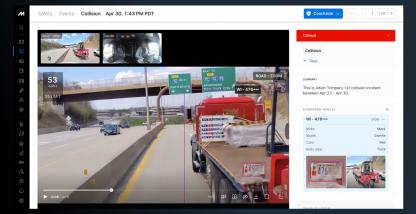
- Personalized coaching. Motive supports personalized coaching that is grounded in timely, driver-specific data. Drivers can review their own safety events in the Motive Driver App to see what changed and how to improve. Managers can use the same data to deliver appropriate coaching.
- Driver rewards. Using Motive’s Driver Rewards feature, organizations can create custom challenges that use safety data to automatically score drivers, update leaderboards, and assign badges and points.
Timeline for implementing Motive’s tools and measuring improvements
Motive’s safety and recognition tools are designed to work with existing fleet infrastructure, which makes rollout faster than building a program across disconnected systems.
A realistic implementation timeline for a safety program looks like this:
| Implementation timeline | Steps |
| Weeks 1–2: Onboarding and baseline setup | Connect available telematics and dash cam dataConfigure the safety behaviors and thresholds you want to trackEstablish your baseline metrics for unsafe behaviors, coaching volume, and retentionAlign internal teams on how scores and recognition will be communicated to drivers |
| Weeks 3–4: Launch scorecards and coaching workflows | Introduce drivers to the scorecard methodology and explain how scores are calculatedStart using Motive Safety Score and behavior trends for coaching conversationsEnable Motive Driver App visibility so drivers can review their own performance and self-coach |
| Month 2: Add recognition and simple challenges | Launch a small Driver Rewards challenge with 2–4 behaviors tied to your top safety prioritiesKeep scoring and rewards simple at firstUse leaderboards, badges, and rank-based prizes to build interest and participation |
| Quarter 1: Measure early operational change | Review changes in speeding, close following, distraction, and other targeted behaviorsTrack coaching completion and driver participation in challengesCollect driver feedback on fairness, clarity, and motivationAdjust weights, thresholds, or challenge design based on what the data shows |
| Quarter 2: Evaluate safety and retention impact | Compare safety trends against your pre-launch baselineAssess whether recognition participation is increasing engagementReview turnover, tenure, and driver satisfaction indicators alongside safety metricsExpand to more tailored challenges, groups, or reward structures if results are positive |
With Motive, you don’t need to wait a year to see whether your safety program is working. Many organizations can begin measuring behavioral improvement within the first quarter.
Building a culture where safety incentives increase loyalty and ROI
When safety programs combine transparent scorecards, timely coaching, and meaningful recognition, they show drivers that the company is paying attention, supporting them, and rewarding improvement. That kind of culture can become a competitive advantage, especially when retention pressure is high.
Frequently Asked Questions
What are the most effective ways to retain commercial drivers?
To retain drivers, start by getting their feedback on the company, culture, and benefits. In survey data, truck drivers cite the importance of home time, predictable pay, stability, respect, prompt maintenance, and good benefits.
How do safety incentives influence driver behavior and retention?
Safety incentives influence driver behavior by making safe actions visible, measurable, and worth repeating. When rewards are tied to specific behaviors — like safe speeds, better following distance, or less mobile phone use — drivers are more likely to connect those actions with positive outcomes and repeat them. When the program is fair, supportive, and encourages public recognition, incentives can also help retention.
How long does it typically take to see results from safety programs?
With an effective safety program, leaders can reasonably expect to see early movement in safety behaviors and coaching engagement within the first quarter. They should then evaluate broader safety score and retention trends over the next quarter as the program gains traction.
What elements make safety recognition programs fair and motivating?
Fair driver safety programs have simple rules, reliable and transparent data, visible progress, meaningful rewards, and a way to recognize drivers for good performance and improvement.
How can organizations with fleets balance technology use to support, not punish, drivers?
Organizations should frame fleet safety technology as a support system, not a surveillance system. They should use telematics, dash cams, and coaching tools to prevent incidents, protect drivers, and recognize improvement. When drivers see that the tools help them avoid incidents, clear false accusations, improve through coaching, and earn recognition for good performance, the technology is much more likely to feel supportive than punitive.