


Visibility across field services has come a long way. Nearly every operation can now see where its vehicles are, track its equipment, and manage its assets from a single screen if they have the right platform. What most operations still cannot do is turn that visibility into lower costs, safer drivers, and a workforce that runs without a mountain of manual work behind it.
That gap defines the state of field service technology in 2026. The industry has the tracking — what it lacks is the insight, prediction, and automation to turn data into results. Field service leaders consistently name three pain points their current tools need to solve but do not:
- Rising fuel costs,
- the operational cost of unsafe driving, and
- equipment theft, fraud, or unauthorized use.
Here is where field service technology gaps offer leaders opportunities to make real gains into 2027:
Field service teams can track equipment but lack insight into future risks
The foundational layer is now widespread, but it is not the finish line. In a 2023 WBR Insights field service survey of 100 field-service leaders in the U.S. and Canada, 97% said their technology enabled them to manage their vehicles, assets, drivers, and equipment from a single integrated platform, while 93% had real-time visibility into asset location. However, 89% said they lacked real-time analytics and reporting for workforce performance and productivity.
Cost control is now a more critical differentiator than basic tracking.
In Motive’s 2026 field services research, 95% of interviewed organizations named rising costs as a top concern, the single most-cited pressure in the study. Roughly two-thirds of field service teams also named the operational cost of unsafe driving and equipment theft or fraud as key concerns as well. The tools meant to control that spend fall short: 59% of organizations said their spend management technology was not very effective at helping them capture fuel discounts. For an organization running on tight margins, money left on the table at the pump is money that never reaches the bottom line.
95% of field service operations name rising costs a top concern.
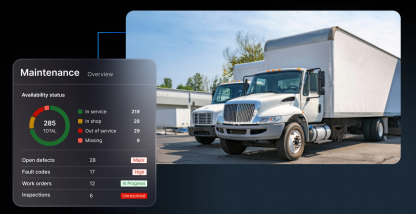
This is where connected spend and telematics tools have moved from tracking to acting. Rather than surfacing overspend long after the money is gone, modern systems flag fuel anomalies in the moment, capture the discounts operators are missing, and pinpoint the wasteful idling and off-plan routing that erode margin every day. Closing that 59% discount gap alone can return real money to operations that have watched fuel costs climb for years. The impact is measurable: in 2024, Motive blocked $56 million in fraudulent and unauthorized spend for its customers and helped them save $65 million through rebates, fraud detection, and spend controls1.
Organizations still struggle with areas of fleet safety and compliance
Field service operations have the basic safety toolkit in place. Most have geofencing, automated maintenance reminders, driver-vehicle inspection reports, and driver coaching profiles. The gap is prediction.
A majority of respondents, 55%, said their driver-safety technology was not very effective at predicting high accident risks, and another 22% said it was not effective at all. (WBR Insights, Advancing Technology in Field Service: Fleet Management & Safety. Commissioned by Motive.)
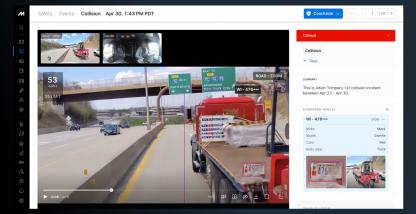
The adoption gap explains why. Only 47% of respondents to the 2023 WBR Insights study said they could leverage AI dash cams for driver safety and compliance. Motive’s AI Dashcam Plus detects unsafe behaviors such as mobile-device use, drowsiness, and close following, then delivers in-cab alerts so drivers can correct those behaviors immediately.
The distinction matters: recording an incident is reactive, while detecting and coaching risky behavior in real time creates an opportunity to intervene before a collision.
The operations that have closed this gap show what predictive safety delivers at scale. KONE, which runs roughly 16,000 vehicles, cut safety events by 52% across its entire fleet after moving to a connected safety platform. Safety failures do not stay in the safety column. They surface as insurance premiums, litigation exposure, vehicle downtime, and the loss of experienced crew, which is why prediction has become the line between a controllable cost and a runaway one.
Field service organizations still find sustainability technology falls short
Sustainability is closely tied to field-service economics because fuel-intensive operating practices can increase both operating costs and emissions. Idling, speeding, hard acceleration, and avoidable truck rolls can increase fuel use and carbon output.
Yet most operations said their fleet, asset, and equipment management technology was ineffective at helping them achieve sustainability goals — 46% called it “not very effective” and 16% “not effective at all,” according to WBR Insights’ 2023 survey of field-service leaders.
The root problem is visibility into behavior, not intent. Seventy percent of operations said they lacked visibility into whether their drivers were idling, speeding, or making hard accelerations, even when coaching programs existed on paper. Without real-time data, a sustainability policy is a binder, not a practice.
70% lack visibility into idling, speeding, and hard acceleration.
Connected telematics closes that loop by turning every one of those wasteful behaviors into a data point a manager can coach against. Reducing idle time and optimizing routes cuts fuel spend and emissions in the same motion, which is why the operations making the fastest sustainability progress are the ones that treat it as an efficiency problem with a financial payback rather than a separate reporting exercise.
Workforce management tools are not providing real-time analytics
The workforce is where the manual-work problem is most acute. In Motive’s 2026 field services research, 53% of interviewed organizations said inefficiency and manual work were holding them back, with time-consuming administrative tasks a core workforce management challenge. In leaner operations, that work piles onto an owner or lone office manager already juggling billing, scheduling, and customer calls. Every hour of data re-keyed by hand is an hour pulled away from billable jobs.
The most striking finding was the analytics gap. The 2023 WBR Insights report found 89% of respondents lacked access to real-time analytics and reporting capabilities that provided insight into workforce performance and productivity. Mobile access was nearly universal as a demand, with 86% calling it very important for crews to access schedules, request time off, and view work-related information from their mobile devices. Yet automation remained a significant gap: only 9% were very satisfied with their current workforce management system’s automation and self-service features.
89% lack real-time analytics on workforce performance.
This is the gap that connected fleet and workforce management is built to close. When location, hours, maintenance, and spend live in one integrated operations platform, reporting can become more current and administrative work can be automated. In Motive’s 2026 ROI Report, some field-services respondents reported reclaiming 24 hours per week with Motive — equivalent to approximately 156 eight-hour workdays per year.
Consolidating this work is what turns those manual hours back into productive ones,
The path forward: smart automated processes
The through line across every section is the same. Field service operations have visibility but not insight, tools but not automation, data but not the analytics to act on it. When leaders describe what they want next, the answer is consistent: AI, real-time reporting, and automation that turn all that captured data into decisions.
The operations already making that move are setting the benchmark. Top respondents in the 2026 Motive ROI research reported roughly $1 million in average annual savings and a return on investment inside of half a year. The broader market is moving the same direction, with the installed base of active fleet management systems in North America projected to grow from about 19 million to more than 33 million by 2029.
24 hours reclaimed per week on a connected platform.
The strategic question for a field service business today is no longer whether to adopt technology. It is whether your technology is preventing the losses that separate the field’s leaders from everyone else, and putting your operation in the first group.
Key next steps for field service leaders
Operations weighing where to invest first should consider:
- Putting spend on autopilot. Move to tools that flag fuel fraud, capture discounts, and catch idling and routing waste in real time, not on a statement weeks later.
- Adopting predictive safety. AI dashcams that coach in the moment prevent the collisions that drive insurance and litigation costs, rather than only recording them.
- Making sustainability a data practice. Use real-time behavior data on idling and speeding to cut fuel and emissions together.
- Giving the back office real-time analytics. Replace manual reporting with live workforce and fleet data so decisions run on today’s numbers.
- Consolidating onto one platform. The savings compound when safety, maintenance, location, and spend stop living in separate tools.
See what a connected platform can do for your operation
The industry has moved from tracking to results, and the gap between leaders and laggards is widening. See where your operation stands and where the fastest gains are, from fuel and safety to workforce analytics. Explore the Motive platform for field service.
- Based on Motive internal data for the 2024 calendar year. The $56 million represents transactions blocked through Motive’s fraud and spend controls; the $65 million represents customer savings from rebates, fraud detection, and spend controls. ↩︎
Frequently asked questions
What are the biggest technology challenges in field service?
Rising costs top the list, named by 95% of field service operations interviewed in Motive’s 2026 research, followed by the operational cost of unsafe driving and equipment theft or fraud, each cited by roughly two-thirds of teams. Most operations have strong asset tracking but lack the tools to predict risk and control these costs.
Do field service operations already have fleet tracking technology?
Yes. In a 2023 WBR Insights study of 100 U.S. and Canadian field-service leaders, 100% could leverage live GPS tracking, 97% could manage vehicles, assets, drivers, and equipment from a single platform, and 93% had complete, real-time location visibility. The larger gap was using that data for visibility into cost control, predictive safety, and real-time workforce analytics.
How does AI improve field service operations?
AI can help operations move from recording events to acting on them. AI-powered tools can flag fuel waste and unauthorized spend, detect risky driving and prompt real-time coaching, and surface workforce insights that reduce manual reporting. According to Motive’s 2026 ROI Report, some field-service respondents reported reclaiming 24 hours per week. Top respondents averaged $1 million in savings per organization, according to our calculations.
Does field service technology work at large scale?
Yes. KONE, operating about 16,000 vehicles, reduced safety events by 52% across its fleet after adopting a connected AI-powered platform, showing the results hold at enterprise scale.