


The physical economy relies on the seamless movement of goods, but for the leaders managing thousands of vehicles, the stakes are higher than ever. By 2026, fleet safety is increasingly driven by data and AI to help prevent more accidents before they happen.
As insurance premiums climb, the standard dash cam has evolved into an advanced, AI-enabled onboard device. For large fleets, transitioning to a fully unified, AI-powered integrated operations platform that unifies safety, operations, and finance is one of the most impactful moves a large fleet organization can make.
This guide provides a strategic roadmap for selecting and scaling AI dash cams that deliver measurable ROI and long-term driver trust.
1. Define your fleet safety objectives and metrics
Success begins by aligning technology with specific, quantifiable goals. High-performing fleets don’t just install cameras; they use them to lower costs. When setting your targets, aim for performance metrics that reflect both safety and financial health.
Example metrics for large fleets:
- Collision reduction: Aim for a meaningful decrease in preventable collisions within the first year.
- Behavioral shifts: Target a significant cut in distracted driving incidents within 90 days.
- Financial impact: Secure measurable insurance premium savings through documented risk mitigation.
- Coaching compliance: Maintain a high coaching completion rate to support a proactive safety culture.
2. Evaluate AI detection and hardware specifications
By 2026, the benchmark for an AI dash cam is its ability to identify a broad range of safety risks — such as distracted driving, tailgating, or signs of fatigue — often at the same time. Rather than simply uploading video to the cloud, these devices leverage on-device computer vision to run multiple AI models in parallel.
When evaluating hardware, prioritize dual-facing units that offer 1080p HD resolution, infrared night vision, and both wide-angle and zoomed-in views. This ensures you capture the full context of the road and cab while still seeing critical details like license plates and vehicle features, even in low-light conditions or during incidents such as hit-and-runs, road rage, or theft.
The following table outlines the key technical specifications and features to prioritize when selecting high-performance AI dash cams for your fleet operations.
| Feature | High-performance AI spec | Why it matters |
| Edge processing | On-device AI inference | Enables real-time alerts without cloud latency. |
| Detection models | 20+ safety events, including phone use, drowsiness, or lane swerving | Provides a comprehensive view of driver risk. |
| Installation | Fast, standardized installation via a unified Vehicle Gateway | Minimizes vehicle downtime during mass rollouts. |
| Connectivity | 4G/5G LTE with automated updates | Keeps AI models current and performing reliably over time. |
3. Pilot AI dash cams on high-risk routes
The gap between a product demo and real-world performance can be significant. Successful deployments begin with a targeted pilot program.
A strong pilot program involves the following strategic steps:
- Select high-risk assets: Deploy hardware to vehicles and routes with the highest historical incident rates.
- Monitor accuracy: Track false positives versus actionable alerts to ensure the AI is trustworthy.
- Validate bandwidth: Confirm your infrastructure can handle mass video uploads without lag.
- Document savings: Use pilot data to refine ROI forecasts and secure executive buy-in for a full rollout.
4. Verify integration with telematics and fleet systems
An isolated dash cam is a missed opportunity. For maximum impact, video data should live within a unified platform. Seamless telematics integration ensures that location, vehicle health, and driver behavior data flow together.
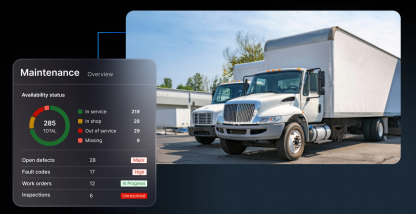
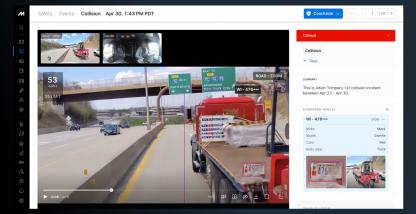
This integrated operations approach lets fleet managers triage events faster. When an incident occurs, the video should automatically link to the driver’s ELD records and the vehicle’s maintenance profile, so managers don’t have to jump between disconnected systems.
When evaluating vendors, consider how quickly they can help you achieve value — including how easy it is to deploy at scale and start seeing measurable improvements in safety and costs.
5. Train drivers with a support-first approach
No technology can succeed without the support of the people using it. For large fleets, the rollout must be transparent.
Drivers are often concerned about privacy, so it is vital to communicate exactly what is being recorded and why.
- Transparency: Clearly explain that the AI dashcam is a tool for protection, coaching, and exoneration — not just surveillance.
- In-cab coaching: Use real-time voice alerts to allow drivers to self-correct behaviors like taking their eyes off the road or seatbelt violations before a manager ever sees the event.
- Exoneration: Emphasize how dual-facing video captures both the road and the cab, providing evidence that can clear safe drivers from false claims and support evidence-based coaching.
Choose partners that make it easy to coach virtually or in person, and that offer strong support and training to help your teams adopt new workflows quickly.
6. Scale and measure ROI
Scaling across thousands of vehicles requires tools for bulk provisioning and centralized policy settings. Once deployed, the focus shifts to optimizing outcomes.
Motive customers have achieved substantial savings with the Motive AI Dashcam and safety platform:
- 80% fewer accidents within one year of Motive AI Dashcam deployment.
- 25% annual reduction in insurance costs.
- 63% reduction in accident-related costs annually.
Even a single exonerated incident can avoid significant claims and legal fees, further improving ROI.
Prepare your fleet for the future with AI
Selecting the right AI dash cam is a strategic investment in the safety and efficiency of your fleet. Motive’s unified platform prioritizes accurate AI for maximum ROI, ensures seamless integration with your operations systems, and enables a driver-centric approach to coaching.
Motive is the only platform that enables safety, operations, and finance teams to manage their workers, vehicles, equipment, and fleet-related spend in a single solution.
Ready to see the impact on your bottom line? Contact Motive today to learn how the Motive AI Dashcam Plus, as part of the unified Motive platform, can help you build a safer, more productive, and more profitable fleet.
Frequently Asked Questions
What AI detection features should I prioritize in fleet dash cams?
Prioritize real-time detection of key risks like phone use and drowsiness. The Motive AI Dashcam Plus can run multiple models simultaneously, ensuring high accuracy and low false positives for trustworthy, actionable safety events.
How do dual-facing cameras support driver safety and claims defense?
Motive dual-facing AI Dashcams capture the road and driver actions. This video is crucial evidence for exonerating safe drivers from false claims and enabling effective, evidence-based coaching to improve long-term habits.
What are the best practices for integrating AI dash cams with existing fleet systems?
The best practice is seamless integration with telematics and maintenance. The unified design of the Motive AI Dashcam Plus automatically links video evidence to driver and vehicle records for faster incident response.
How can fleets maximize insurance savings using AI dash cam data?
Use aggregated safety and incident data from the Motive AI Dashcam to prove a reduced risk profile to insurers. This transparency supports premium reduction and speeds up resolutions for not-at-fault claims.
What cloud storage and video retention policies are recommended for large fleets?
Event-triggered recording ensures critical footage is saved. The Motive AI Dashcam Plus offers battery backup recording, ensuring video uploads even if power is lost in a severe collision.