


Fleet leaders need to know whether an AI dashcam can distinguish meaningful risk from noise. The answer affects driver trust, coaching, collision prevention, and the return on a safety investment.
Motive achieves high accuracy by combining high-precision cloud-based AI models designed to analyze every safety event, purpose-built hardware, a 400+ person Safety Team that reviews low-confidence events, and structured side-by-side trials against real-world data.
While some providers may claim “unmatched accuracy” simply because their algorithms are trained on millions of miles of data, fleet leaders know that raw data volume doesn’t automatically equal precision in the field. An AI model is only as useful as the hardware running it and the human validation cleaning up its mistakes.
Motive customers and the real-world impact of AI accuracy
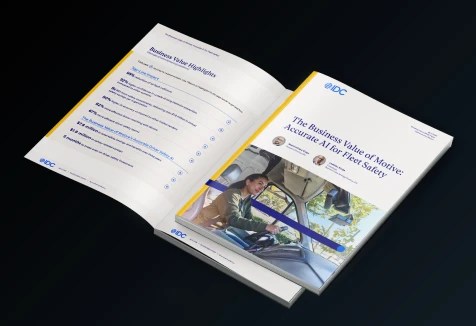
A 2026 IDC Business Value white paper sponsored by Motive found that six interviewed organizations using AI-powered driver safety solutions reported an average 95% reduction in at-fault collisions.
IDC’s three-year financial model estimated an eightfold return on safety investment and a five-month payback period. In initial trials, the interviewed organizations reported 50% higher AI accuracy than other trialed vendors.
Combined with privacy controls and positive driving detection, that accuracy is what ultimately determines whether an AI dash cam earns trust in the cab and in the back office.
Why does AI dashcam accuracy matter for fleet safety and ROI?
Accurate AI affects what a safety team sees, how quickly it can respond, and whether drivers view coaching as fair. A missed event can leave risky behavior unaddressed. A false positive can waste review time and make drivers question the system.
The IDC research connects these effects. Along with the reported 50% higher AI accuracy, the interviewed organizations also reported 92% higher confidence in preventing unsafe driving behavior compared with other evaluated systems.
When detection is more reliable, safety teams can focus on the behaviors most likely to cause harm instead of sorting through alerts that do not require action.
That accuracy also supports financial performance. Fewer preventable collisions can reduce claims, vehicle downtime, legal exposure, and disruption to operations.
How does the Motive AI Dashcam Plus work?
The Motive AI Dashcam Plus combines multiple sensors — cameras, telematics, GPS, and motion data — with on-device AI to detect unsafe behavior in real time and capture high-quality video evidence.
At a high level, it:
- Continuously analyzes video from road-facing and optional driver-facing cameras.
- Fuses that video with telematics signals like speed, braking, and location.
- Flags potential safety events, then uploads clips and data to the Motive platform within seconds.
What each camera monitors
- Road-facing (wide + zoom): Close following, lane departures, rolling stops, cut-ins, unsafe lane changes, pedestrians and vehicles ahead, license plates in incidents.
- Driver-facing (dual-facing model): Distraction, fatigue, seat belt use, mobile phone use, smoking, eating, and other in-cab behaviors tied to risk.
Because processing happens on the device, rather than relying solely on the cloud, the dashcam can identify and alert on risk in real time, even in challenging conditions.
What hardware makes the Motive AI Dashcam Plus more accurate?
Motive designed the AI Dashcam Plus as an all-in-one device that combines the Vehicle Gateway and AI Dashcam, built on a next-generation Qualcomm Dragonwing QCS6490 AI processor.
Hardware matters because AI models need enough computing power and visual context to interpret what is happening around a vehicle. Stereo road vision can provide depth information for events such as forward collision warnings, close following, and lane swerving. The zoom lens can help capture vehicle details and license plates when Collision Evidence Capture1 is available.
Competing platforms often talk about “reducing the noise,” but they leave the heavy lifting of video filtering to their AI alone. The reality is that unvalidated AI floods safety queues. True accuracy requires a human backstop, which is why Motive combines its models with a dedicated 400+ person review team to filter out the false positives AI alone misses.
The system also uses event data beyond video. Combining video with audio, GPS, motion, and vehicle information can help distinguish a true safety event from an ambiguous moment. That context helps reduce unnecessary alerts and gives managers clearer evidence for coaching and claims.
What safety events can Motive’s AI detect?
Motive detects over 20 safety events with up to 99% accuracy, including both high-risk maneuvers and subtle behaviors that often precede collisions.
Examples of events Motive detects today include:
- Mobile phone usage.
- Driver distraction and fatigue.
- Close following and forward collision warnings.
- Unsafe lane changes and lane swerving.
- Stop sign violations and unsafe parking.
- Seat belt violations and speeding over the posted limit.
- Smoking, eating, obstructed cameras, and more.
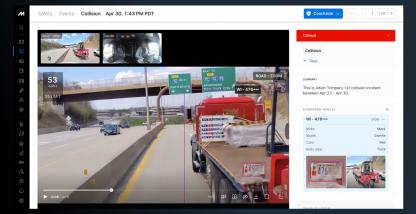
Motive automatically detects 99% of severe collisions and uploads video in seconds, giving safety teams the context they need when every minute counts.
Event coverage is only one part of accuracy. Organizations should also ask how a vendor measures precision, recall, false positives, and performance across conditions such as night, weather, city streets, and highways.
How does Motive reduce false positives with human-in-the-loop review?
Even a strong AI model can misinterpret a complex situation. Motive pairs AI detection with its Event Validation Engine, or EVE, and a dedicated Safety Team that reviews potential collisions and routes low-confidence events to our 400+ member Safety Team, so safety managers only see true safety risks while our AI models continuously improve.
The typical flow is:
- AI detects a potential event and uploads video and data.
- EVE evaluates the event and assigns a confidence level.
- Low-confidence events are routed for human review.
- Confirmed events reach managers with context for coaching or claims.
This human-in-the-loop approach helps managers spend less time reviewing noise and more time addressing real risk. It also gives drivers a clearer basis for feedback. The IDC research found that interviewed organizations reported 82% more effective driver coaching with Motive compared with prior approaches.
The same reduction in manual review can improve team capacity. IDC reported a 67% improvement in driver safety-team efficiency among the interviewed organizations. In the study’s operational model, safety-team resources shifted away from validating uncertain events and toward coaching and risk mitigation.
What do real-world results and independent evaluations show?
The IDC Business Value white paper is based on structured interviews with six organizations using Motive’s AI-powered driver safety solutions across industries including logistics, construction, sanitation, equipment supply, pest control, and shipping. The findings reflect the organizations’ reported experiences and IDC’s financial analysis.
The business value highlights include:
- An average 95% reduction in at-fault collisions after deploying Motive cameras and technology.
- 50% higher AI accuracy than other trialed vendors in initial trials.
- 92% higher confidence in preventing unsafe driving behavior compared with other evaluated systems.
- 82% more effective driver coaching.
- 67% more efficient driver safety teams.
- An estimated eightfold return on safety investment over the three-year researched window.
- A five-month payback period based on customer-reported costs and benefits.
- More than $1.8 million in annual safety-related savings per interviewed organization and approximately $7.8 million in total safety savings and benefits over three years.
These figures should be read together. Accurate detection supports timely alerts. Validated events support focused coaching. Better coaching supports behavior change. Fewer preventable incidents and more efficient workflows support the financial case.
What should fleets look for when evaluating AI dashcam accuracy?
When comparing AI dashcams or validating a current system, look beyond a single accuracy percentage. Ask vendors to explain:
- Event coverage: Which behaviors and collision types does the system detect today, and which matter most to the organization’s risk profile?
- Measurement: How are precision, recall, and false-positive rates tested across different routes and conditions?
- Validation: Is there a human review layer? Which events are reviewed, and how quickly?
- Privacy and policy fit: Do privacy controls, data retention, and coaching workflows align with company policy and driver expectations?
- Benchmarking: Are third-party studies or structured trial frameworks available for side-by-side comparison?
- Business value: Can the vendor connect safety outcomes to claims, downtime, staffing capacity, and payback?
Don’t let a vendor hide behind abstract statistics or grand claims of “unmatched risk assessment.” The goal is not to choose the vendor with the biggest marketing claim. It is to find the system that reliably identifies meaningful risk, supports fair coaching, and produces measurable results.
Motive encourages fleets to run structured dash cam trials — using published guides and independent research — to validate how well any dashcam’s AI performs in the field.
Is Motive’s AI Dashcam Plus accurate enough for your fleet?
For safety-critical decisions, accuracy must hold across routes, drivers, behaviors, and operating conditions. Motive’s approach combines on-device AI, purpose-built hardware, event validation, human review, and measurable outcomes.
The IDC findings give organizations a clear starting point: interviewed organizations using Motive reported an average 95% reduction in at-fault collisions, an estimated eightfold return on safety investment, and a five-month payback period.
They also reported higher AI accuracy, greater confidence in preventing unsafe driving behavior, more effective coaching, and more efficient safety teams than with prior or trialed approaches.
If you’re evaluating AI dashcams or revisiting your current program, run a structured trial with Motive’s AI Dashcam Plus and AI Accuracy guides. The fastest way to answer the accuracy question is to test it in your fleet, side by side.
1 – Motive Collision Evidence Capture is not available in all locations. Learn more.
Frequently asked questions
How accurate are Motive’s AI dashcams?
Motive’s AI Dashcam Plus detects more than 20 safety events with up to 99% accuracy, and automatically detects 99% of severe collisions, uploading video in seconds. Many fleets see safety events fall by over 90% within six months when they fully adopt Motive’s Driver Safety program.
What did IDC find about collision reduction and ROI?
The six interviewed organizations reported an average 95% reduction in at-fault collisions after deploying Motive cameras and technology. IDC’s three-year financial model estimated an eightfold return on safety investment and a five-month payback period based on customer-reported costs and benefits.
What role does human review play in improving AI accuracy at Motive?
Motive combines cloud-based AI with EVE, its Event Validation Engine, and a 400+ member Safety Team that reviews potential collisions and low-confidence events to remove false positives before they reach managers. This ensures drivers aren’t coached or penalized based on incorrect alerts.
Can weather or lighting affect dashcam performance?
Any vision system can be challenged by rain, snow, glare, or darkness, but Motive’s models are trained on real-world data across conditions and use HD cameras plus sensor fusion (video, audio, GPS, IMU, and vehicle data) to maintain accurate detection in low-light and complex scenarios.
How does Motive protect driver privacy while using AI dashcams?
Motive offers Driver Privacy Mode, geofenced camera behavior, lens covers, and clear in-cab indicators. These controls can help organizations limit recording when drivers are off duty or vehicles are stationary while preserving the footage needed for safety and exoneration.