


How to survive the enforcement blitz.
From July 12 through July 18, law enforcement officers across the United States, Canada, and Mexico will be watching commercial and passenger vehicle drivers closely, looking for unsafe behavior behind the wheel.
Operation Safe Driver Week is the annual enforcement and education campaign run by the Commercial Vehicle Safety Alliance (CVSA). The 2026 focus area is reckless, careless, or dangerous driving. It’s the third year in a row CVSA has selected that area of focus, for good reason.
If you run a fleet, the week is a checkpoint, not a test. Throughout the week, officers will be looking for the same behaviors that drive up your Safety Scores, insurance rates, and risk exposure every other time of the year. The organizations that come through Safe Driver Week even better than they entered it are the ones already managing driver behavior as an everyday operation.
What officers are actually watching for
CVSA defines reckless driving as operating a vehicle in willful or wanton disregard for the safety of people or property. Careless or dangerous driving means operating without proper attention or reasonable consideration for others on the road. In practice, that means officers will be on the lookout for the following behaviors:
- Speeding
- Distracted driving
- Following too closely
- Improper or unsafe lane changes
- Impaired driving
- Failure to wear a seat belt
- And ignoring traffic control devices.
Why does CVSA keep returning to these behaviors year after year? The answer lies in the numbers. Driver actions, whether something a driver did or failed to do, often put others at risk. Speeding was a factor in 11,288 U.S. traffic deaths in 2024, 29% of all roadway fatalities. Distracted driving killed another 3,208 people that year. Of the passenger vehicle occupants killed in 2024, various demographic data show that among men and young adults specifically, most weren’t wearing seat belts.
What last year’s enforcement found
The results from CVSA’s 2025 Operation Safe Driver Week, released last October, show where drivers were cited and warned for unsafe driving. Over one week in July, officers in the U.S. and Canada stopped 8,739 vehicles and issued more than 6,000 warnings and citations combined, with the vast majority going to commercial drivers.
The official focus area in 2025 was the same as this year: reckless, careless, and inattentive driving. It produced 20 citations and 53 warnings across the entire continent over seven days. Speeding, by contrast, produced 917 citations and 1,249 warnings, making it the top infraction by a wide margin. Drivers received 491 speeding citations and 1,073 speeding warnings.
Officers aren’t writing tickets that say “reckless driving,” because reckless driving is a judgment call that’s hard to charge at the roadside. They write tickets for speeding, following too closely, using a handheld device, and not wearing a seat belt. Those are the measurable behaviors that constitute reckless driving.
In 2025, commercial drivers also picked up 79 citations and 107 warnings for texting or using a handheld device, and 248 citations and 204 warnings for failing to wear a seat belt. None of those land under the “focus area” line in the report. In practice, all of them are the focus area.
If your safety program only watches for dramatic, obviously reckless behavior, you are watching for the very thing officers rarely cite. The behaviors that actually generate the violations, and the CSA violations behind them, are the same, everyday behaviors that a high-quality dash cam and telematics program surfaces year-round.
A one-week campaign with a much longer tail
A warning or citation during Safe Driver Week isn’t relevant for just that week. Driver-side violations feed the Unsafe Driving BASIC in FMCSA’s Safety Measurement System, and that score shapes how often your vehicles get pulled in for inspection going forward.
A speeding ticket, a violation for following too closely, or a seat belt citation can stay on a carrier’s profile for two years, raising your percentile, increasing inspection frequency, and giving a plaintiff’s attorney a documented pattern to point to if one of those drivers is ever in a serious collision.
Carrier and driver behavior records are discoverable. In the current litigation climate, where a single nuclear verdict can put a carrier out of business, the gap between “we have a safety policy” and “we can prove we enforced it” is the gap that costs you. Safe Driver Week is a useful function because it makes that gap visible for one week. The hard work comes in closing that gap for the other 51 weeks of the year.
What safe organizations do before, during, and after the week
Organizations with fleets that treat Safe Driver Week as an annual readiness check know their level of risk before the officers do. They’re already looking at driver behavior data, so the drivers most likely to draw attention during the campaign are coached before July 12, not after a citation is issued.
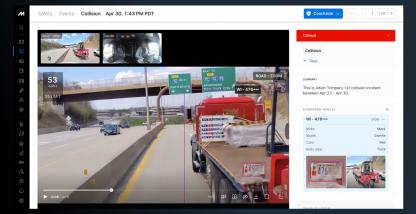
They make the in-cab moment count. The most effective coaching happens in the seconds a behavior occurs, not in a meeting three weeks later when the driver barely remembers the trip. A following-distance alert or a speeding alert in the moment changes the next mile. In an automated coaching conversation built on video, the driver can actually see video clips of their unsafe actions and work to change them.
A scorecard that flags every hard brake equally is a scorecard drivers learn to ignore. The organizations getting results are weighing the behaviors that actually predict collisions, prioritizing the handful of drivers who need attention, and leaving the safe majority alone.
Where Motive fits
Motive was built for this. The Motive AI Dashcam, for example, alerts to the exact behaviors CVSA is targeting this year, including speeding, distraction, and following too closely, and it does it with in-cab alerts that reach the driver while the trip is still happening.
The Motive Safety Score weights events by real risk, so coaching time goes to the drivers who move the needle rather than those who happen to drive on bumpy roads. Automated coaching workflows and shareable event video close the loop and timestamp it, so the proof that you followed your own policy builds itself in the background. Hours-of-service and ELD data live in the same platform; fatigue, one of the quieter contributors to careless driving, stays visible too.
Safe Driver Week comes and goes in seven days. The safest operators don’t have to scramble for it. When the week arrives, they watch drivers move through just like they do every other week of the year: clean
Want to see how your risk profile looks heading into Safe Driver Week? Let a Motive professional demonstrate how you can get ahead of fleet risk. Request a demo today.