
Changing providers is a decision with real operational risk. Here’s what four organizations operating fleets found when they evaluated alternatives, made the change, and tracked the results.
Nobody switches fleet technology casually. Switching involves unwinding contracts, replacing devices, retraining drivers, and a reasonable fear that the new system might just trade one set of problems for another. That’s why often the most useful evidence for an organization weighing a change is to look at results from fleets who already made one.
Let’s look at four different organizations with fleets. Each one starts from a different place: detection gaps, driver trust issues, rising accidents, compliance reporting that took too long. And each ends with real, measured results from making a change.
What did organizations find when they tested Motive head-to-head against Samsara?
Two organizations ran structured, head-to-head trials before choosing Motive over Samsara, and what they saw in their own vehicles was clear: drivers preferred Motive, and its AI detection was more accurate.
Reliable Carriers transports high-value vehicles for automotive brands across the U.S. and Canada, where damage and late delivery are both expensive. Its incumbent system lacked the safety visibility the team needed for proactive coaching. So Reliable narrowed its search down to two finalists, and ran a months-long trial across 40 drivers. In the end, 100% of test drivers chose Motive over Samsara.
Product Manager Lauren Abrams pointed to several reasons:
- The AI Dashcam’s detection accuracy and automatic video tagging meant the safety team could go straight to the events that mattered.
- Drivers could view their own dash cam footage right in the Motive Driver App, while with Samsara they had to call the back office, a sign the Motive product was designed with drivers in mind.
The feedback, said Abrams, was consistent from drivers across over-the-road, regional, and owner-operator roles, so “we knew we had it right.”
Over the following year, Reliable reports it sustained 99.9% damage-free delivery rate and 100% on-time delivery rate — results the company attributes to Motive working alongside Reliable’s own hiring requirements, orientation program, and continuing education. “Switching to a new provider can be an incredibly daunting task,” Abrams said. “But if I can leave you with one piece of advice, it’s this: trust me, Motive’s worth it.”
EnerCorp, an oilfield services company operating in high-risk West Texas conditions, faced a different obstacle. EnerCorp’s team felt that their existing Geotab telematics lacked the detail the team needed, but leadership worried that adding dash cams would drive drivers to quit.
U.S. Fleet Manager Aaron Kelver needed proof before anyone would approve a change, so he designed a test: Samsara units in seven vehicles for three months, then Motive AI Dashcams in the same vehicles with the same drivers for the next three.
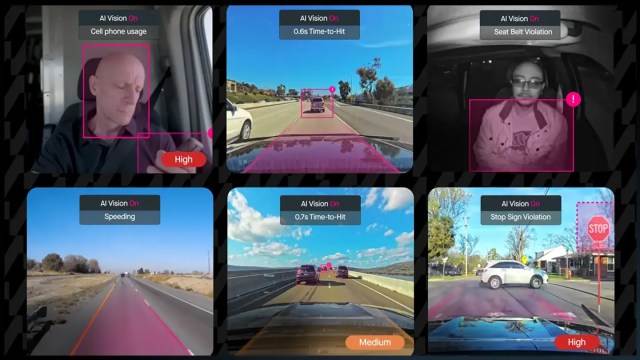
Kelver’s verdict: “Its AI detection was far more accurate, especially when detecting distracted driving and cell phone use.” He valued the ability to “[recognize] positive driving habits, allowing us to reward drivers for doing the right thing.”
After choosing Motive, EnerCorp’s in-house mechanics installed cameras in all 220 vehicles within 90 days. Within two months of installation, EnerCorp reported:
- Cell phone use fell 25%.
- Distracted driving fell 10%.
- Stop-sign violations fell 19%.
See the full Motive vs. Samsara comparison.
What changed when a line haul carrier switched from Lytx?
A 125-vehicle line haul service provider in Texas found risks it had not been seeing, and then reduced them sharply.
The freight carrier was looking at a puzzle: accidents were rising, yet its Lytx dash cams reported very few unsafe driving events. “We had very few alerts from Lytx, giving leadership the impression that we had safety well in hand,” its vice president of risk management said, “but as soon as we switched to Motive, the data told a very different story.”
That story changed quickly. After the switch, the vice president reports:
- Recorded speeding events went “from about three to hundreds per month.”
- On cell phone use, he said: “Lytx had recorded no cell phone events. In our first month with Motive, we had hundreds of cell phone events captured.”
- Across the fleet, once Motive was installed, coachable alerts rose 3,900% in a single month, or 40 times the previous level.
With that visibility, the team now aims to address an event within an hour, using the video to show drivers exactly which behavior needs to change. The carrier has since reported a 74% reduction in DOT accidents, a 33% reduction in preventable accidents, and a 67% reduction in total video events, which the vice president attributes to accurate, real-time alerts, proactive driver coaching, and greater visibility into driver behavior. “Statistically, the number of unsafe events we’re having are going down,” the vice president said. “Our accidents are going down. Our inspections are getting better.”
Weighing the same switch? See how Motive compares to Lytx.
How did Heritage-Crystal Clean simplify compliance after switching to Motive?
The company replaced a system that was difficult to work in and unreliable in the cab with one its team found much easier to use — Motive.
Heritage-Crystal Clean moves hazardous and recycled materials across more than 90 service branches with nearly 1,000 vehicles, so compliance data matters. Its previous telematics provider made that data hard to reach. “Just to get to the data we needed for simple compliance and safety interactions was a challenge,” said Ryan Duffy, DOT Compliance and Safety Manager.
The driver app was worse: it crashed, missed trips, and disconnected. Said Duffy: “It was practically a guarantee to have four or five calls a day about something calamitous with the app.”
After vetting multiple vendors, the company switched to Motive. “In Motive, the compliance and safety data is presented in a way that’s a lot simpler to see and to share,” Duffy said. The team now uses Motive for OSHA recording across all safety-sensitive employees, including people who never drive a commercial vehicle but still need their work hours captured. Since switching, Heritage-Crystal Clean has reported 25% fewer Hours of Service violations and a 38% improvement in CSA scores.
How quickly do fleets see value after switching to Motive?
Fleets see value 1.4-2x faster than they did with their previous provider, according to Motive customers who made the move.
In the 2026 Motive ROI Report, surveyed customers who switched to Motive reported reaching value more than 2x faster coming from Samsara, 1.9x faster from Verizon Connect, and 1.4x faster from Lytx. Those figures compare each respondent’s time to first ROI with Motive against their time with the previous provider, averaged across all respondents who answered. In G2’s Fall 2026 reports, enterprise fleet management customers reported reaching ROI in 5.7 months, compared with 9.44 months for Samsara customers.
Independent research points toward the same conclusions.
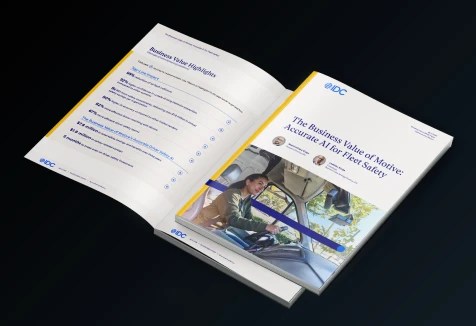
When IDC studied six organizations using Motive’s AI-powered safety tools, it found that those achieving the strongest outcomes had run structured, side-by-side trials in real driving conditions and chosen based on their own evidence, the approach Reliable Carriers and EnerCorp both took. Those organizations reported 58% fewer unsafe driving behaviors, such as phone use and close following, compared with their prior driver safety technology. Organizations that ran comparative trials perceived Motive’s AI detection as 50% more accurate than the other solutions they trialed, on average, based on their own evaluation criteria and testing. The organizations also reported a five-month payback on their safety investment.
See the switching data in full. The 2026 Motive ROI Report covers what 351 organizations reported, including time to value compared with previous providers. “The Business Value of Motive’s Accurate AI for Fleet Safety” provides IDC’s findings from interviews with Motive customers.
Methodology note:
Customer results come from published Motive customer stories for Reliable Carriers, EnerCorp, a line haul service provider, and Heritage-Crystal Clean, and reflect those organizations’ reported experiences; individual results vary. The 2026 Motive ROI Report reflects an online survey of 351 current Motive customers across North America, conducted June through August 2025; switching figures reflect the average difference in time to first ROI after adopting Motive versus a previous provider, across all respondents. G2 figures come from G2’s Fall 2026 reports. IDC findings come from the IDC White Paper sponsored by Motive Technologies, Inc., “The Business Value of Motive’s Accurate AI for Fleet Safety,” Doc #US54413826-BVWP, May 2026, based on interviews with six organizations. IDC is explicit about the findings’ limits: these are customer-reported results from six organizations in real operating conditions, rather than a controlled vendor comparison or a population-level study.