


One of the fastest ways to improve your operation is to learn from peers who have already solved the challenges you’re facing. Whether it’s reducing administrative work, improving visibility, strengthening compliance, or resolving customer disputes faster, high-performing organizations often uncover practical strategies that others can adapt and apply.
Here are four real-world use cases that showcase how operators are driving efficiency gains — and how you can apply similar approaches in your own business.
Use case #1: Use video footage to verify service and resolve complaints faster
Going from 3 hours per dispute to a single phone call
At Weedman Epic3, service verification is critical to customer satisfaction and retention. In running 330 vehicles, the business gets about 100 customer complaints a week, mostly people calling to say “You didn’t treat my lawn.” That’s why confirming service with video footage from 360-degree cameras has been so pivotal for the organization.
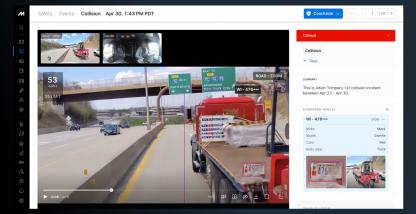
With 360° cameras like the AI Omnicam on its vehicles, Epic3 can capture when and how lawn treatments take place. The cameras allow managers to see what’s going on and check standardization and consistency across the board, especially since the company has 34 locations and continues to grow.
“We use the Omnicams like crazy. They allow us to take the ‘he said, she said’ situation out of it and really change the customer’s perception. When you go out there and someone says, ‘He didn’t do it right the first time,’ this footage has really allowed us to take the bias out of it and rebuild that trust.
By having video footage available whenever they need it, the company has ample video evidence on hand to resolve disputes quickly. It’s a far cry from life before cameras, when Epic3 sent managers into the field to address disputes in person. With some customers an hour’s drive from the office, the visits became incredibly time-consuming, taking up to three hours for a single manager alone.
“With that Omnicam footage and verification process, we’ve been able to really minimize the time they go out and talk to that homeowner,” Bejarano says. “We can just handle it on the phone. We still give them the option to go back out and show them what’s going on. But ultimately, if we can handle it over the phone, that’s a win in our books.”
Use case #2: Spend less time on fuel reporting — and more time growing your business
Going from manual data from 10 vendors to $10k/month in savings with a single system
Many customers are battling high operating costs, tight margins, and constant pressure to cut costs while maintaining service levels. That makes it critical to find hidden savings, maximize ROI, and use data-driven insights to make more impactful business decisions.
For TransSouth, that challenge was especially painful. The medical transport provider operates more than 800 vehicles across 23 states, running roughly 14 million miles each year. Fuel was one of the company’s biggest operating expenses, but the bigger problem was how hard it was to get a clear picture of that spend.
Before making a change, the team was pulling fuel data from as many as 10 vendors, entering that data by hand, and piecing it together manually to look for fuel theft, misuse, and anomalies. The work was fragmented, slow, and reactive, taking hours that could have been spent improving the operation.
By deploying the Motive Spend Management solution, anchored by the Motive Card, TransSouth consolidated fuel transactions and reporting into one unified platform. As a result, the team moved from fragmented, manual data entry to proactive, data-driven decision making, allowing them to reclaim hours of lost time.
“I can just click, run a report for whichever day I want to, and within 10 minutes, it’s done. So, we’ve essentially gone from 16 hours of wasted labor per person down to having a report in 10 minutes.
The real story isn’t the time savings. It’s what the team did with that time once they got it back. Instead of treating efficiency as an administrative win, TransSouth reinvested those hours into higher-value work — supporting its safety incentive program, looking for ways to improve vehicle efficiency, and taking a more proactive approach to fuel management.
“We’ve gone from a reactive approach to being proactive and reinvesting time into our drivers and our system,” Arnold says.
That evolution has made a measurable financial impact. Within the first month or so of switching to the Motive Card, TransSouth was already seeing fuel savings of $20,000. But for leaders looking at the bigger picture, the most important takeaway may be that teams have the time and clarity they need to make decisions that help strengthen the bottom line.
Use case #3: Use AI cameras to catch costly mistakes before they leave the yard
Going from hoping for the best to clear verification
Gilbert Solano, equipment maintenance and support operations manager at Watco Greens Port, oversees hundreds of vehicles and pieces of heavy equipment across an 850-acre operation in Southern Texas. With eight vessel docks, three barge docks, 43 miles of railroad track, and 3.3 million square feet of warehouse space, the site is too large and complex to monitor with people alone.
That’s where AI-powered cameras come in. Watco uses the livestream from Motive’s AI Dashcam as “digital eyes” in the field, giving managers visual confirmation that the right materials are going to the right customers in the right vehicles.
The team also mounts the AI Omnicam 360° camera onto a fuel truck, pairing it with Radio Frequency Identification (RFID) readers to verify each fill-up. The camera captures the fueling, while the RFID reader identifies the vehicle, helping Watco confirm the exact time, location, and vehicle involved. Together, these tools help the team catch discrepancies, conserve fuel, and accurately charge the right department, all before they leave the complex.
“Before Motive, we were just going out and crossing our fingers, hoping that we didn’t have a mistake or hadn’t put the wrong aggregate into the wrong truck. Motive has provided us with a platform that we’re able to use to solve a lot of those issues and be versatile.
For large, distributed operations, this kind of real-time visibility helps eliminate guesswork, reduce costly errors, and ensure that teams have the information they need to make faster decisions.
Use case #4: Let AI handle the documents so your team can handle the work
Going from hours of repetitive admin to one-click automation
For commercial fleets, paperwork is more than a filing problem. It spans driver qualifications, vehicle documents, asset records, and trip documents such as fuel receipts and bills of lading. Those documents don’t help much by sitting in a binder or on someone’s desk. They need to be tied to the right drivers and vehicles, tracked for expiration, and checked for completeness so teams can spot gaps before they turn into compliance issues.
For Robin Guzzo, DOT and safety leader at Vapor Point, document management used to mean manual data entry, spreadsheets, and constant follow-up. Her team tracked expirations in spreadsheets, entered information from documents by hand, and emailed managers individually about upcoming renewals.
On the vehicle side, the process was just as cumbersome. If something was missing, the team often had to track down the right person. Sometimes, they went directly to the truck to figure out what documents were there and what still needed attention.
That manual process created both inefficiency and risk. If something was missed, a driver or vehicle could end up operating out of compliance or get caught with an expired document during a roadside inspection. It also consumed valuable back-office time that could have been spent on higher-value work.
With Motive, that work became far more streamlined. Instead of manually entering issue dates and expiration dates, Guzzo can upload a document, let AI scan it, and have the system extract the relevant information automatically. For vehicle documents, Motive can read details like the VIN, license plate, and unit number, associate the document with the right vehicle, and store everything in one place.
“I go into the documents. All I have to do is click. It has everything already in there. Whatever type of compliance applies to your company, it has it in there. You just upload it, hit ‘process,’ and it scans it.
Just as importantly, the system helps reduce the constant chasing that manual document management creates.
- Alerts and review workflows make it easier for teams to see what’s missing, what’s expiring, and what needs attention.
- At Vapor Point, those notifications go to managers, who can then follow up before an issue becomes a compliance problem.
- The result is a more proactive compliance workflow. Alerts automatically go to the right managers, documents are easier to track, and drivers can access the right records in the driver app when connected to their truck.
What used to be tedious back-office work is now a faster, more reliable system that reduces manual entry, lowers the risk of errors, and helps the team stay prepared for audits and roadside inspections.
Conclusion
While every organization faces different challenges, the best operators often share a common mindset. They look for ways to eliminate manual work, improve visibility, and give teams more time to focus on priorities. These examples show that efficiency gains don’t just save time — they create opportunities to improve customer service, reduce risk, and drive stronger business outcomes.
Learn from your peers
Want to see how other fleet leaders are solving challenges like these? Explore all the sessions from Motive’s customer conference to see what other ideas you can implement at your organization.