

Physical operations teams have more visibility than ever: alerts, fault codes, safety events, safety scores, dashboards. But that visibility creates a growing to-do list of its own. Organizations without a way to act on this data automatically have no way to catch patterns before they turn into incidents, no way to respond the same way every time, and no way to scale operations without scaling headcount.
Teams relying on manual processes face a different problem. Alerts get chased instead of acted on, and follow-up happens after the collision, HOS violation, or maintenance issue instead of before it. The same risks resurface because nothing intervenes consistently. Oversight becomes a bottleneck instead of a strength.
The cost adds up. Motive estimates organizations lose $46 billion to preventable downtime, compliance violations, and idling, and 42% of surveyed organizations in Motive’s 2026 ROI Report name operational inefficiency, including excess admin work, a top concern.
There’s a better way to run your operations. Introducing Agents, powered by Motive AI.
Today, you define the conditions and the actions once, and Agents handle the rest. Agents can watch your operations continuously and act the moment something meets your criteria, reaching the right person through email, SMS, or app alerts, and drivers directly through in-cab voice messages. Later this year, Agents will also be able to reach drivers through voice agent outreach on AI Dashcam Plus.
And that’s just the starting point.
Early next year, you’ll be able to start from the goal itself: describe an outcome in plain language, such as fewer collisions, more on-time jobs, improved fuel economy, or lower maintenance costs, and let Agents determine the path. Agents will be able to run continuously across your operations, and improve over time as they learn and adapt as conditions change. You’ll also be able to choose from a library of Motive-built Agents, ready to run with no configuration required.
Agents can help organizations save time, reduce costs, and prevent issues before they happen.
Set up Agents in minutes and get hours back for your team.
Every organization has goals that span more teams and systems than any single workflow can cover, and how to reach them isn’t always obvious.
Agents already take your operations from reactive to proactive. Today, you build Agents to automate complex workflows with full control over triggers and actions. In early 2027, you’ll be able to start from the goal itself. Choose the starting point that works best for your team:
- Start from a prebuilt template for idling, fault codes, fatigue, and more, then tailor it to your workflow.
- Combine multiple triggers and actions into a single Agent, so one setup does the work of several separate workflows.
- Describe the workflow you want in your own words, and let AI turn it into the triggers and actions. No technical expertise required. Coming early 2027
- Set an outcome, such as fewer collisions, and Agents can determine the path and work across your organization to achieve it. Coming early 2027
- Access a library of Motive-built Agents for every part of your operation, from coaching to maintenance, ready to run with no configuration required. Coming early 2027
- Whether you define the workflow or just the outcome, the point is the same: your team optimizes for the result, not the process.
Take action fast when driver fatigue is detected.
Driver fatigue is a major safety risk, but early warning signs are often missed without consistent monitoring and follow-up.
Agents can help fleets identify and address fatigue risks earlier, allowing organizations to:
- Identify risky behaviors early with Agents that trigger timely intervention before conditions become unsafe.
Have Atlas call the driver through AI Dashcam Plus to check how they are doing and talk them through finding a safe place to pull over and rest.
Instantly escalate to the safety manager with an Atlas call that explains the fatigue risk detected, waits for them to accept, then connects them directly to the driver.
By intervening earlier, fleets can reduce risk, improve driver safety, and maintain compliance at scale.
Get ahead of severe weather to keep drivers safe and routes on track.
Storms, ice, and high winds can turn a routine route into a safety and delay risk. By the time conditions change, drivers are often already in them.
Agents can help fleets spot changing conditions and intervene earlier, allowing organizations to:
- Automatically detect storms, ice, or high winds forming on each active route and notify the driver while the weather is still miles out, giving them time to prepare.
- Have Atlas call the driver in the cab through AI Dashcam Plus to talk through the conditions and recommend an alternate route, a safer speed, or the nearest place to stop.
- Alert safety and fleet managers with the full context and bridge them into a two-way Atlas call with the driver when a conversation is needed.
- Keep dispatch informed as conditions change so they can adjust schedules, downstream stops, and customer expectations before delays spread.
Knowing about severe weather ahead of time helps keep drivers safer, prevent avoidable collisions, and keep trips on schedule.
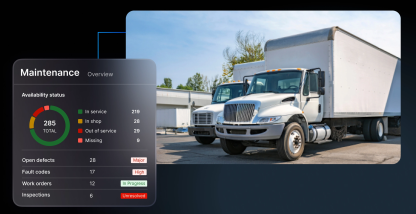
Catch maintenance issues early and fix vehicles faster, with less downtime and paperwork.
Fault codes that go unnoticed or are addressed too late lead to costly downtime. Creating work orders and tracking vehicle status by hand delays repairs and sidelines vehicles longer.
Agents can enable organizations to detect and respond to maintenance issues as soon as they arise, helping teams:
- Instantly understand vehicle fault codes with AI-powered insights, including a clear explanation, severity level, recommended actions, and suggested driver messages.
- Have Atlas call the driver through AI Dashcam Plus to explain the fault code and talk them through taking safe action before damage occurs.
- Automatically create a work order and mark the vehicle as out of service when a fault code meets your criteria, so repairs start immediately without anyone manually opening a ticket.
- Stay ahead of maintenance with timely alerts that surface upcoming service needs before they become problems.
Catching issues early and acting quickly keeps vehicles on the road, reduces the admin work of manual tracking, and can help avoid expensive repairs.
Reduce fuel costs and emissions.
Unnecessary idling drives up fuel costs, increases emissions, and accelerates engine wear, but it can be difficult to monitor and correct in real time.
Agents can help organizations detect and respond to idling as it happens, enabling teams to:
- Automatically flag excessive idling to cut fuel waste, emissions, and engine wear.
- Account for ambient temperature so necessary idling in extreme heat or cold isn’t mistaken for waste.
- Guide drivers to shut off engines with automated in-cab alerts from AI Dashcam Plus.
- Notify fleet managers the moment idling thresholds are exceeded so they can step in when needed.
Addressing idling in the moment can help lower costs, improve sustainability, and extend vehicle life without added manual work.
Smarter operations start with Agents.
Agents turn the visibility you already have into action. Your team stops chasing alerts and starts preventing the issues behind them. Today you define the workflow, and soon you’ll define the outcome.
Agents are available today. Talk to your Motive representative to get started.