


While fuel is a necessary expense for any organization with a fleet, it can be a major piece of the budget. Fuel made up more than 21% of trucking operational costs in 2024, according to the American Transportation Research Institute.
However, with the right fuel management strategies, organizations with fleets can reduce fuel costs.
Discover how to manage fuel costs better by establishing baseline visibility, improving workflows, and adopting a fuel purchasing strategy.
Key fuel management strategies for fleet-based organizations
Establish baseline visibility
Begin improving fuel management by discovering where your fleet stands in terms of fuel economy.
1. Track fuel consumption and idling
While you’ve likely seen indicators that your fuel spend is high, start by validating any instincts or gut feelings against data. Review how the fleet is doing as a whole on fuel use and idling time.
Motive makes discovering your baseline easy. Motive Fuel Hub paints a complete picture of where fuel is going, how much is wasted in idling, and which vehicles or drivers are leading those trends. Fuel Hub can:
- Track data like total fuel used, MPG, and fuel cost for vehicles over any date range.
- Show top and bottom performers on a leaderboard, and enable you to explore a single vehicle’s fuel history.
- Break out idling fuel use so that you can identify whether idling is a problem for your fleet.
2. Benchmark fuel performance
Even when you have visibility around what the fleet’s fuel consumption looks like, it can be hard to know what “good” looks like or what’s realistic for your operation to achieve.
To show where you stand, Fuel Hub offers built-in benchmarking so that fleet managers can compare their MPG, fuel costs, and idling performance against their fleet. Benchmarks are customizable by a fleet’s vehicle class, make/model, fuel type, and year, so organizations are always comparing apples to apples.
3. Use AI analytics to see fuel trends
After you’ve gotten a baseline and benchmarked it, dig into your own data to identify fuel trends. Trends can indicate when it’s time to take action:
- Renegotiate or reroute around expensive corridors.
- Launch targeted coaching for drivers with poor fuel economy.
- Retire vehicles that always underperform.
Over time, data and smart decision-making help you turn fuel management into a disciplined, data-driven program.
Instead of stitching together fuel receipts and odometer readings to find these trends, access a live, updated view of trends in Motive’s Fuel Hub. Fuel Hub collects data (such as vehicle telematics, trip distance, and fuel purchases from Motive Card) from across the Motive platform, then uses AI to identify fuel consumption trends.
Improve operational workflows
Once you know the baseline, remove the kinks in your operational workflows.
4. Review fleet vehicles
Cutting or replacing fuel-burning vehicles in your fleet is a simple way to improve fuel management. Look for the vehicles with chronically low fuel economy and see if there are any trends. Does one type of truck or an older model always have a worse MPG than its peers? Use fuel and maintenance data to reduce the number of vehicles that burn excess fuel.
Motive’s Fuel Hub shows MPG, idle fuel, and fuel wasted for every vehicle over time. Benchmarking lets you spot vehicles that consistently underperform others with the same make, model, and duty cycle.
If a vehicle still shows low fuel economy after continuous proper maintenance, it may be time to reassign that vehicle or plan to replace it.
5. Train fuel-efficient driving behaviors
Driving habits like speeding and idling waste fuel. Mike Roeth, executive director of the North American Council for Freight Efficiency (NACFE), explained the connection between speed and fuel economy: “Many of our MPG tips, like watching your speed and driving slower if you can, can save a lot. With big trucks, there’s a lot of aerodynamic drag. And the [MPG] difference between 75 mpg and 65 and from 65 to 55 is huge — in excess of a mile per gallon.” On a large scale, these habits can quickly add up.
Identify drivers with these driving behaviors and encourage them to stay aware of fuel-wasting habits and how to improve their fuel economy.
Easily coach drivers using these Motive features:
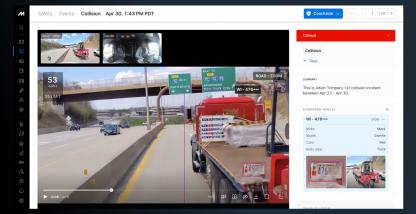
- Spot speeding with the Motive AI Dashcam Plus and alert drivers with in-cab notifications.
- Review Fuel Hub’s driver fuel details and idling reports to see which behaviors are hurting fuel economy.
- Employ Motive’s AI-powered coaching tool to give targeted feedback and track improvements over a 30-day baseline.
Motive AI Dashcams allow us to monitor and coach our drivers, helping us instill safer and more fuel-efficient driving practices.
6. Practice proactive maintenance (PM)
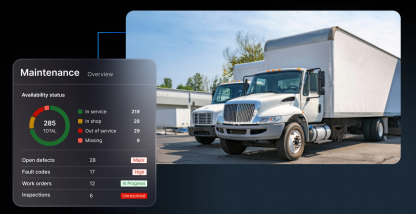
When engines are running smoothly and tires are properly inflated, vehicles and equipment operate more efficiently. Staying on top of scheduled tune-ups, filter replacements, and regular inspections can prevent a lot of little fuel waste from adding up into a big bill.
Motive’s fleet maintenance product makes it easy to automate usage-based service schedules so that vehicles get serviced when they need it and don’t accidentally miss an interval.
If you use Fleetio, Motive’s integration with Fleetio provides AI-powered fuel and maintenance optimization, including automatic fuel cost tracking. Teams can see exactly how better maintenance practices translate into lower fuel spend over time.
7. Optimize routes
The shortest route on the map isn’t always the lowest cost. Stop-and-go traffic, construction, and detours all increase fuel consumption. With Motive, dispatchers can go to the Motive Dashboard to build and adjust routes that minimize these factors.
Paired with Fuel Hub, you can then measure improvements, such as how those routing decisions change metrics like MPG, idling, and fuel cost per mile over time.
8. Reduce unproductive miles
Unnecessary miles, including deadhead trips to find a missing trailer, picking up the wrong piece of equipment, or shuttling assets between yards, burn fuel without producing revenue.
By carefully monitoring equipment, operations teams can match the right trailer or machine to the closest available vehicle, stage equipment closer to jobs, and cut out unproductive back-and-forth trips.
Use Motive’s GPS asset tracking and equipment monitoring to gain visibility into the location and utilization of all your assets. Motive builds in multiple layers of location technology so that customers have support even in hard-to-track locations.
9. Automate IFTA fuel tax reporting
IFTA mistakes, such as overreported gallons or having to pay penalties and interest, raise your effective fuel cost per mile.
Automate IFTA reporting with Motive to generate compliant reports without manual work or spreadsheets. By combining accurate GPS mileage with Motive Card fuel transactions, Motive can reduce over-reporting, admin work, and fines.
When we switched to using Motive to complete IFTA reports, we calculated time savings of more than 800 hours a month just from trip reports.
Adopt a fuel purchasing strategy
Finally, reduce the cost of buying fuel by adopting a purchasing strategy.
10. Use a fleet card to manage fuel costs
A good fuel purchasing strategy starts with the right payment tool. Fleet cards consolidate fuel spend in one place, making it easier to see your true cost per gallon and fuel cost per mile across vehicles and routes.
The Motive Card provides detailed transaction data that ties each purchase to a verified driver and vehicle. You can see where and when drivers fueled, how far they drove between fill-ups, and how that behavior impacts fuel economy and total cost.
Using the Motive Card, we can track where and when our drivers stop for fuel and their actual mileage between fill-ups. Fuel is one of our most significant expenses, but we had to guesstimate these figures, missing critical data points in the past…. Instead of simply monitoring our fuel spend, we can implement active measures to control it.
11. Work within a fleet card network to find low cost fuel
Small differences in pump price add up when you’re buying thousands of gallons a month. A structured fuel purchasing strategy uses card network data to steer drivers toward lower-cost locations and away from convenient fills that raise the fleet’s average price per gallon.
Motive Card combines a large discount network with broad acceptance so drivers can actually use it in the real world. Customers earn fuel rebates at 38,000+ partner locations across North America, with Tier 1 diesel savings commonly averaging $0.20+/gallon.
12. Block more expensive fueling stations
Knowing which stations are expensive is only half the battle — you also have to prevent stops from happening in the first place. By analyzing card data over time, organizations can see where drivers routinely pay above-average pump prices or buy outside preferred networks. Once those patterns are visible, managers can block or discourage high-cost locations to lower the average price per gallon.
Fleet managers use the Motive dashboard to identify expensive merchants, coach drivers toward better choices, and then enforce those policies with AI-powered controls.
13. Set up spend controls
Spend controls are a way for managers to encode fuel policy into each fleet card, so card expenses stay focused on legitimate, in-policy purchases.
Motive Card gives customers fully customizable spend controls by vehicle and driver. Admins can restrict spending by time of day and day of week, transaction amount, and more, and drivers use mobile-based card unlock to verify identity. Real-time reporting makes it easy to see which controls are working and where to tighten policies.
14. Use AI to reduce fraud
One unexpected challenger to efficient fuel management is fraud. Based on the Motive ROI report, 21% of Motive transportation and logistics survey respondents list fraud as a top concern. According to Motive’s Physical Economy Outlook, leaders estimate that 19% of fleet spend is lost to fraud, with construction leaders estimating an even higher number of 22%.
Recapture the budget you’re losing from fuel fraud with AI-powered prevention. By combining vehicle telematics data like location and tank level with Motive Card transaction data, the Motive Card can auto-decline suspicious transactions in real time. In 2024, Motive customers prevented over 80,000 unauthorized transactions with our fraud detection capabilities, saving $55 million.
Jonathan Keyes, Director of Project Management at Hawx Pest Control, explained how they’ve seen both fuel savings and fraud reduction by using the Motive Card. “We’ve saved about $21,000 in 2024, but the bigger, more unexpected impact has been fraud reduction,” he says.
Powerful fleet fuel management controls from Motive
From precise fuel data and analytics to powerful spending controls, Motive gives you everything you need to put these fuel management strategies into practice. With one system for assets, drivers, and spending, you can take fuel from an unpredictable expense to a manageable line item.
Motive’s fleet management platform is a fully integrated, AI-powered suite of products built for organizations that want to save on fuel while running safer, more efficient operations.
Want to see it in action? Watch a short demo or get in touch with our team.