


Fleet safety can often feel “squishy.” Everyone agrees safety is important, but when you’re asking for a budget for dash cams, telematics hardware, or simply a modernized driver safety program, executives want to see hard numbers more than good intentions. The good news is that fleet safety ROI is measurable and immensely valuable to the bottom line.
This guide to fleet safety ROI gives you a business‑ready way to talk about return on investment for safety programs, along with metrics to measure effectiveness.
Fleet safety ROI statistics roundup
When you’re pitching a safety investment internally, pair industry benchmarks with real organizational outcomes. The chart below pairs fleet safety ROI numbers with a specific story to illustrate the statistic.
| ROI Category | Benchmark | Case Study |
| Fewer collisions and safety incidents | Motive customers see up to 80% fewer collisions in the first year, on average.1 | Estes Forwarding Worldwide reduced collisions by 89% and speeding events by 90% with an AI-powered safety program. |
| Lower insurance, claims, and risk of nuclear verdicts | Top respondents2 in the 2026 Motive ROI Report saw a 25% annual reduction in insurance costs on average.3 | Hawx Smart Pest Control saved $216,000 annually on insurance while reducing overall incidents by 39% with Motive. |
| Operational efficiency savings | Survey respondents using the Motive Integrated Operations Platform report $1M in average business savings per fleet.4 | Hardy & Harper cut fuel costs by about 24% while improving driver behavior and fleet visibility with Motive’s integrated platform. |
| Culture, retention, and reputation | Organizations with highly engaged employees experience 64% fewer safety incidents (accidents) than those with low engagement. | FusionSite’s safety and incentive program helped cut driver turnover from 7% to 1%, while unsafe driving events dropped by more than 90%. |
What is the ROI of fleet safety?
Fleet safety ROI is the measurable financial return your organization gets from reducing collisions and high‑risk driving relative to your investment in fleet safety.
Fleet safety investments can be a profit center, not a cost center. According to the 2026 Motive ROI Report, surveyed customers using the Motive Integrated Operations Platform report $1M in average business savings per fleet.5
Those returns can be grouped into four main ROI categories:
- Fewer collisions and safety incidents
- Lower insurance premiums, claims, and risks of nuclear verdicts
- Safety as a lever for productivity, maintenance, and fuel savings
- Culture, retention, and reputation
1. Fewer collisions and safety incidents
For many organizations, the biggest return from fleet safety is fewer collisions.
Motive data highlights that organizations using the Motive AI Dashcam see up to 80% fewer collisions in the first year.6
One standout example is Ernst Concrete, which reports about$6.5M in total savings and 2,000% ROI, including $1.3M annually in direct loss savings.
From an executive standpoint, these results make the decision clearer. Prevented collisions avoid a multitude of costs from:
- Loss of life
- Vehicle repair
- Towing
- Lost loads
- Injury costs
- Wage replacement
Instead of asking, “What are the odds this happens to us?” the better question — especially when building a business case — is: “What is the upside of preventing 50–80% of our collisions?”
When you plug your own numbers into that question, fleet safety becomes very compelling.
2. Lower insurance premiums, claims, and risks of nuclear verdicts
Reduced collisions can lower insurance spend and the severity of claims. For many organizations with fleets, the impact of reduced insurance costs from fleet safety programs becomes impossible to ignore.
Top respondents to the 2026 Motive ROI Report say they saw, on average, a25% annual reduction in insurance costs since adopting Motive.7
After FusionSite Services deployed Motive AI Dashcams and a structured coaching program, they achieved about$2.5M in insurance savings in a single year.
In a trucking environment where nuclear verdicts are driving premiums up, the ability to exonerate drivers for not-at-fault incidents is essential. When you can show clear footage, telematics, and driver behavior data for every event, your organization can:
- Resolve not‑at‑fault claims faster or avoid payouts entirely.
- Reduce the pressure to settle, especially on borderline cases.
- Protect reputations with shippers, regulators, and the public.
Keep this ROI tidbit in mind: A fleet safety program can reduce both the frequency and severity of your risk equation, which is why the ROI can be so strong.
3. Operational efficiency savings
Fleet safety’s ROI isn’t limited to saving lives. A strong program can also streamline workflows and cut operating costs.
According to the 2026 Motive ROI Report, fleet managers save 20 hours per week — equal to 1,000 hours a year — from doing less paperwork. When manual tasks are managed by software and safety, maintenance, and spend are centralized in one platform, they can focus on managing the business.
Safety and fuel efficiency also go hand in hand. Research from the American Transportation Research Institute (ATRI) indicates that when drivers are coached on fuel‑efficient habits, fleets can reduce fuel use by 5–20%.
According to the ATRI report, the most efficient drivers tend to:
- Maintain steady speeds instead of constantly speeding up and slowing down.
- Spend a high share of trip distance in top gear.
- Use cruise control when possible.
- Minimize harsh accelerations, hard braking, and unnecessary idling.
The Motive AI Dashcam Plus detects unsafe, but also fuel‑wasting behaviors like speeding and harsh braking in real time. It delivers in‑cab alerts so drivers can self‑correct before those habits turn into incidents or higher fuel bills.
4. Culture, retention, and reputation
Finally, there’s the ROI that doesn’t always fit into a spreadsheet, but eventually shows up in a costly way: Driver retention.
Research from Gallup shows that companies with highly engaged employees have 64% fewer safety incidents, 43% lower turnover, and far fewer absences than low‑engagement peers.
When making a business case for fleet safety, this is your final pillar: a modern safety program makes it easier to keep good drivers, attract new ones, and protect your brand.
With Motive Safety Scores and incentives at the center of its data-driven fleet safety program, FusionSite saw turnover go from from 7% to 1% in a single year.
For organizations with fleets, an investment in safety can mean:
- More experienced drivers staying longer.
- Fewer hiring and training cycles.
- A reputation that makes it easier to recruit and win high‑value contracts.
Our drivers see that the Motive AI Dashcams are able to capture video of events that weren’t their fault, and it makes them feel valued. We’re investing in their safety, and it shows our drivers that we care about them.
How to realize fleet safety ROI
Organizations that consistently get strong returns from fleet safety tend to have four things in place:
- A unified platform
- A vendor with a proven track record
- Accurate technology
- Engaged drivers
Look for a unified platform, not point solutions
One tool for one problem might sound easier, but this approach adds complexity and limits savings (and visibility). The 2026 ROI Report shows that fleets using the Motive Integrated Operations Platform achieve results up to 2x faster than with previous providers.
For large fleets (1,000+ vehicles), those gains compound quickly. Many see ROI in about 2.5 months.
Find a vendor with a proven track record of ROI
When you choose a partner, you’re buying more than features — you’re buying their ability to deliver ROI in for your specific context.
The 2026 Motive ROI Report shows that surveyed customers switching to Motive saw value faster than with previous providers:
- Samsara: 2x as fast
- Verizon Connect: 1.9x as fast
- Geotab: 1.5x as fast
- Lytx: 1.4x as fast
- Omnitracs: 1.3x as fast
Make sure safety alerts are accurate, reliable, and fast
If technology is inaccurate, drivers start to ignore alerts and managers stop trusting the data. Your fleet safety technology needs to be accurate, reliable, and fast. In the 2026 Motive ROI report, top respondents report up to 69% greater AI accuracy, which reduces false positives and shows real risk.
Engage drivers with coaching, recognition, and leadership
Technology alone won’t deliver as much ROI on fleet safety. Leaders and coaches have to use it in ways that drivers perceive as fair and worthwhile:
- Use video‑based coaching to focus on trends, not one‑off mistakes.
- Recognize positive behaviors with tools like Positive Driving and incentive programs.
- Treat safety dashboards and Safety Scores as game film and goals, not surveillance.
When you combine those leadership practices with accurate data and a unified platform, it can lead to faster, more predictable ROI on fleet safety.
How to measure the effectiveness of your fleet safety program
To measure the ROI from your fleet safety program, use these metrics:
- Collision rate per million miles (before vs. after)
- Total claims and average claim cost (frequency and severity)
- Insurance cost per mile and year‑over‑year change
- Unsafe event rate (such as harsh braking, speeding, distraction per 10,000 miles)
- Driver safety trends by driver, region, and fleet
- Coaching metrics (how long it takes to coach after an event, and whether behavior changes)
You can build your own model that connects those metrics to dollars, but Motive also offers a self‑service shortcut. The Motive ROI Calculator lets you plug in your fleet size and other assumptions to estimate savings across safety and other key categories.
Fleet safety ROI is real, repeatable, and faster than you think
For many organizations, the stakes of fleet safety are existential: For a national or global carrier, a nuclear verdict can erase years of profit; for a regional company, a single catastrophic collision can be business‑ending. But the right question isn’t, “What are the odds this happens to us?”
Instead, ask: “What will we gain, year after year, by improving safety?”
To see what fleet safety ROI could look like for your operation, talk to Motive about a tailored ROI analysis.
FAQs about fleet safety programs
What if we have driver turnover because of a fleet safety program?
Driver turnover is a common fear — especially with driver‑facing cameras — but Motive’s customer stories tell a different story. When safety technology is accurate, fair, and used for recognition as well as coaching, it can actually improve retention. FusionSite, which uses Safety Scores and incentives heavily, reduced turnover from 7% to 1% after modernizing its safety program with Motive.
Do the benefits of a fleet safety program outweigh the costs?
For most organizations with fleets, fleet safety ROI does outweigh the costs. The 2026 Motive ROI Report shows survey respondents who use the Motive Integrated Operations Platform achieving $1M in average business savings per fleet. When juxtaposed against the cost of cameras, software, and implementation, the payback period is usually measured in months, not years.
What’s the return on investment for driver safety programs?
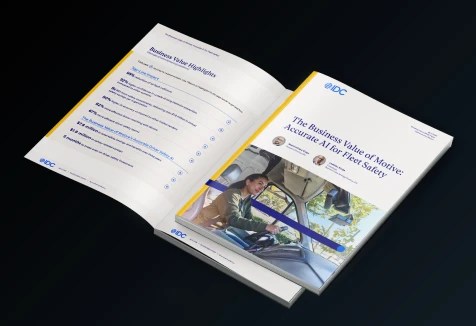
Every organization will have its own specific ROI numbers from fleet and driver safety programs, but indicators point to strong ROI from a blend of factors: fewer collisions and claims, lower insurance rates and legal exposure, operational efficiency savings, and stronger driver retention and culture. In fact, across a three‑year period, the International Data Corporation (IDC) — the premier global analyst firm that helps organizations make technology buying decisions — found an 8x return on safety investments generating more than $1.8M in annual safety‑related savings for the average Motive customer interviewed.
- Motive’s internal data — Estimated based on an internal study of fleets with 150+ active monthly vehicles, in which at least 90% of such vehicles had Dual-Facing AI Dashcams for at least 12 months ↩︎
- Top respondents are the top quartile of customers based on reported ROI outcomes, clearly labeled as such. ↩︎
- Calculated based on top respondents’ average reported annual insurance savings, average fleet
size, industry-standard insurance premium averages, and industry average miles driven per vehicle.
↩︎ - Average business savings across top respondents since adopting the Motive platform.
↩︎ - Average business savings across top respondents since adopting the Motive platform. ↩︎
- Motive’s internal data — Estimated based on an internal study of fleets with 150+ active monthly vehicles, in which at least 90% of such vehicles had Dual-Facing AI Dashcams for at least 12 months ↩︎
- Calculated based on top respondents’ average reported annual insurance savings, average fleet size, industry-standard insurance premium averages, and industry average miles driven per vehicle.
↩︎