
AI in fleet operations has entered a new phase. What started as a focus on AI-powered visibility is now evolving into AI-powered execution. In a recent Motive webinar, operations leaders shared how AI is no longer just helping them understand what’s happening. It’s helping them act on it, faster and at scale.
Turning unsafe behavior into measurable safety outcomes
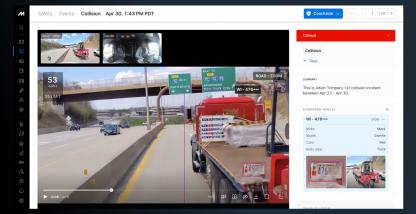
One of the most immediate ways AI delivers ROI is by improving driver behavior in real time. Instead of relying on after-the-fact coaching, AI dash cams like the Motive AI Dashcam Plus detect unsafe driving behaviors, such as speeding and distracted driving, as they happen. Drivers receive instant alerts, allowing them to correct these habits right away.
At CoolSys, Director of Environmental Health and Safety Shawn Martinez has seen how powerful that shift can be. “With the Motive AI Dashcam, the alerts themselves are coaching our drivers, and it’s had the greatest impact on our driver behavior,” said Martinez. That consistent, in-cab feedback reduces reliance on in-person coaching, builds trust in AI, and creates a more uniform safety standard across the organization.
Turning AI-powered visibility into savings
Fewer unsafe driving behaviors lead to safer performance, translating into fewer repairs, more uptime, and lower insurance premiums.
Jonathan Keyes, senior director, Operations Infrastructure at Hawx Smart Pest Control, has seen those savings materialize.
“We’ve reduced $2 million in insurance premiums,” he said. “AI allows us to actually improve and reduce cost, which means better benefits for the company and the employee base. So now we’ve got more revenue coming in and fewer expenditures going out.”
At the same time, Hawx has uncovered hidden costs that were previously difficult to detect. With AI-powered fuel monitoring, fuel discrepancies are surfaced right away.
“We’re getting alerts that say ‘You pumped 19 gallons, but only six went into the tank,’” Keyes said. “That’s a red flag. And then we’re able to actually pull the video footage off the camera, and sure enough, we’re able to see the employee. So we actually terminated multiple people last year because of it.”
Driving efficiency across daily operations
Inefficiencies like excess idling or static routing were often accepted as part of doing business. Hawx uses AI to rethink how work gets done.
“We’re using AI to build a route based upon the employee skill set, what the customer’s needs are, and their availability,” he said. That approach allows operations to adapt routes and scheduling as needed instead of relying on fixed plans.
The result: meaningful efficiency gains. “Through Motive, we’ve reduced our carbon footprint significantly,” notes Keyes. “We’re idling less than 10%.”
Reducing risk through real-time visibility
AI is reshaping how organizations manage risk, providing better insight into what’s happening in the field.
As Keyes said: “We didn’t even know what a fatigue event was until we implemented AI Dashcams.”
With better insight, managers can spot patterns and intervene before incidents occur. When incidents do occur, video evidence provides critical protection. “We were completely exonerated from a claim and handed the footage over to the police,” Keyes said. Objective video evidence helps reduce legal exposure, speed up resolution, and strengthen compliance by surfacing issues that might otherwise go unnoticed.
Developing better leaders through AI
As AI takes on more of the analytical and operational workload, it’s reshaping how leaders spend their time. Instead of navigating problems, managers can focus on coaching and developing their teams. At CoolSys, that shift is already underway.
“Our operations leaders are coaching more than they ever have,” Martinez said.
This creates a more scalable model for leadership, especially in large or distributed organizations. Managers can support more employees, deliver more consistent coaching, and build stronger relationships with their teams.
“They’re becoming far better safety leaders in terms of their relationships with their employees,” Martinez said.
Ultimately, the impact goes beyond performance metrics. “The most important return on investment is that everyone makes it home safely,” he said.
How a unified platform amplifies ROI
While each of these outcomes is valuable on its own, the greatest ROI comes when systems are connected. By bringing together safety, operations, and spend in a single, unified platform, organizations can act on data faster and more consistently.
As AI continues to advance, platforms like the Motive Integrated Operations Platform are extending value even further — enabling organizations to not just see and understand their operations, but to continuously optimize them.
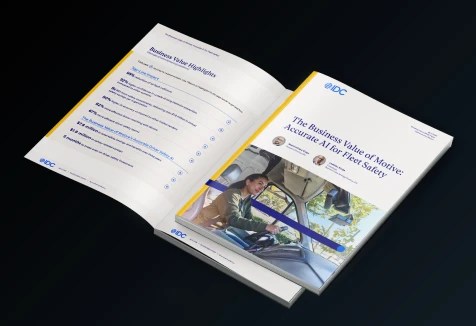
Motive customers report achieving ROI up to 2x faster than with previous providers, with improved safety, lower insurance costs, and significant productivity gains.See what a unified platform can unlock for your organization. Watch the AI trends webinar, then dive into the 2026 ROI Report to see how Motive customers are maximizing value from AI.