

Surprise repairs and reactive fixes add up fast. And while fleet maintenance will always be part of the job, the real cost comes from failing to keep up with service needs.
This guide shows how to get proactive — so you can calculate maintenance costs accurately, stay ahead of unplanned downtime, and spend smarter across your fleet.
Part 1: Calculate costs
To determine how much you’re spending on maintenance by vehicle, sum up the expense bills from that vehicle for the period. We recommend using 12 to 24 months of data. Look at fixed costs (such as regular service, recurring maintenance software costs, and salaries of in-house maintenance staff) and variable costs (such as parts replacement, repair labor, and downtime costs).
Did you know? With Motive, it’s easy to stay on top of maintenance costs with our digital records of service.
Next, you’ll want to calculate your cost-per-mile (CPM) for maintenance. CPM is used to normalize maintenance costs across vehicles, because it helps you compare more accurately even when their mileages are different.
Here’s how to get your CPM by vehicle:
- Add up the total costs for the vehicle, including the fixed and variable maintenance costs for a specific period (monthly, quarterly, annually).
- Apply the CPM formula: Take the total maintenance costs for a vehicle over a specific period, divided by the total mileage of the vehicle during the same period.
Example: If a vehicle had $950 in maintenance costs in a month and drove 2,000 miles, its maintenance CPM would be $950 / 2000 miles = $0.475 per mile.
If possible, review industry benchmarks or peer fleets to see how your costs-per-mile compare. As a baseline, the American Transportation Research Institute (ATRI) reports that the average marginal costs-per-mile for repair and maintenance was $0.198 for 2024.
Part 2: Analyze costs
You can analyze vehicle-specific data or maintenance spending data as a whole to find trends, inefficiencies, and areas for improvement in spending. Use the data to diagnose problem areas. Here you can move beyond the “what” to the “why.” Explore:
- The effectiveness of your maintenance programs. Analyze the relationship between your maintenance schedule and unscheduled repairs. Could you benefit from a preventative maintenance strategy?
- The impact of driver behavior. Connect specific driving patterns to vehicle wear and maintenance needs.
- The efficiency of parts and labor. Analyze maintenance invoices to identify inefficiencies in both the cost and time spent on parts and labor.
- Downtime analysis. While not a direct maintenance expenditure, the cost of vehicle downtime is a hidden maintenance expense.
- Vehicles with excessive maintenance costs. Investigate vehicles with unusually high maintenance costs or a cost-per-mile that continues to climb.
Part 3: Reduce spending
While every fleet has unique needs and you might discover specific ways to cut costs tailored to your operations, there are four strategies that can significantly reduce any fleet’s maintenance costs. By understanding these core solutions, fleet managers can implement changes to improve their bottom line.
Adopt a preventative maintenance strategy
A preventive maintenance strategy uses real-time data and analytics to forecast problems, allowing you to address critical issues before they lead to a breakdown. This approach maximizes vehicle availability and prevents unexpected (and expensive) repairs.
By using Motive to proactively identify necessary repairs before they became critical issues, Duncan Oil slashed vehicle downtime by 50%. Marc Vanco, safety manager at Duncan, said: “If you’re taking your vehicle in for a service and you’re letting them know ahead of time what the fault codes are, then that limits the downtime. Because they already have the parts on hand. Motive’s preventative maintenance has reduced our average vehicle downtime from two days to one day, very easily.”
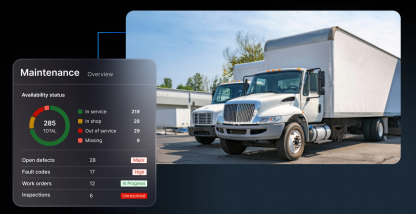
Motive’s fleet maintenance software can track maintenance needs in real time. You’ll be able to:
- Automate maintenance reminders. By using a fleet maintenance software to set up a preventative maintenance schedule and alerts, you can ensure that vehicles and assets are serviced on time and keep moving.
- Schedule data-based maintenance. Customize your maintenance schedules based on real-time data about your vehicle usage.
- Review centralized data. Review comprehensive records of services completed, along with costs, service notes, and service type
By reducing the number of trucks we have out of service, we’re saving $150,000 to $200,000 a year in maintenance costs. That’s another area where we save so much money with Motive.
– Stefan Varagic, founder and president, Cargo Network Solutions
Use telematics data to coach drivers
Certain driving patterns can lead to higher maintenance costs. For example, consistent harsh braking, rapid acceleration, or excessive idling can cause more wear and tear on brakes, tires, and engines. Invest in fleet management software that provides telematics data, so that you can identify unsafe and wasteful driving patterns and use the data to coach your drivers.
For example, at building materials provider Staker Parson, managers noticed that some vehicles needed a surprising amount of maintenance. “We noticed that a vehicle operated by a certain driver was having more events than others,” Telematics Site Champion Cristian Zuniga said. “That vehicle in particular needed tire replacements more often than other vehicles of the same type.”
Without any data to understand the discrepancy, more expensive maintenance was the only solution. Before using Motive, Staker Parson spent about $2 million on equipment repair costs, all because of driving behaviors like harsh braking and harsh acceleration.
With Motive, Staker Parson used real-time data to identify and address the unsafe driving behaviors that were driving up maintenance costs.
Adopt a fleet card program
Many fleets use regular fuel cards to save on fuel, but a fleet card is broader. It allows you to pay for a variety of expenses across your fleet. This way, you can get discounts and rebates when the card is used to pay for maintenance expenses. For example, Motive fleets get discounts on maintenance services at partners like Rush Truck Centers, Discount Tire, and Motive Roadside Assistance. They can see impressive returns from the Motive Card: up to 2.5% from cashback and rebates, a potential 5% back from fraud reduction, another 5% by capturing missed savings, and up to 7% in productivity gains.
Adopt an integrated operations system.
Too many fleets operate with disjointed technology and miss opportunities to align and save. An integrated operations platform like Motive lets you manage your maintenance, safety, and operations in one place. And it works to cut costs: Motive customers surveyed reported 20% lower maintenance costs per year and 62% less equipment downtime. By pinpointing the exact maintenance issue with detailed fault code alerts, tracking time out of service, and capturing defect severity, they can actively optimize operations.
It could work like this. When a fault code comes up on a vehicle, Motive’s CMMS integrations automatically transmit that code to your CMMS. You can prioritize the issue if it’s severe, mark the vehicle as out of service, and check off when a fix is completed in the system. Dispatchers can see defects and work with maintenance on what to prioritize.
Motive’s vehicle diagnostics gives us insight into what malfunctioned in the truck in real time. If it’s something my team can fix, I can avoid paying $3,000 for a tech to head out or $15,000 for a tow truck.
– Brian Adelman, Roadco Transportation Services
Take control of fleet maintenance costs
The physical economy runs on tight margins, and rising costs for fuel, insurance, and maintenance make things even tougher. By calculating and analyzing fleet maintenance costs, you get the clear view you need to reduce them. With the right cost-cutting strategies, you can make sure maintenance costs are right where they should be.
Take a proactive fleet maintenance strategy with Motive. Watch a demo