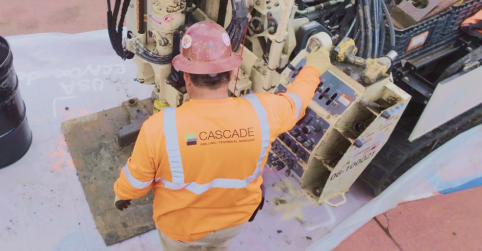



Most AI products are designed to live comfortably in the cloud — assuming stable high-speed Wi-Fi, low latency, and a user sitting patiently at a desk looking at a screen.
Building Physical AI is an entirely different discipline.
At Motive, our technology operates inside moving trucks, construction vehicles, and heavy equipment, often in remote areas with spotty connectivity. Our users are drivers, field workers, and fleet managers who don’t have time to navigate complex dashboards while operating machinery. Getting AI wrong doesn’t just mean a bad software recommendation — it can mean a missed critical safety moment.
We sat down with Sean, who leads Motive’s AI Platform product team, to discuss how his team builds voice assistants, agentic workflows, and edge infrastructure that power real-time decisions where it matters most: in the field.
Bringing Physical AI to the field: Atlas Voice and AI Agents
Sean’s team owns Atlas, Agents, Analytics, Documents, and Labs, alongside the core platform infrastructure that powers Motive’s AI capabilities.
To solve real-world operational challenges, his team focuses heavily on bridging edge hardware with autonomous cloud systems:
- Atlas Voice: A wake-word and natural language pipeline running directly on the AI Dashcam and edge devices. It gives field workers a hands-free assistant capable of operating in noisy, moving equipment without requiring a screen.
- Motive AI Agents: An autonomous system that closes the loop on real-time data. It turns incoming telematics and safety events into automated action without needing human intervention at every step.
“Most AI products assume someone is sitting at a desk. Ours has to work inside moving trucks for people who can’t stop what they’re doing to look at a screen. Voice and automation aren’t nice extras for us—they’re the only way the product actually works in the real world.”
— Sean Santschi, Product Lead — AI Platform
From insight to action: Real-time fleet safety in the field
A major milestone for Sean’s team was the recent rollout of Agents and Live Two-Way Calling.
Historically, fleet management relied on post-event review — analyzing reports hours or days after a driver experienced a harsh braking incident, speeding event, or vehicle anomaly. The new release changes that paradigm entirely by enabling fleet managers to see and speak with drivers in real time, while allowing AI Agents to take immediate action the second a safety threshold is crossed.
Building a system that functions reliably in unpredictable environments presented steep technical challenges:
- Edge-to-cloud latency: Optimizing Atlas Voice to respond instantly—even before establishing a full cloud connection — ensuring the user experience never feels laggy in low-coverage zones.
- Acoustic noise reduction: Training voice models to parse speech in high-decibel environments (cab rumble, highway wind, industrial equipment) and accommodate natural human speech pauses.
- Uncertainty management: Designing AI models with strict confidence thresholds so the system knows precisely when to execute an automated action versus when to hand control back to a human.
Accuracy as a promise: Engineering for customer trust
When customers rely on Motive for Fleet Safety, Driver Coaching, and Fleet Maintenance, AI precision is paramount.
Sean’s team approaches accuracy not as a checklist metric, but as a commitment to customer safety:
- Know your limits: If an AI model is confident, it acts. If it falls below a strict confidence threshold, it explicitly states its uncertainty and hands the decision back to an operator.
- Field-first validation: Validation isn’t confined to lab simulations. Engineering teams test hardware and models in real vehicles under actual driving conditions. Sean even runs Motive hardware directly in his personal vehicle for daily real-world testing.
- Full auditability: Every action taken by a Motive AI Agent is logged with complete visibility, ensuring fleet managers know exactly what decision was made and why.
“For us, accuracy isn’t a metric we check off—it’s a promise we make to every customer who trusts us with their safety and operations. Every AI feature we build knows its own limits.” — Sean, Director of Product at Motive
Why engineers choose Motive
Building Physical AI requires solving hardware-software constraints that digital-only SaaS products never encounter. For engineers looking to tackle high-stakes, real-world problems, Motive offers a unique environment:
- Cross-disciplinary collaboration: Engineering at Motive brings together firmware, edge computing, computer vision, and cloud infrastructure to solve physical-world challenges.
- Rapid prototyping: An internal framework allows product and engineering teams to prototype new AI workflows, validate real customer value, and iterate rapidly before full-scale deployment.
- Tangible impact: Code shipped at Motive directly impacts driver safety, vehicle efficiency, and physical supply chain operations globally.
Looking ahead: The future of unified Physical AI
The long-term vision for Motive’s AI Platform is a single, unified intelligence layer spanning voice, chat, and autonomous action — where an insight generated in a manager’s dashboard can instantly trigger an action on behalf of a driver in the field.
Whether it’s voice-activated coaching, instant document processing, or automated fleet maintenance workflows, the goal remains the same: surfacing the right insight immediately so operations run safer and faster.
Interested in building Physical AI that operates in the real world?
Explore open engineering and product roles on our Careers Page.