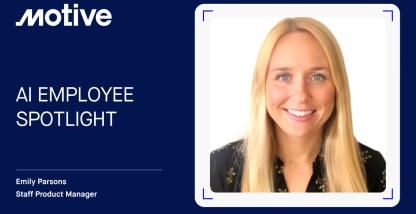
Meet the product manager behind Motive MCP, helping keep AI accurate.
At Motive, building AI isn’t just about training large models on static web text or designing slick interfaces for a desktop screen. It’s about solving hard, real-world problems for physical operations — connecting data signals from moving vehicles, heavy equipment, and frontline workers directly to intelligent, automated action.
In this edition of our Team Member Spotlight series, we chat with Siva Thota, Product Manager on the Customer & AI Platform team to explore how Motive is making fleet data programmable, opening up rapid experimentation through Motive Labs, and pioneering automated evaluations to maintain high AI accuracy in unpredictable environments.
What is your role at Motive, and how does your team apply Physical AI to your focus area?
I am a Product Manager on the Customer & AI Platform team at Motive, focused on building AI-first platform capabilities that make physical operations data more useful and actionable. My team works at the intersection of Physical AI and product infrastructure, connecting real-time data from vehicles, drivers, and equipment to AI experiences that can answer questions, surface risks, and trigger workflows.
Through products such as Motive Model Context Protocol (MCP) and Motive Labs, we are making that intelligence securely accessible to AI assistants, internal teams, and customers so they can move from insight to action faster. The goal is not simply to display data, but to help fleet and operations teams make better decisions in the moment, improving safety, productivity, and profitability. We’re helping make fleet data programmable and product experimentation faster without compromising accuracy, security, or trust.
What are some recent platform capabilities you’ve helped launch, and what technical hurdles did you overcome?
Motive MCP, which I launched last month, lets non-technical builders and users query their Motive fleet data directly through AI instead of needing engineering support. It’s already helping automate repeated jobs that used to require manual data pulls or custom reports. The hardest technical problem wasn’t any single tool — it was consolidation: taking a sprawling set of endpoints and building tools for them in a way that stayed fast and reliable for the customer instead of turning into a slow, bloated catalog as more capabilities were added.
Separately, I also worked on the Motive Labs beta launch this month, which presented its own distinct set of technical challenges around scaling a shared experimentation platform across multiple global regions.
Physical AI operates in complex, real-world conditions. How do you maintain high AI accuracy and security across edge cases?
In Motive Labs, the “unpredictable environment” isn’t just a sensor or a camera — it’s AI-built apps hitting real, live fleet data across US, EU, and CA regions with no dry run. Builders use AI agents to “vibe-code” these apps, which means the accuracy risk isn’t just a model drifting; it’s an AI agent shipping something that mishandles real customer data — like a wrong region config, unbounded API pagination, an exposed credential, or an edge case a builder never tested for.
We solved this by building verification directly into the development process rather than relying on manual review. Every app has to run through an automated security scan and a QA skill before it can publish. It specifically checks authentication, loading and error states, region handling, and API call frequency. Any finding must be fixed or explicitly flagged before proceeding. The accuracy bar isn’t enforced by a person reading code; it’s enforced by the same skill every builder is required to run, letting us open this up to non-engineers without accuracy becoming a gamble.
“Most AI teams are optimizing for a screen. Ours has to work on a truck sitting at a loading dock in Texas heat, a driver on a mountain road with no signal, or a trailer crossing three regulatory jurisdictions in one shift.”
— Siva Thota, Product Manager, Motive Customer & AI Platform team
How does your team ensure customers can trust Motive AI for real-time operational decisions?
Trust starts with treating this as a rigorous testing problem, not a hope. We’re actively investing in end-to-end reliability: we’ve built automated evaluations directly into how MCP ships, so every change gets tested against real usage patterns before and after release. Using AI-driven evaluation to test AI-driven tools has been a genuine game changer for catching issues that manual review would miss. Automated evals are how we help ensure the system our customers depend on for real-time decisions and safety alerts keeps getting more reliable over time.
What makes building Physical AI at Motive unique compared to traditional SaaS or digital-only AI teams?
A digital-only product can fail quietly and get patched next sprint. Ours can’t, because our output isn’t just a recommendation someone reads later—it’s something that has to hold up in the actual physical world a fleet operates in, right now, with all the noise and edge cases that come with real trucks on real roads.
What excites me most is the feedback loop. As a Product Manager here, the distance between an idea and seeing it change how a real fleet operates is shorter than almost anywhere else. I’ve taken capabilities from a whiteboard idea to a customer using it in weeks—not because we cut corners, but because the data, the APIs, and the infrastructure to build on real fleet operations already exist and are ready to deploy.
Building AI that’s accurate enough to be trusted with real-world decisions—where efficiency gains directly translate into safer roads—is the most rewarding part of this job, by a wide margin.
Join the team building Physical AI
Want to build technology that impacts the physical world and transforms how fleets operate every day? Check out our open engineering and product roles on theMotive Careers Site.