

Fleet maintenance managers stay on top of preventive maintenance by turning scattered signals into one repeatable process. They centralize schedules, standardize inspections, use telematics to prioritize issues, assign repair ownership, and keep service records in one system.
For organizations with hundreds of vehicles, the goal is to identify issues early and move each repair from detection to resolution without losing information between teams.
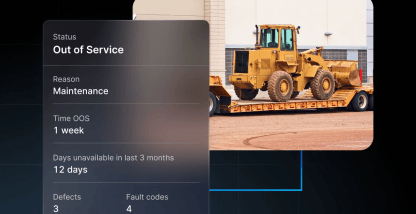
Motive Maintenance supports this workflow within Motive’s Integrated Operations Platform. It connects inspection defects, scheduled services, vehicle data, fault codes, work orders, inventory, and maintenance history in one view. Because maintenance data sits alongside the broader operation, teams can connect vehicle and asset health with availability, repair status, and cost information.
For maintenance teams, this creates a practical rhythm: review the fleet, act on the highest-risk issue, plan the work, and verify the outcome. For operations leaders, it connects maintenance activity with the vehicles available for work.
This can help teams scale preventive maintenance with less reliance on manual tracking across disconnected systems.
Why is reactive maintenance costing your fleet?
Reactive maintenance can create cost because teams wait for a vehicle to fail or a warning to become urgent. Preventive maintenance plans service before failure using time, mileage, engine hours, inspections, and vehicle-health signals.
Reactive work also creates scheduling risk. A small defect can become a larger repair, and an emergency may arrive when the shop is full or a replacement unit is unavailable. Siloed tools can hide who owns the next step and how long a vehicle has been out of service.
How can fleet maintenance managers reduce unplanned downtime?
Five steps connect maintenance signals to completed work.
1. How to centralize PM schedules
Fleet maintenance managers should create one schedule for recurring services and trigger reminders from the data that best reflects vehicle use: calendar time, mileage, engine hours, or a combination.
Group vehicles by type and duty cycle. Define the interval, warning window, owner, and completion rule. The schedule should answer three questions: What is due, which vehicle is affected, and who owns the next step?
2. How to standardize inspections and defect reporting
Standardized digital inspections can help capture consistent information before a defect becomes a roadside failure. Forms should reflect vehicle types and give drivers a simple workflow in the Motive Driver App.
Define inspection parts, required information, defect severity, and photo or signature requirements. Every defect should be resolved, deferred with a reason, or tied to an out-of-service decision. Keep each defect visible until repaired.
3. How telematics help prioritize vehicle health issues
Telematics helps maintenance teams move from a long list of vehicles to a ranked list of issues.
Mileage, engine hours, fuel data, and diagnostic trouble codes add context to inspections and scheduled service.
A severe defect, active fault code, or vehicle already out of service may require immediate action. Teams can coordinate planned service with operations. The goal is to give a maintenance manager enough context to decide what needs attention first.
4. How to assign accountability for every repair
A maintenance signal needs an owner, due date, and visible status. Fleet maintenance supervisors can assign each issue to an internal technician, maintenance group, or third-party shop and define what “complete” means.
Use this workflow:
- Capture the defect, diagnostic, or PM trigger.
- Review severity and vehicle availability.
- Create or assign the work order.
- Set the shop, technician, schedule, and due date.
- Track progress through open, in progress, waiting for part, and complete.
- Confirm the repair and return the vehicle to service when appropriate.
5. How to track parts, service history, and repair status together
A complete record connects the issue, work performed, parts used, cost, and availability status. Without a complete record, teams repeat diagnostics and miss warranty information.
For in-house maintenance, track parts across locations, reserve stock for open work orders, and set alerts for critical inventory levels. For outsourced repairs, share a standardized work order and capture the result in service history.
Keep findings, fault codes, service dates, work-order status, parts, labor, invoices, warranties, and out-of-service time in one record.
How do you build accountability across your maintenance team?
Accountability improves when managers review the same measures weekly: overdue PM, unresolved defects, open work orders, parts delays, and recurring issues.
Track measures tied to uptime and cost:
- PM completion rate by due date.
- Overdue services and unresolved defects.
- Time from issue detection to work-order creation.
- Time from work-order creation to completion.
- Vehicle hours or days out of service.
- Repeat repairs by vehicle, component, or shop.
- Maintenance cost per mile, hour, vehicle, or asset.
Use the measures to trigger procurement, deeper diagnosis, or schedule changes.
What to look for in fleet maintenance software
Fleet maintenance software should connect the full maintenance lifecycle, not just create reminders.
| Capability | What to evaluate | Why it matters |
| Scheduling | Time, mileage, and engine-hour triggers; recurring service; alerts | Keeps PM planned around actual use |
| Diagnostics | Fault-code visibility, severity, vehicle-health context | Helps teams prioritize issues |
| Work orders | Creation, assignments, statuses, vendor sharing | Moves repairs from signal to completion |
| Inventory | Multi-location stock, reservations, thresholds | Helps reduce parts-related delays |
| Reporting | PM completion, downtime, cost, repeat repairs, total cost of ownership (TCO) | Turns maintenance activity into decisions |
| Integrations | Telematics, OEM, computerized maintenance management system (CMMS), shop, and accounting connections | Reduces rekeying and preserves continuity |
Motive Maintenance connects vehicle and asset health with inspections, scheduled maintenance, work orders, parts and inventory, service history, warranties, and cost visibility. Confirm feature availability, configuration, and integrations for your fleet before choosing a system.
How telematics supports a more proactive maintenance program
Predictive maintenance is often described as the next step after preventive maintenance. In practice, teams get there by first building reliable inspection and service processes, then using vehicle-health data to improve maintenance timing and prioritization.
A practical progression is:
- Standardize inspection and service data.
- Set PM schedules using time, mileage, and engine hours.
- Add fault codes and vehicle-health signals to daily triage.
- Compare repairs, downtime, usage, and cost by vehicle or asset.
- Adjust service plans when data shows recurring failures or changing duty cycles.
Motive Maintenance supports this progression by bringing inspection defects, scheduled services, fault codes, vehicle availability, and maintenance workflows into a connected view. This helps maintenance teams decide what needs attention first, move issues into the right repair workflow, and build a more proactive maintenance program over time.
Stay ahead of PM with Motive
Fleet maintenance managers stay ahead of PM with a connected process: schedule, capture, prioritize, assign, repair, and measure.
Explore Motive Maintenance to see how it can reduce manual handoffs and support uptime.
Frequently asked questions
What does a fleet maintenance manager do?
A fleet maintenance manager plans preventive maintenance, monitors vehicle health, coordinates repairs, manages shop resources, and tracks uptime, costs, and service history.
What is the difference between preventive and predictive maintenance?
Preventive maintenance schedules service before failure using time, mileage, or engine hours. Predictive maintenance adds condition data to anticipate which assets may need attention.
What should fleet maintenance software include?
Fleet maintenance software should include PM scheduling, inspections, diagnostics, work orders, parts and inventory, service history, reporting, and relevant integrations.
Can telematics replace a preventive maintenance program?
No. Telematics provides vehicle-health signals, but teams still need policies, inspections, owners, and a repair workflow.
How can Motive Maintenance help fleet managers succeed?
Motive Maintenance helps fleet managers move from reactive repairs to proactive maintenance by bringing vehicle and asset health, inspections, fault codes, service schedules, work orders, and maintenance costs into one connected system. Managers can identify issues earlier, prioritize and track repairs, reduce manual work, and make data-backed decisions that help improve uptime, control maintenance spend, and keep assets ready for work.