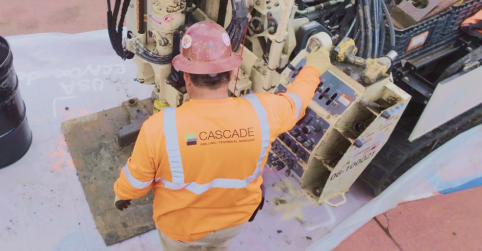



Field service leaders do not need to be sold on the idea that the job is getting harder. Costs are climbing, skilled labor is scarce, and customers expect faster, more reliable service than ever. What they need to know is whether artificial intelligence can actually do something about it, or whether it is one more expense that promises more than it delivers.
Evidence points clearly to the first answer. When Motive surveyed field service operations for its 2026 research, three challenges rose above the rest: 95% cited rising costs as a top concern, 53% said inefficiency and manual work were holding them back, and 84% named safety and accident prevention a top priority. AI is being applied directly against all three, and the results are measured rather than promised.
Here is how field service fleets are using AI to solve their three biggest problems, and what those results look like.
What are the top three challenges AI helps field service fleets solve?
The top three challenges AI helps field service fleets solve are:
- Rising operating cost
- Inefficiency and manual work
- Worker safety
AI addresses each through a specific capability: it controls spending by catching fuel waste and fraud automatically, it eliminates manual work by automating dispatch, coaching, and reporting, and it prevents accidents by detecting and correcting risky driving in real time. According to Motive’s 2026 ROI Report, field-service respondents reported reclaiming 24 hours per week, while top respondents to the survey who adopted the Motive platform reported average savings of $1 million per organization. The report found that when respondents considered time-to-ROI, Motive customers reached ROI in an average of 5.3 months1.
Challenge 1: Rising operating costs
Cost is the challenge field service leaders feel most acutely, named by 95% of operations. Fuel, maintenance, and insurance all move in the wrong direction, and the traditional tools for controlling them react too slowly to help. A fuel-card statement that arrives weeks after the fuel was burned cannot stop the waste that already happened.
AI changes the timing. Instead of reviewing spend after the fact, connected spend and fuel tools flag anomalies as they occur, catch fraudulent charges, surface available fuel discounts, and pinpoint the idling and inefficient routing that quietly add up every day. Hawx Smart Pest Control put these tools to work across its service fleet and saved roughly $21,000 a year in fuel costs alone by acting on idle and routing data it could finally see in one place. For an operation watching every dollar, catching that waste as it happens is the difference between a lean year and a healthy one.
Challenge 2: Inefficiency and manual work
More than half of interviewed field service operations, 53%, say inefficiency and manual work are holding them back, according to Motive’s 2026 ROI Report. The culprit is familiar: dispatchers coordinating by phone, technicians filling out paper work orders, and office staff re-entering data across disconnected systems. Each handoff can add time and create opportunities for error, making the process harder to scale as the operation grows.
AI removes the busywork. Automated dispatch assigns jobs to the closest available technician and reroutes in real time. AI-generated reports replace hours of manual assembly. Automated coaching workflows flag the driver behaviors that matter without a manager reviewing every trip.
The time this returns is substantial: field-service respondents interviewed for the ROI report documented an average of 24 hours per week reclaimed with Motive. In leaner operations, that additional capacity could give owners and office managers more time for billing, scheduling, customer response and other work that supports growth. That is how efficiency turns into growth rather than just relief.
Challenge 3: Worker safety
More than 80% of field-services respondents identified safety and accident prevention as a top priority, according to Motive’s 2026 ROI Report. That concern is especially relevant for crews that spend their days driving between jobs and working at uncontrolled sites. Depending on the incident, the impact can reach beyond the incident itself to insurance premiums, legal exposure, vehicle downtime, and workforce continuity.
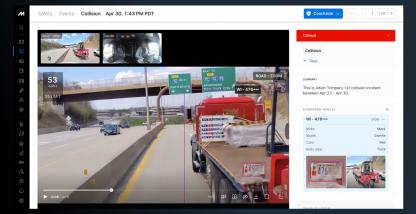
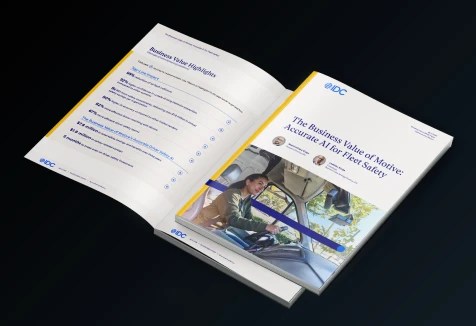
This is where the results are clearest. AI safety systems detect risky behaviors such as distracted or drowsy driving and coach the technician in the moment, before a near-miss becomes a collision. An independent 2026 IDC Business Value study interviewed six Motive customers who reported an average 95% reduction in at-fault collisions. Based on IDC’s three-year financial model using customer-reported costs and benefits, the organizations achieved an estimated eightfold return on safety investment, $1.8 million in average annual safety-related savings, and a five-month payback. In comparative trials, the organizations indicated Motive’s AI was 50% more accurate than other trialed solutions on average, and reported 82% more effective driver coaching with Motive.
Field service operators see that prevention in their own numbers. CoolSys, which runs a large refrigeration and HVAC service fleet, cut at-fault collisions by 25% after deploying connected safety tools. Fewer collisions mean lower premiums, fewer trucks in the shop, and fewer crews sidelined, which is why safety improvements land on the bottom line as directly as any cost-cutting measure.
Bringing it together for the evaluation
The three challenges are not separate problems. The same unified platform that catches fuel fraud also automates the dispatch that reduces distracted driving and captures the safety data that lowers insurance costs, bringing safety, operations, and finance into a single system. Solving one challenge in isolation leaves money on the table. Solving all three on one unified AI platform is what produces the compounding return that shows up in the IDC findings.
For an operation evaluating its options, the practical test is whether a solution addresses cost, efficiency, and safety together, with proof behind each. The results above come from real field service fleets, at a range of sizes, measured by independent research rather than vendor claims. That is the bar worth holding any AI investment to.
See what AI can do for your operation
The fastest way to know whether AI will move your numbers is to see it against your own operation. Review the independent IDC study on Motive’s AI ROI for the full results.
- Out of the surveyed respondents who responded to questions about the number of months it takes to begin seeing return on investment (ROI) after adopting Motive vs. after adopting their previous provider, Motive averaged such respondents’ answers and calculated the average difference in time to begin seeing ROI (“time to value”). The reported results reflect the average across all respondents, not top respondents. ↩︎