

In an era of rising insurance premiums and driver shortages, punitive measures are no longer enough. More organizations are turning to driver incentive programs to recognize strong performance, reinforce safer habits, and build trust with drivers.
A fleet safety incentive program transforms telematics and AI-powered dash cam data into a fair, transparent safety score. This shifts culture away from a Big Brother mindset toward a professional, recognition-first approach. By rewarding excellence rather than just penalizing mistakes, organizations with fleets can see four critical results:
- Lower risk: Fewer collisions and FMCSA violations.
- Higher retention: Drivers stay where they feel recognized.
- Reduced costs: Lower insurance premiums and maintenance.
- Stronger culture: Safety becomes a shared, competitive goal.
With Motive’s AI-powered Integrated Operations Platform, safety, operations, and finance teams can use the Motive Safety Score and Driver Rewards together to make work safer, more productive, and more profitable.
Why driver incentive programs matter
A driver incentive program is more than a morale initiative. It can become an operating system for recognition, accountability, and continuous improvement.
1. It gives drivers a clear reason to improve
Drivers respond better when expectations are visible and progress is measurable. A well-designed program makes it easy to see which behaviors are rewarded, how points are earned, and what actions will help performance over time.
2. It helps build trust in your safety program
Trust matters. If drivers believe scoring is inconsistent or unfair, participation drops. Objective data, consistent rules, and visibility into performance help teams move away from a “gotcha” culture and toward a recognition-first mindset.
3. It supports retention and engagement
Recognition matters, especially in high-turnover environments. Driver incentive programs give organizations a structured way to reward drivers for doing the right thing consistently, not just for avoiding the worst outcomes.
4. It turns performance data into action
The best programs do more than report on driver behavior. They make that data useful. Instead of tracking performance in spreadsheets and announcing winners manually, teams can run repeatable programs that motivate action every day
How to design a successful driver rewards program
A successful driver recognition program is built on objective data, not guesswork. To move from a basic perks plan to a high-performance system, follow these Motive-backed best practices:
Start with strategic goals
Don’t just reward “good driving.” Tie incentives to specific, measurable behaviors like reducing cell phone use, improving following distance, or eliminating hard braking. Ensure your program is part of a broader safety culture that includes proper training and equipment maintenance.
Use the Safety Score as your backbone
The Motive Safety Score acts as the backbone of your program by providing a single, stable metric that supports every reward decision. By automatically calculating over 15 distinct driving behaviors, it replaces subjective guesswork with a fair and transparent foundation.
Here is how the score provides the essential structure for your rewards:
- Thresholds: Require a minimum score to qualify for any rewards.
- Tiered rewards: Offer escalating bonuses for higher score ranges.
- Operational layering: Add points for clean Driver-Vehicle Inspection Reports (DVIRs) and Hours of Service (HOS) compliance to reward professional consistency.
Keep rules simple
Complexity kills engagement. If a driver can’t explain how they earned their bonus in two sentences, the program is too complicated. Clear rules and easy-to-understand rewards ensure the program stays sustainable and scalable.
Reward improvement, not just perfection
Top performers should be recognized, but progress matters too. Programs that reward improvement help middle-tier drivers stay engaged instead of feeling like the same few winners will always come out on top.
Make recognition visible
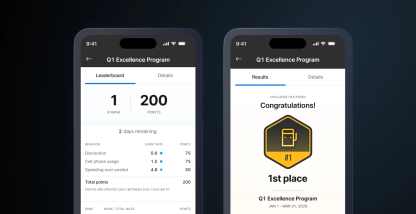
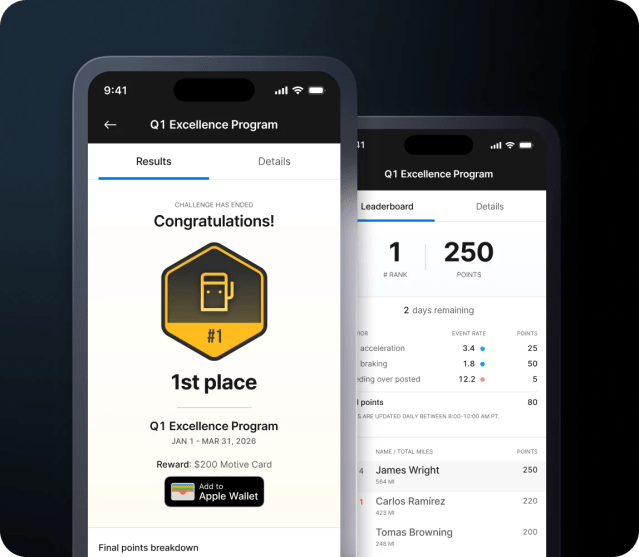
Recognition works best when it is timely and easy to see. Leaderboards, badges, challenge standings, and team-based competitions all help turn performance into momentum.
Five gamified driver incentive program patterns to try
Gamification turns safety into a structured, competitive challenge drivers are motivated to participate in. By incorporating these patterns into your gamified driver incentive programs, you maintain high engagement year-round.
To provide a clear comparison of gamified driver incentive programs, the following breakdown categorizes common patterns by their primary strategic objectives and reward structures.
| Incentive Pattern | Best For… | Example Reward |
| Threshold bonuses | Consistent baseline safety | Offer a monthly bonus for staying above a clear bar, such as rewards or prizes for keeping a Safety Score above 90. |
| Champion awards | Top-tier performers | Recognize “Champions” who are location-based or “Regional Winners.” Higher-tier rewards for top performers create a sense of elite status. |
| Micro-rewards | Immediate engagement | Offer immediate spot rewards like gift cards or company swag for a perfect 100 Safety Score or a week of zero violations. |
| Progress incentives | Middle-tier improvement | Reward the “Most Improved,” not just top veterans. Recognizing a jump from a Fair to Good score keeps middle-tier drivers motivated to climb. |
| Team competitions | Collective accountability | Create team rewards like catered lunches or charity donations foster collective accountability and peer coaching. |
What is the real-world impact of a driver incentive program?
The real-world impact of a driver incentive program can include up to a 70% improvement in safety scores, fewer insurance claims, and gains in driver retention, based on results from Motive customers. Motive customers across industries have used Safety Scores to drive massive improvements:
- Hawx Smart Pest Control: Launched the “Hawx Safety Guardians” program, using Motive AI Dashcam data to award monthly cash prizes to top-performing drivers and teams.
- FusionSite: This enterprise fleet built a tiered driver rewards program where high Safety Scores became a primary topic of conversation, leading to dramatic reductions in unsafe events and improved driver retention.
- Agmark: A smaller fleet that mastered “quick wins.” They offer gift cards and gear whenever a driver hits a perfect Safety Score of 100, relying on peer-to-peer pride to maintain a safe culture.
These stories highlight a clear pattern where recognizing drivers for their skills leads to better performance, higher retention, and safer driving.
How to manage a driver rewards program — without adding more admin work
The manual work of tracking scores in spreadsheets is often what kills a fleet driver incentive program. To solve this, Motive Driver Rewards, a Workforce Management feature, productizes the entire process and lets fleets run automated, highly engaging challenges directly through the Motive platform.
Choose one program goal
Pick one primary outcome for the first rollout, such as safer driving behavior, better compliance, stronger fuel habits, or more consistent adoption of a company process.
Limit the number of tracked behaviors
A focused program is easier to explain and easier to trust. Start with a few high-value metrics instead of trying to reward everything at once.
Make rewards meaningful
Rewards do not have to be huge, but they should feel relevant. Public recognition, digital badges, gift cards, merchandise, and team prizes can all work when they match your culture.
Show drivers how they are doing
A recognition program should never feel mysterious. Drivers should be able to understand where they stand, what they have earned, and what they can do to improve.
Review and refine over time
Once the program is live, look at participation, score distribution, and manager feedback. Then adjust the rules, challenge structure, or reward mix based on what is driving engagement.
Build a culture of recognition, not just enforcement
The strongest driver incentive programs help organizations recognize what good performance looks like and repeat it. They give drivers more visibility, create more consistency for managers, and make recognition part of the operating rhythm.
That is where Motive Driver Rewards fits. It gives teams a way to turn performance data into challenges, recognition, and rewards without building a manual process around spreadsheets and one-off updates.
If your goal is to create a more engaging driver recognition program, the right system should make rewards easier to run, easier to trust, and easier to scale.
Frequently Asked Questions
What is a driver incentive program?
A driver incentive program is a structured program that rewards drivers for target behaviors such as safe driving, compliance, fuel efficiency, or other operational goals. The best programs use objective data and clear rules so drivers understand how rewards are earned.
How do you measure the success of a driver safety incentive program?
Success is measured by a reduction in FMCSA-reportable crashes, lower insurance claims, and an increase in fleet-wide Safety Scores. Additionally, many fleets see improved driver retention rates as a direct result of these programs.
How do you implement a gamified driver incentive program?
To implement gamification, use a telematics platform to create a leaderboard based on objective metrics like Safety Scores. Incorporate “prizes” for top performers, “milestone badges” for progress, and “team challenges” between different terminals to foster healthy competition and social accountability.
Does a driver incentive program really improve safety?
Yes. Fleets using Motive’s AI-powered incentive structures have seen up to a 70% improvement in safety scores within months. By focusing on rewards instead of punishments, drivers are proactively motivated to eliminate behaviors like cell phone distraction and close following before they lead to collisions.
Can you run a driver rewards program without manual tracking?
Yes. Modern solutions like Motive Driver Rewards automate the process by pulling data directly from AI dash cams and ELDs. This allows fleet managers to set challenge parameters — such as timeframes and point values — while the system automatically tracks rankings and assigns digital badges to drivers.