

Getting a Department of Transportation (DOT) violation from a roadside inspection is serious, but the seriousness ranges by type of violation and the motor carrier’s history of violations.
Learn more about what happens when you get a DOT violation, and a list of common inspection violations the Federal Motor Carrier Safety Administration (FMCSA) looks for.
What is a DOT violation?
A DOT violation occurs when a driver or motor carrier fails to comply with any of the Federal Motor Carrier Safety Regulations (FMCSRs). The FMCSA’s compliance categories (updated from the previous methodology called BASIC) supply the standards that motor carriers must meet. When the vehicle or driver doesn’t meet a standard, a violation is given. These violations are primarily identified during roadside inspections, but can also be found during safety audits, compliance reviews, or collision investigations.
Getting pulled over for a roadside inspection is largely based on a motor carrier’s safety history. The FMCSA uses an Inspection Selection System (ISS) score to decide whether a passing commercial motor vehicle should be inspected. As systems get more automated, the FMCSA is testing a process where they can identify vehicles for inspection electronically or even find violations by scanning them as they drive by.
5 steps that happen if you get a roadside DOT violation
These five steps happen when a federal DOT violation is found during a roadside inspection:
- Report. The inspector identifies the violation and records the specific code in an inspection report.
- Decision. The inspector determines if a violation warrants an out-of-service (OOS) status based on the CVSA North American Standard Out-of-Service Criteria. These are categorized into vehicle and driver violations:
Vehicle OOS: If a vehicle is placed OOS (for example, for faulty brakes), it can’t be driven until the mechanical issue is repaired.
Driver OOS: If a driver is placed OOS (for example, for Hours of Service or English language proficiency), that specific individual is prohibited from operating any CMV. - Resolution. If a violation does not meet the OOS threshold, the vehicle may be driven away, but the carrier is legally required to correct all cited violations before the next dispatch. Regardless of OOS status, the carrier must sign and return the inspection report within 15 days, certifying that all repairs or corrective actions were completed.
- Score. The violation data flows into FMCSA’s system, the Motor Carrier Management Information System (MCMIS). The Safety Measurement System (SMS) uses that data to calculate Compliance Safety and Accountability (CSA) measures and percentiles for each compliance category for the carrier.
- Intervention. When a compliance category percentile goes above the FMCSA’s intervention threshold, the carrier can be targeted for actions, which could include: a warning letter, more focused roadside inspections, offsite investigations, onsite focused or comprehensive reviews, and in more serious cases, a Notice of Claim (a civil penalty). See the FMCSA’s list of maximum monetary penalties.
This process is for federal DOT violations. States may have their own procedures.
6 categories of DOT violations
Commercial carriers and their drivers should be aware of the potential violations below, grouped by six of the FMCSA’s new compliance categories.
1. Unsafe driving
These DOT violations are given for dangerous driving behaviors.
Common violations include:
- Speeding. The FMCSA increases the severity of the violation based on how many miles per hour over the posted speed limit the driver was going.
- Distracted driving. Texting or using a handheld device while operating a commercial motor vehicle.
- Reckless driving. Following too closely, improper lane changes, or failing to yield.
This category now includes drug and alcohol violations and continuing to operate while under an OOS order.
2. Vehicle maintenance: Driver observed
These DOT violations focus on defects that a driver should have caught during a routine pre-trip or post-trip walk-around. The FMCSA separated this category from vehicle maintenance to distinguish between mechanical failures and simple items that should have been caught and fixed before the vehicle departed. Common violations include:
- Inoperable lights. Headlights, turn signals, and brake lights that aren’t working.
- Tire issues. Visibly flat tires, audible air leaks, or bald tread.
- Emergency equipment. A missing or discharged fire extinguisher and missing reflective triangles.
- Cargo securement. Loose straps, open doors, or unsecured loads visible from the outside.
High scores indicate to the FMCSA that DVIRs are not prioritized by the carrier and its drivers.
3. Vehicle maintenance
This maintenance category is about the quality of your maintenance program. These violations focus on the complex, internal systems that usually require a mechanic to identify. Common violations include:
- Brake systems. Brakes out of adjustment, contaminated linings, or leaking air chambers.
- Suspension. Cracked leaf springs, broken U-bolts, or worn bushings.
- Frame and fuel. Structural cracks in the frame or fuel tank leaks.
- Exhaust. Leaks that could allow dangerous fumes into the cab.
This category tells the DOT how well a carrier’s maintenance program is working. While a driver may miss a suspension problem, a maintenance team shouldn’t. Persistent violations here suggest that vehicles may be running too many miles between professional inspections.
4. Hours of Service (HOS) compliance
Fatigue is a leading cause of large truck collisions. This compliance category tracks whether drivers are getting enough rest and whether records — typically from an electronic logging device (ELD) — are accurate.
Common violations include:
- Driving over limits. Exceeding the 11-hour driving limit or the 14-hour on-duty window.
- Rest break violations. Failing to take the mandatory 30-minute break after eight cumulative hours of driving.
- Log falsification. Intentionally editing logs or using multiple ELD accounts to hide driving time.
- ELD non-compliance. Operating with a device that isn’t on the FMCSA’s approved registry or failing to transfer data to an inspector.
Penalties for HOS violations are expensive. A standard non-recordkeeping violation can now cost a carrier up to $19,246, while knowingly falsifying HOS records can trigger a fine of $15,846 per entry.
5. Driver fitness
Violations in this category penalize the carrier for driver legal and physical issues. While these violations rarely cause a collision on their own, they can indicate a carrier was negligent. Common violations include:
- Medical certificate issues. Operating with an expired medical card or failing to ensure the driver’s digital Motor Vehicle Record (MVR) is updated.
- English proficiency. Failing to meet the requirement that every driver must be able to read and speak English well enough to communicate with the public and respond to official inquiries.
- Invalid or expired license. Driving with a CDL that has been suspended, revoked, or has expired.
6. Hazardous Materials (HAZMAT) compliance
This category is only for specialized carriers hauling regulated hazardous materials. Because an HAZMAT incident can lead to a public catastrophe, these violations are among the most expensive and damaging to a company’s reputation.
Common violations include:
- Placarding. Missing, damaged, or obscured placards on the outside of the vehicle.
- Shipping papers. Failing to have the required HAZMAT manifest within reach of the driver or having incorrect technical names for the chemicals.
- Cargo securement. Leaking containers or packages that aren’t properly braced to prevent movement during transport.
- Package integrity. Using a non-spec container or a drum that shows signs of structural failure.
Practical guidance for preventing DOT inspection violations
The best way to reduce inspections is to make sure your safety, compliance, and maintenance processes are in order.
Use these strategies to improve your inspection record and pass with flying colors when your vehicles are waved over for a DOT FMCSA roadside inspection.
1. Use AI technology to prevent unsafe driving behaviors
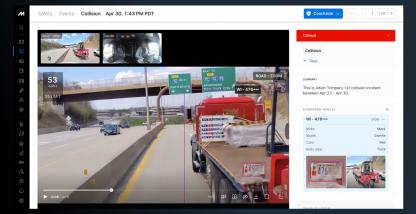
Unsafe driving behaviors can be prevented and corrected with smart technology, reducing the likelihood of getting DOT violations in this category. For example, the AI models used in the Motive AI Dashcam Plus detect 15+ unsafe driving behaviors with up to 99% accuracy, including mobile phone use, close following, and drowsiness.
The dash cam sends real-time in-cab alerts so drivers can self-correct before a collision or a roadside inspection. Post‑event driver coaching workflows in Motive, including AI Coach, Safety Scores, and focused coaching sessions help turn dash cam data into behavior change.
This way, organizations with fleets can systematically reduce repeat offenses that affect CSA scores.
Fleets can customize which behaviors trigger alerts and Safety Scores to align with their highest‑risk compliance categories and operating environments.
Estimated based on an internal study of fleets with 150+ active monthly vehicles, in which at least 90% of such vehicles had Dual-Facing AI Dashcams for at least 12 months.
2. Standardize DVIRs with digital workflows to reduce driver‑observed violations
FMCSA’s shift to separate driver observed violations from broader vehicle maintenance violations makes the quality and consistency of your DVIR workflow more important than ever.
The Motive driver experience product walks drivers through a step-by-step inspection checklist, so common issues are less likely to slip through. In this digital DVIR process, drivers can flag major vs. minor defects, add notes, and upload photos right from the inspection screen. Managers and maintenance gain a clear, time-stamped record of what’s wrong before the vehicle gets on the road.
As the FMCSA starts grading carriers on what drivers should have seen, you can’t treat DVIRs as a check-the-box exercise. A digital, guided, and fully documented DVIR workflow like Motive’s turns your inspection workflow into a useful, defensible process.
3. Shift to preventive maintenance
The more you rely on paper, memory, or generic intervals for maintenance, the easier it is for problems to turn into DOT violations.
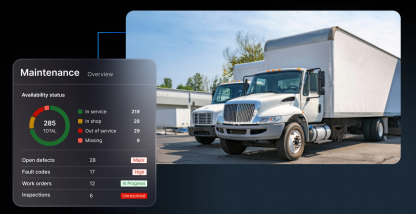
Use Motive’s fleet maintenance product to get ahead of roadside inspection findings. Motive uses data — such as odometer readings and engine hours — rather than manufacturer intervals to send automatic maintenance alerts. Each vehicle can follow a schedule tailored to how it’s actually used so you’re ready for annual and periodic inspections.
Motive’s preventative maintenance has reduced our average vehicle downtime from two days to one day, very easily.
4. Eliminate logbook and HOS violations with automation
The best way to eliminate HOS errors is to remove the manual work. Motive’s ELD compliance product automates compliance workflows, reducing the form and manner errors and over-hours violations that inspectors look for.
These features are designed to streamline HOS management:
- HOS clocks. Show drivers exactly how much drive, shift, or cycle time they have left.
- AI Face Match. Reduce unassigned driving with Face Match to automatically identify drivers and match them to vehicles as soon as they begin driving.
- Log maintenance. Drivers can view, edit, and certify logs directly from their device, ensuring they are up-to-date for inspections.
Face Match is not available in Illinois.
5. Tighten driver qualification, training, and documentation
Instead of trusting file folders and spreadsheets, use a system that warns you well before expirations occur. Motive Workforce Management centralizes documents and expirations in one place so you can fix issues before they become violations.
otive just makes compliance easier. It’s one click to get to the Compliance Hub, and I’m there. It shows me which drivers I need to worry about, which drivers have more violations, and which drivers have less. It’s all there, and it saves me a lot of time. I’m not digging around and hunting down that kind of stuff anymore.
Use Motive to keep all things driver fitness in order:
- AI‑powered document capture. When a manager or a driver uploads a document, Motive’s AI reads the file, extracts key data like expiration dates, and updates the driver profile to reduce manual data entry.
- Expiration alerts and eligibility status. Motive automatically flags upcoming expirations and shows which drivers are qualified versus at risk.
- Integrated MVR workflow. With Integrated MVRs, fleets can request, review, and store Motor Vehicle Records directly in Motive.
Prevent DOT violations with modern technology and smart workflows
Motive brings driver safety, compliance, maintenance, and workforce management into one platform, so that motor carriers can use AI and automation to improve operations.
Learn more about the Motive Integrated Operations Platform or watch a short demo to see Motive’s platform in action.
Frequently Asked Questions
How long does a DOT violation last?
The FMCSA is interested in how motor carriers have been operating recently, rather than all time. Because of this, the SMS only looks at the last 24 months of performance data when calculating a score. However, not all 24 months are treated equally. The FMCSA uses time weighting to ensure that recent mistakes are weighted more heavily than older ones. The good news is that any improvements you make now will soon start to help your scores improve.
Do DOT violations go on a driver’s record?
DOT violations go onto a driver’s pre-employment screening program (PSP) record. DOT provides this optional program to help carriers make more informed hiring decisions by providing secure, electronic access to a commercial driver’s five-year collision and three-year inspection history. Unlike the PSP, a driver’s MVR only includes a driver’s motor vehicle convictions in a given state.
Can you get a violation removed early?
Accordion Header
Accordion Body content
Accordion Header
Accordion Body content