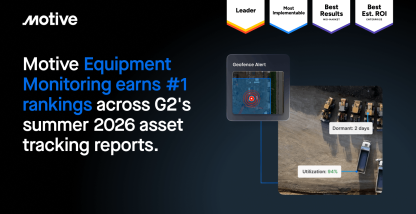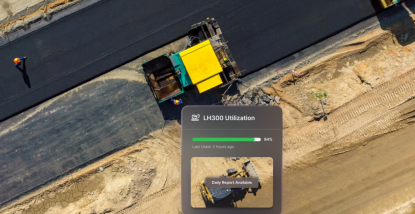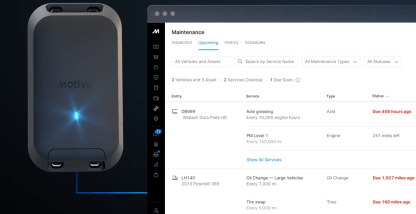


Manual spreadsheets and phone calls can’t keep up with modern fleets spread across regions, yards, and job sites. As asset counts grow, so do blind spots, theft risk, and underutilization.
Industries like construction, trucking, oil and gas, and field services rely on fleet asset trackers to protect high-value, distributed assets.
What is scalable GPS asset tracking?
Scalable GPS asset tracking refers to technology solutions that use satellite and cellular data to monitor the real-time location, status, and usage of fleet vehicles and equipment — no matter the organization’s size or footprint.
With accurate real-time GPS tracking and AI fleet management, fleets can cut costs, improve compliance, and boost productivity.
Ready to see what a scalable GPS asset tracking system could do for your operation? Explore how the Motive AI-powered Integrated Operations Platform unifies vehicles, equipment, and fleet-related spend in one view.
The 5 key features of scalable GPS asset tracking systems
Leading scalable GPS asset tracking solutions share five core pillars that help fleets standardize on one platform as they grow:
- Real-time tracking and accuracy
- Data analytics and performance insight
- Geofencing and alert management
- Integration with fleet telematics and ELD systems
- User experience and dashboard usability
Use this quick feature-to-benefit breakdown to see how each pillar translates into real business value for large, distributed fleets:
| Pillar | What it does | Business benefit |
| Real-time tracking and accuracy | Continuously updates asset location and status | Faster dispatch Fewer “lost” assets Better service |
| Data analytics and performance insights | Turns raw data into trends, KPIs, and forecasts | Higher utilization Lower fuel and maintenance costs |
| Geofencing and alert management | Automates boundary- and rule-based notifications | Theft deterrence After-hours control Compliance support |
| Integration with fleet telematics and ELD systems | Connects GPS with telematics, ELD, maintenance, spend | Single source of truth Fewer manual workflows |
| User experience and dashboard usability | Surfaces insights by role with clear maps and reports | Faster adoption Less training Better decisions |
Motive builds these pillars into an AI-powered Integrated Operations Platform that scales from hundreds to tens of thousands of assets, so large fleets can standardize on one set of tools as they grow.
Real-time location tracking and accuracy
Real-time location tracking streams up-to-the-minute positions for vehicles, trailers, and equipment so managers can secure assets, verify ETAs, and eliminate yard hunts — especially when equipment is parked for long periods or dispersed across multiple states.
A stolen vehicle recovered across state lines via GPS shows the nationwide reach of modern trackers. Modern trackers combine satellite and cellular networks for 24/7 visibility, even when assets move across states or remote regions.
To deliver this level of always-on visibility, Motive pairs powerful hardware with intelligent tracking features. With Advanced Location Services for the Asset Gateway Mini, fleets get:
- Hybrid satellite and cellular tracking ensures accurate location data in dense cities and remote job sites.
- Reliable location visibility even when cellular coverage is limited or inconsistent.
- Configurable ping rates allow fleets to balance tracking frequency, battery life, and operational needs.
- On-demand “Locate My Asset” pings provide immediate, real-time location updates when fleets need answers now.
Data analytics and performance insights
Raw location data alone doesn’t drive ROI. Fleet data and analytics deliver real-time statistics on asset efficiency, maintenance needs, and utilization, enabling informed, data-driven decisions.
Within the Motive platform, fleet managers can:
- Spot underutilized trailers or equipment and redeploy them to high-demand regions.
- Optimize routes and dwell time to reduce fuel and detention costs.
- Shift from reactive to preventive maintenance using engine hours, fault codes, and usage trends.
The same analytics also power smarter scheduling. With real-time visibility into assets, dispatchers can assign the nearest right-sized asset, avoid double-booking across sites, and rebalance equipment as demand shifts by region.
QUOTE: “Our scheduler isn’t getting calls at 1 a.m. because a roller can’t be located. The asset gateways have really helped us schedule more efficiently and make sure the right equipment is at the right location.” – Cristian Zuniga, Telematics Site Champion, Staker Parson
Geofencing and alert management
Geofencing and alerts are critical for risk mitigation, compliance, and fast incident response. Companies with fleets define virtual boundaries around yards, job sites, customer locations, or restricted zones, then receive automated alerts when assets cross those lines or violate policies.
Common uses include:
- After-hours usage alerts for high-value equipment.
- Restricted site or cross-border entry notifications.
- Exceptions for route deviations or unauthorized stops.
Motive combines geofences with movement, power, and behavior-based alerts so organizations can deter theft, respond quickly to suspicious activity, and maintain a clear audit trail for regulators, insurers, and customers.
Integration with fleet telematics and ELD systems
A scalable GPS asset tracking system delivers the most value when it plugs into your existing fleet telematics platform, dash cams, and ELDs. Telematics integration connects GPS tracking with telematics and ELD platforms to consolidate operational data, automate compliance, and enable end-to-end asset visibility.
With Motive’s asset tracking integration and fleet telematics platform, fleets are able to:
- Tie location and usage data to HOS, DVIRs, and fault codes.
- Link GPS events with AI-powered dash cam video for richer safety context.
- Feed maintenance, TMS, and ERP systems with accurate asset data so finance, safety, and operations all work from a single source of truth.
This connected stack turns GPS asset tracking into a backbone for automated workflows across the business.
User experience and dashboard usability
Even the most advanced system fails if people don’t use it. An intuitive user experience with clear dashboards keeps engagement high across dispatch, maintenance, and site teams.
In the Motive Dashboard, users get:
- Responsive live and historical maps for vehicles, trailers, and equipment.
- Configurable widgets and real-time activity feeds tailored to each role.
- Role-based views so executives, fleet managers, and site supervisors see only the data they need.
A clean user interface shortens training time, boosts adoption, and makes it easier to act on insights in minutes, not days.
How large fleets track and manage non-powered assets at scale
What are non-powered assets?
Non-powered assets are resources without an onboard electrical supply, such as trailers, containers, portable machines, and similar equipment. These assets need self-powered GPS trackers that can operate for months or years without frequent intervention.
Motive offers Bluetooth asset trackers, including the Asset Gateway Mini and Motive Beacon, designed for non-powered assets, such as:
- Battery-powered units for multi-month deployments on trailers, containers, and equipment.
- Solar-powered units for outdoor assets that need ultra-long life with minimal maintenance.
- Ruggedized designs with weatherproof enclosures and flexible mounting options.
Combined with Motive Equipment Monitoring and GPS Asset Tracking, these devices deliver long-life, real-time GPS tracking that keeps non-powered assets visible and productive.
Multi-location asset visibility
Multi-location asset visibility enables organizations to monitor the real-time status and utilization of assets distributed across different operations, job sites, or territories from a single screen.
Motive’s platform allows companies with large fleets:
- Group assets by region, business unit, or site and see rollups alongside drill-downs.
- Filter by asset type, status, or utilization to rebalance equipment quickly.
- Apply consistent policies and permissions while giving local teams the access they need.
This level of visibility, from vehicles to small, unpowered assets, helps fleet managers answer “What do we have, where is it, and how is it being used?” in seconds, not hours.
QUOTE: “We can lose track of equipment easily on some of these job sites. Equipment could be behind a huge pile of aggregate and we wouldn’t know without the [Asset Gateway] Minis.” – Cristian Zuniga, Telematics Site Champion, Staker Parson
Scaling GPS asset tracking across large fleets and trailers
A scalable GPS tracking solution smoothly handles growth in fleet size, geographic coverage, and data volume without loss of performance or oversight.
Motive’s scalable GPS asset tracking solutions are built to support:
- Thousands of concurrent devices and users across business units.
- Cloud-native, microservices architecture for resilient uptime and fast updates.
- A single platform for vehicles, trailers, heavy equipment, and small assets.
Think of rollout as a flow: start with a pilot on high-risk assets, validate ROI, expand to critical regions, then standardize enterprise-wide with integrations and role-based governance.
How GPS tracking prevents theft and speeds asset recovery
Real-world recoveries — like vehicles tracked across multiple states or small GPS units leading law enforcement to stolen valuables — show how precise location data shortens response times and improves outcomes.
With Motive, fleets can:
- Pair real-time movement, after-hours, and geofence alerts to detect suspicious activity early.
- Use breadcrumb history and Locate My Asset pings to coordinate with law enforcement.
- Combine GPS data, vehicle-asset pairing, and AI dash cam video to document incidents for insurers and legal teams.
By turning visibility and alerts into a clear playbook, fleets deter more theft, recover more assets, and reduce replacement and rental costs.
Turn asset visibility into an advantage with Motive
For large fleets, scalable GPS asset tracking is more than dots on a map. It’s about protecting high-value equipment, eliminating blind spots, automating compliance, and turning data into decisions that can increase utilization and uptime.
Motive brings fleet asset trackers, real-time GPS tracking, and AI fleet management together on one platform so you can standardize, scale, and prove ROI as you grow. Ready to see what that looks like in your operation?
Request a Motive demo or explore Motive’s GPS asset tracking products to get started.
Frequently Asked Questions
What is scalable GPS asset tracking?
Scalable GPS asset tracking uses satellite and cellular networks to monitor the real-time location, status, and usage of vehicles, trailers, and equipment across any fleet size. A scalable platform can grow from dozens to thousands of assets without losing performance, accuracy, or control, even as operations expand into new regions.
How do fleet asset trackers work in large fleets?
Fleet asset trackers are hardware devices installed on powered and non-powered assets. They collect GPS and sensor data and transmit it over cellular networks to a cloud platform. Managers see assets on live maps, configure geofences and alerts, and review history to improve utilization, uptime, security, and customer service.
How much does scalable GPS asset tracking cost?
Scalable GPS asset tracking is typically priced per asset or device, with volume discounts as your operation grows. Total cost depends on hardware, software features, connectivity, and contract length. Motive offers flexible plans designed to lower total cost of ownership through fewer losses, better utilization, and stronger compliance. Contact Motive for a tailored quote.
How does GPS asset tracking improve scheduling and dispatch?
Scalable GPS asset tracking gives dispatchers real-time visibility into where assets are, how they’re being used, and when they’re available. With that data in a single dashboard, teams can assign the nearest right-sized asset, prevent double-booking, and keep projects on schedule as operations grow.
Why is real-time GPS tracking essential for high-value assets?
Real-time GPS tracking lets fleets locate high-value assets instantly, verify arrivals and departures, and detect unauthorized movement within minutes instead of hours or days. That speed improves dispatch, reduces manual check-ins, and gives teams a critical time advantage for theft prevention and recovery across multiple sites and states.
How does AI fleet management enhance GPS asset tracking?
AI fleet management analyzes GPS and telematics data to surface patterns humans might miss. It flags underutilized assets, predicts maintenance needs, and prioritizes alerts so teams focus on the highest-impact exceptions. Combined with AI dash cams, AI links asset location, driver behavior, and video for a more complete risk picture.
What should large fleets look for in scalable GPS asset tracking solutions?
Large fleets should verify support for their asset mix, real-time accuracy, battery life, and rugged hardware. Equally important are data analytics, geofencing, integrations with telematics and ELD systems, and intuitive dashboards. The strongest solutions unify GPS asset tracking, safety, maintenance, and spend in one AI-powered platform built to scale.