


At Motive, we build AI for the physical economy: transportation and logistics, construction, field services, utilities, energy, and the public sector. These environments are high-stakes, fast-moving, and unforgiving of delay or error. When something goes wrong on the road, seconds matter. That reality shapes how our AI system is designed.
To understand Motive’s approach, it’s important to recognize that our AI operates across three distinct but connected layers, with real-time, in-cab decision-making at the core, each with a different role in improving safety, accuracy, and customer outcomes.
First, a quick foundation: AI and computer vision
Artificial intelligence (AI) refers to systems that perform tasks typically requiring human intelligence, such as perception, decision-making, and pattern recognition. While much of today’s conversation around AI focuses on large language models (LLMs) that generate text, the most impactful safety applications rely on computer vision — AI that interprets visual information, such as objects, motion, and behavior, in video.
Computer vision powers everything from medical imaging and autonomous vehicles to jobsite monitoring and driver safety, where accuracy and speed are non-negotiable. A missed event or a delayed alert can have real-world consequences for drivers, pedestrians, and communities.
The three layers of Motive’s AI system
1. Real-time, in-cab AI on the edge (for drivers)
Motive’s AI Dashcam runs proprietary computer-vision models directly on the device, inside the vehicle, also known as edge AI. That means unsafe behaviors — such as distraction, drowsiness, close following, or cell phone use — are detected as they happen, without relying on the cloud or human intervention.
When unsafe behavior is detected, the system delivers an immediate, in-cab alert to the driver. This is where the AI does its most important work to prevent collisions. There is no human in the loop at this moment — there can’t be. At highway speeds, there is no time to send video to the cloud, wait for processing, or involve a person. Only on-device, real-time AI can react fast enough to change behavior and prevent a collision.
2. Validated events in the dashboard (for safety managers)
At Motive, we believe accuracy doesn’t stop at detection. Customers’ safety managers shouldn’t be burdened with false positives, and drivers should never be penalized for invalid events. That’s why we employ data annotators to validate safety events and remove false positives before they reach the Fleet Dashboard.
Once a model achieves very high precision on the edge, events flow directly to safety managers, with ongoing sampling to ensure performance hasn’t regressed.
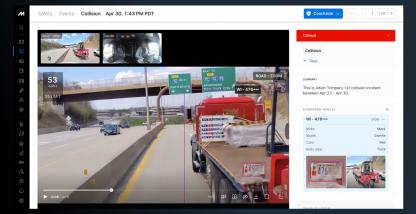
Collision detection is the exception. Our collision AI is optimized for high recall. We never want to miss a collision. Data annotators review all collision events to assess validity and severity, enabling services like Motive First Responder, which helps notify emergency services faster when a severe collision occurs.
The quality of the camera, the accuracy of the AI event detection, and the speed of the alerts are all equally important, and that’s what we get with Motive.
3. Humans-in-the-loop driving recursive AI model improvement
Humans-in-the-loop (HITL) play a critical role across the AI industry. Leading companies, including OpenAI, Google, Anthropic, Amazon, Microsoft, and Uber, rely on human feedback and annotation to train and refine models for complex, nuanced, or safety-sensitive tasks. Motive was an early adopter of this approach, building and scaling our own in-house data annotation team to ensure our AI meets the demands of real-world physical operations.
When we launch a new AI model, it initially runs silently. In-cab alerts are disabled so drivers aren’t interrupted by false positives. The AI model generates events, which data annotators then review. Those reviews don’t affect drivers in the moment, but they are essential to making the AI model better over time.
This process creates a rapidly growing, high-quality training dataset that feeds back into model retraining. Over time, accuracy improves until the model meets our strict performance threshold – targeting highly accurate precision on the edge — before real-time alerts are enabled.
This recursive improvement loop is the foundation of Motive’s AI advantage. Today, approximately 400 full-time data annotators process tens of millions of events each year, enabling us to rapidly train new models while continuously improving existing ones.
Our data annotators perform two critical human-in-the-loop functions:
- Labeling edge cases and complex scenarios to train and improve models
- Reviewing uncertain or high-impact events to prevent false positives and maintain trust
Human labeling improves what the model learns. Human validation helps ensure reliability at scale. Together, they strengthen the real-time AI that operates in the cab, where safety decisions actually happen.
Why this architecture matters
Physical operations demand AI that is fast, accurate, and trustworthy.
- Edge AI prevents accidents in real time
- Validated events enable effective coaching and oversight
- Human annotation helps ensure continuous improvement
Motive’s AI architecture is purpose-built for the high-stakes world of physical operations. By combining the immediacy of edge AI for real-time driver safety, the clarity of validated events for coaching, and the continuous refinement from our human annotation team, we deliver on the promise of AI that is fast, accurate, and most importantly, trustworthy.