Products

How much will you save with Motive?
Improve your bottom line with Motive’s cutting-edge technology that enhances safety, boosts productivity, and drives profitability.
Solutions
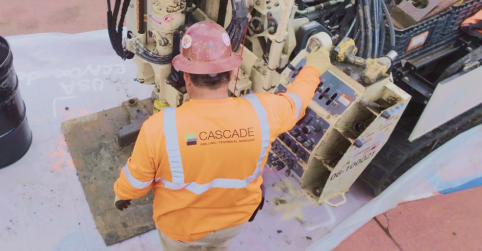
Cascade improves safety by 50%, reclaims ~10K hours per year.
With the Motive platform, Cascade has a consolidated view of fleet and spend management across its fleet of more than 3,000 vehicles.
Resources
Company

Vision 26: May 26-28
Join us in Nashville to connect with other industry leaders, get hands-on training, and see how AI and automation can transform your business. Register today and save!
CUSTOMER CASE STUDY
EnerCorp cuts distracted driving and improves safety following a head-to-head trial of Motive and a key competitor.
Within two months, the oilfield services leader cut cell phone use by 25%, reduced distracted driving by 10%, and lowered stop sign violations by 19%—proving that better visibility leads to safer roads and stronger driver trust.

Overview
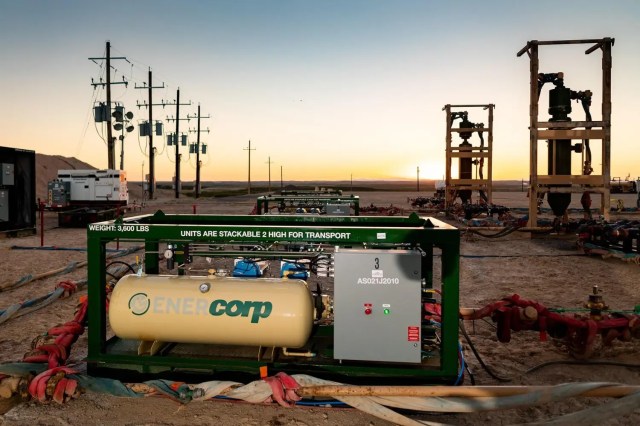
EnerCorp is a leading oilfield services company specializing in sand management solutions and operating in high-risk environments. Rising safety incidents among fleet drivers and limited visibility into road conditions prompted EnerCorp to run a head-to-head trial of Samsara and Motive AI Dashcams. Motive was the clear winner, and within two months, EnerCorp reduced cell phone use by 25%, distracted driving by 10%, and stop sign violations by 19%. The company is now trialing Motive’s Asset Gateways and AI Omnicams to further boost safety and efficiency across their fleet.
25%
decrease in cell phone use
10%
reduction in distracted driving
19%
drop in stop-sign violations
Written by Aaron Kelver, U.S Fleet Manager at EnerCorp
Few jobs carry more pressure — literally — than the work we do at EnerCorp. We provide sand management for oil wells, removing proppant, which is material used in fracking, from the flow stream to prevent equipment damage on the surface. The material comes out at incredible velocity, with wells running 3,000–15,000 pounds per square inch (psi). It only takes 75 psi to kill a person, and when you add factors like corrosive materials, remote sites, and miles of West Texas roads that have high winds, low visibility, and oversized vehicles, the stakes get very high, very quickly.
I experienced those conditions myself. I started with EnerCorp in 2015 as a junior operator, working my way through operations and into management. Today, I’m our U.S. asset manager, responsible for more than 1,500 assets and 200 fleet vehicles. My frontline experience shapes how I think about safety. I know how quickly things can go wrong and how preventable many incidents really are.
Rising incidents and limited visibility
Our fleet consists of half-ton pick-ups, one-ton trucks, Class 8 trucks, and more. We also have trailers that move sand separators, manifolds, and flowback equipment to and from well sites. Regardless of the type of vehicles in operation, safety has always been our top priority. Still, vehicle incidents began to climb in recent years, with distracted driving and cell phone use being persistent problems.
We were using Geotab telematics, but it lacked the detail we needed. Reports were limited, analytics weren’t actionable, and support didn’t exist. I was determined to digitalize the fleet further, but I had to jump another hurdle: employee privacy. Our leadership team worried that installing dash cams would lead to driver pushback. The assumption was that people would quit if we put cameras in trucks, and that fear stopped multiple proposals in their tracks.
To move forward, I needed proof — proof of value, proof of fairness, and proof that we could protect our people and their privacy while gaining much-needed data to optimize operations.
On trial: Samsara vs. Motive
I ran a six-month, head-to-head test between Samsara and Motive. We put Samsara units in seven vehicles, including mine. After three months, we swapped them out for Motive AI Dashcams and ran the same test with the same drivers. Both times, we monitored key behaviors like seatbelt use, near misses, and distracted driving.
The Motive platform was objectively better. Its AI detection was far more accurate, especially when detecting distracted driving and cell phone use. Even more impressive, instead of simply flagging risky behaviors, Motive recognized positive driving habits, allowing us to reward drivers for doing the right thing.
In addition to accuracy, Motive’s roadmap placed a strong focus on innovation, data integrity, and turning insights into actionable results. The team built the platform for the future, making them the ideal partner for growth
Motive’s roadmap placed a strong focus on innovation, data integrity, and turning insights into actionable results. The team built the platform for the future, making them the ideal partner for growth.
Change management begins with transparency
Even with the right technology, we knew adoption would fail unless we earned driver trust. Giving people the “why” is critical. People need to understand why you’re making a change, what the problem is, how and why we’re going to solve it, and how it affects them.
We did two things right off the bat:
- Set the right privacy controls.
Motive’s flexibility allowed us to disable the audio and live streaming from the cameras. We could then reassure our drivers that we weren’t listening to any conversations or watching them in real time. Typically, we only review video in the event of an incident.
- Gave them the “why.”
We presented employees with the actual statistics on incidents, injuries, and costs, helping them to recognize the big-picture issues. Then we explained how the camera footage would keep them safe, reduce costs, and reward good driving. They understood the value and got on board once they realized this was about safety, not surveillance.
Once we decided on Motive, we moved fast. Our in-house mechanics installed cameras in all 220 vehicles in just 90 days. The EnerCorp management team got involved, spending time in each district to oversee installs and demonstrate their commitment to our employees.
That show of solidarity mattered. Change is easier to accept when leadership is accessible and stands shoulder-to-shoulder with the rest of the team.
Giving people the ‘why’ is critical. People need to understand why you’re making a change, what the problem is, how and why we’re going to solve it, and how it affects them.
The Motive team matched that energy, taking the time to understand what was important to us and tailoring the system to our needs. Our implementation manager was always just a phone call away, ready to resolve any issue. The close communication and personal service made a world of difference and let us hit the ground running.
Immediate results and lasting impact on driver behavior
Installing Motive cameras gave us immediate and complete visibility into life on the road, including near misses and high-risk driving behaviors.
In just the first two months, the improvements were encouraging:
- 25% reduction in cell phone use
- 10% reduction in distracted driving
- 19% reduction in stop sign violations
Video evidence also helps protect and exonerate our drivers. In one recent T-bone collision, footage clearly proved that the other vehicle ran a stop sign. It has also been valuable in verifying accounts of incidents like deer strikes on rural roads.
Motive video footage has transformed our approach to driver safety. Now, we spend more time reviewing behavior with our drivers, highlighting what they’re doing well and coaching them on areas where they can improve. We can act on the data we receive, and the balance between correction and recognition has been key to building trust.
Motive video footage has transformed our approach to driver safety. Now, we spend more time reviewing behavior with our drivers, highlighting what they’re doing well and coaching them on areas where they can improve.
Driving safety forward with Motive
These numbers are a great start. As we roll out more structured coaching, we expect to see even greater improvements.
We’re piloting the Motive AI Omnicam on 18-wheelers to monitor loads, Asset Gateways on trailers to track equipment, and Beacons to extend visibility beyond the cab. We’re also exploring predictive maintenance and AI-powered analytics to discover other ways to enhance safety and efficiency.
While pressure is part of the job at EnerCorp, using Motive means we can manage it. We have the visibility, partnership, and roadmap to keep our people safe and our fleet ready for anything the road throws our way.
Ready to get started?
Explore Motive’s fleet management solutions and see how your fleet could benefit.
Quick Links