


As chief information officer at Bennett Family of Companies, Praveen Boppana invests in technologies that help improve efficiency and lead to better decision-making.
In evaluating AI products to invest in, Boppana looks at how each solution will drive efficiency, support growth, and improve the bottom line. He also considers how each investment allows the team to focus on higher-value work.
Shared processes, scalable AI
Bennett operates across 14 companies, so any operational challenge is effectively multiplied by 14. Many of the business units provide similar services with slight variations, making it difficult to standardize processes and implement AI consistently.
To address this complexity, Bennett is establishing cross-functional teams that support all business units in shared workflows. Rather than each unit operating independently, they create a centralized approach.
“If you’re talking about sending invoices, for example, you have one cross-functional team that’s helping all the businesses,” Boppana explains. The team follows a unified set of standard operating procedures, allowing for the specific variations each unit needs.
“AI isn’t a magic bullet,” Boppana says. “You have to have the right data and business processes in place. When you do, AI can really work to your advantage.”
Measuring impact with clear KPIs
No AI investment truly matters unless you can prove it’s working. Bennett has been implementing success criteria and KPIs to show how AI is actually helping.
Before rolling out any new AI solution, Bennett defines what success will look like, whether it’s:
- Higher automation rates.
- Faster processing times.
- Fewer collisions.
- Less manual effort.
“The value we’re getting from AI is so fast,” Boppana says. “The whole timeline of when we start to see value from our investments has shrunk — by half, at least, in some cases.”
“AI isn’t a magic bullet. You have to have the right data and business processes in place. When you do, AI can really work to your advantage.
Choosing AI investments with Motive at the center
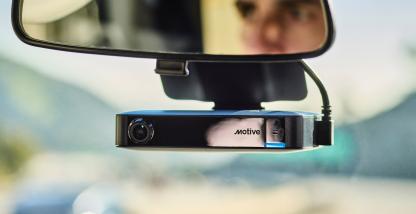
As a business, Bennett’s AI strategy spans safety, operations, and the back office. Their Motive investment has focused primarily on using Motive AI Dashcams to prevent collisions and protect drivers on the road.
With AI-powered cameras, Bennett has gained real-time visibility into unsafe driving behaviors. And it’s considering investing in AI Coach, an AI avatar that delivers personalized, automated coaching at scale.
Bennett has been working on implementing AI solutions to optimize routes, match drivers and loads, and automate back-office work, allowing teams to focus on their more pressing responsibilities. Instead of reviewing every invoice line by line, Bennett is testing AI-powered workflows that handle routine tasks and surface only true exceptions for human review.
Coaching unsafe behaviors with Motive AI Coach
With 4,500 drivers, it’s nearly impossible for Bennett safety personnel to coach every driver who needs it. To streamline and scale the coaching process, Bennett recently started a trial of Motive AI Coach.
“AI Coach helps us coach drivers faster,” Boppana says. “We’re able to expand our scope and fine-tune our coaching automatically.”
Using data and video clips from the Motive AI Dashcam, Bennett focuses on unsafe behaviors that drive the most risk — things like speeding, close following, and stop sign violations. Drivers aren’t always aware that they’re following too closely or rolling through stop signs. AI brings those moments to light so safety leaders can act on them.
“Close following is probably one of the most important behaviors for us to get ahead of,” Boppana explains. “If we can coach drivers on that, we can reduce the rear-end incidents that constitute a majority of our accidents and strengthen our overall safety position.”
It’s imperative that every driver who needs coaching receives it, especially given the liability Bennett faces should a driver have a collision. A single incident could cost the business tens of thousands of dollars.
“The more collisions we can prevent, the better it is for our bottom line,” Boppana says. “Preventing accidents isn’t just about liability and costs. It’s about keeping our drivers safe, coaching them proactively, and proving to our customers that we’re a safe carrier they can rely on.”
Turning Motive Safety Scores into real rewards
With so many drivers, Bennett uses Motive Safety Scores to understand which drivers are in need of coaching, incentivizing them to improve. By tying Safety Scores to Bennett’s driver incentive program, the benefits become clear.
“The goal is to improve the drivers’ scores, which translates into rewards for them,” Boppana says. “When their score goes up, their reward goes up — and that puts more money in their pocket.”
Rolling out AI Coach
Bennett is still trialing AI Coach, but if the positive results continue, the company plans to roll it out in phases, beginning with company drivers, then expanding to owner-operators.
That phased approach is generating excitement across the business. “There’s huge excitement around it, all the way from our CEO to our safety department,” Boppana adds. “It’s going to be a game changer for us.”
Conclusion
Bennett’s approach to AI is grounded in clear goals and measurable outcomes. By making Motive part of its AI strategy, the company has simplified complex operations, empowered its teams, and proactively addressed risk across its network of 4,500 drivers.
Ready to see how Motive turns AI investments into measurable returns? Download the 2026 Motive ROI Report to see how fleets like Bennett are improving safety, productivity, and profitability with a unified AI-powered platform.