

Field service operators need more than a dot on a map — they need a single platform that shows what’s happening on the road, at the jobsite, and across their equipment.
They need to know whether a crew made it to the jobsite, completed the work, left equipment where it belongs, and have the proof to resolve a dispute quickly when a customer calls.
Field service leaders use the unified Motive platform for connected visibility across safety, operations, and assets to solve real problems at once: video to defend against false claims, geofences to track what’s happening at shifting jobsites, and connected reporting to cut the manual work of running a distributed operation.
This matters in field service because the truck is often just the beginning of the workflow. The real work happens at the jobsite, around equipment, on customer property, and in conditions that change fast. The biggest opportunity is better visibility, faster decisions, and a safer, more connected operation.
Why field service needs more than a dash cam
For field service companies, road risk is only part of the exposure.
The work itself creates a second layer of operational complexity. Crews move between jobsites. Vehicles function as mobile tool cribs. Equipment gets reassigned. Customers may challenge whether work happened or whether property damage existed before a crew arrived. Managers need visibility into all of it.
The strongest field service use cases go beyond collision footage. Field service leaders are increasingly looking for technology that helps them protect workers, improve jobsite visibility, and create proof of work in environments where accountability can be hard to maintain.
What XKIG’s story shows about modern field operations
Tucker Miller, Director of Central Office at XKIG, gave a clear view of what this looks like in practice.
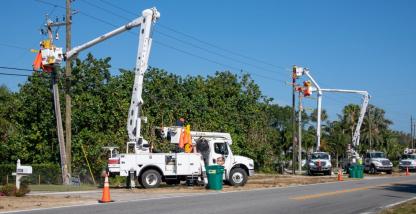
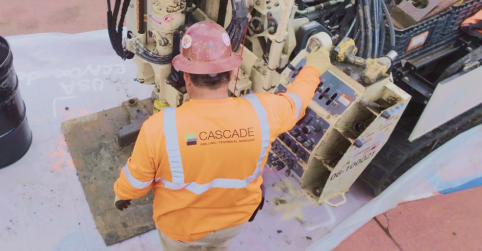
XKIG is one of the largest vegetation management companies in the United States, operating across 44 states with roughly 8,000 pieces of equipment. The business manages constant movement: crews clearing vegetation to protect utility networks and prevent wildfire spread, equipment shifting between jobsites, frequent acquisitions, and storm response that can spin up overnight. Disconnected tools create drag in that environment. Connected visibility creates leverage.
Three parts of the XKIG story stood out.
- Safety buy-in matters as much as safety technology
One of Miller’s most salient points had nothing to do with hardware. It was about rollout.
XKIG has acquired 15 companies in the last two years. When new teams come into a business through acquisition, safety technology can easily be framed as surveillance. Many of these companies have no cameras at all, or don’t even use GPS. Miller takes the opposite approach: making it clear from day one that the goal is a safer operation and better outcomes for the people doing the work. He tells XKIG employees: “It’s there for your safety.”
That framing matters in field service, where drivers are vegetation crews, service technicians, and field operators first. The vehicle is just how they get to the real job. The best field service programs are built around making data usable and actionable for the people closest to the work.
At XKIG, that approach has shown up in the numbers. Using self-coaching in the Motive Driver App to help drivers build better habits on their own, the company’s driver score went from 76% to roughly 98%. New acquisitions typically reach that level within about three months.
- Video becomes more valuable when it proves what happened at the jobsite
In field service, the more common questions sound like “Did your team complete the work?” or “Did your crew damage this property?” Connected video becomes operationally valuable in a different way when those are the questions on the table.
XKIG uses video to handle complaints about cracked driveways, ruts in yards, and disputes over whether work was actually performed. During storm response, the complaints multiply: debris left behind, property damage, homeowner escalations through the utility company. Said Miller, “We use the cameras all the time. … it [can help] eliminate the claim.”
This moves the value of visibility beyond safety into customer trust, dispute resolution, and business protection. Video can support service verification, jobsite accountability, and more confident operations alongside incident review.
XKIG also uses engine-off recording to extend that visibility after hours. Crews park bucket trucks and chip trucks facing each other at the end of the day so the cameras cover each other’s blind spots, creating what Miller calls a free security system. The setup has helped them catch theft on weekends when no one is on-site.
- Geofences and automation become more valuable when risk changes in real time
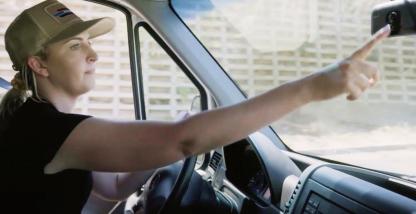
XKIG also uses geofencing for dynamic risk response. During wildfire season, the team creates geofences tied to active risk zones and uses automations to deliver a spoken alert through the AI Dashcam Plus when a vehicle enters the area, reminding crews of XKIG-specific policies: clearing brush under chippers, fueling in designated areas, no smoking.
Crews may already know the general policy, but wildfire risk zones can shift daily, even hourly. This is operational context delivered at the moment it matters. Geofencing can support jobsite visibility, alerts, and location-based workflows across field operations, but it becomes especially powerful when the risk environment is shifting in real time.
The bigger takeaway: connected visibility is becoming a field service advantage
XKIG’s story points to a broader shift in how leading field service operators think about technology.
They’re looking for a single, integrated system that helps them build a stronger safety culture, understand what happened on the road and at the jobsite, verify service and defend against false claims, keep track of equipment and reduce loss, respond faster when operating conditions change, and cut the manual effort required to turn data into action.
XKIG tracks every drivable asset with a Motive Asset Gateway Mini for GPS and pairs high-theft-risk equipment with a hidden Motive Beacon as a backup. When a side-by-side walked off a jobsite, that layered approach is what helped them recover it. Across 8,000 assets and 44 states, that kind of granular tracking is what keeps operations visible at scale.
That visibility extends to reporting. Miller’s BI team used to spend hours stitching together reports manually. With Motive Analytics, much of that work is now automated and delivered on a daily schedule across fuel, idle time, geofencing, and more, helping the team move from data to decisions faster.
Said Miller: “A lot of the reports that were taking the BI team hours to get to is all automated now.”
For field service leaders, that may be the most important shift. Better visibility is valuable on its own. But better visibility that also reduces manual work, speeds up decisions, and helps teams act more consistently is where the business case gets real.
What field service leaders should take from this
If you run field operations, the takeaway goes beyond more cameras and better safety scores.
The best field service programs connect road visibility, jobsite proof, asset awareness, and operational workflows in a way that reflects how the business actually runs. That’s the difference between a tool that captures data and a platform that helps you use it.
For field service teams under pressure to protect crews, defend margins, and improve customer confidence, that distinction matters.
See how Motive helps field service teams improve safety, service verification, and operational visibility across vehicles, equipment, and crews.
Additional resources