


Every year the Traffic Commissioners for Great Britain publish their annual report, a scorecard for the state of haulage and passenger transport. On paper, it’s a judicial document, but for lorry drivers, transport managers, and fleet operators, it’s really a mirror showing where the industry is currently and where it needs to improve.
The 2024-25 report makes two things clear. First, the system is busier than ever with 66,222 goods licences covering 376,044 vehicles, and more than 1,000 public inquiries heard in a single year. Second, the old failures keep repeating. They include poor maintenance, falsified drivers’ hours, and rogue operators cutting corners.
If you talk to drivers on the road, mechanics in the shop, or operators trying to keep the lights on, you’ll hear that these aren’t abstract “compliance failures.” They’re daily pressures, rising costs, tight schedules, lack of secure parking, and thin margins that push people into risky decisions. The Traffic Commissioners see the outcome in hearings and revocations. Drivers and operators feel the grind every day.
This blog takes the 2024-25 report as a starting point, adding perspective to show what these issues mean in practice. It also shows how fleets can bridge the gap with practical tools and a stronger safety culture.
Maintenance: Where small misses become big risks
The Commissioners call maintenance a “persistent weakness.” They’re right. Brakes, tyres, and steering fail because a fitter missed it, a driver didn’t log it, or an operator hoped the Ministry of Transport (MOT) would catch it.
The report highlights continued cases where operators believed outsourcing maintenance shifted the responsibility away from them. It doesn’t. In fact, in 2025 the Maintenance Provider Rating Scheme (MPRS) was rolled out to grade workshops after repeated complaints about poor quality service.
On the frontline, most drivers will tell you they’ve seen faults ignored or “penciled off” at garages. Operators often juggle the cheapest slot they can find. That’s how tyres run bald and brake issues get missed — until the Driver and Vehicle Standards Agency (DVSA) finds them during a roadside check.
The takeaway is simple. Operators must own the process. Drivers need time and tools for thorough walk-arounds. Workshops need clear accountability.
Motive helps make that possible with digital walk-around inspections; defect reports that allow you to annotate defects and upload photos; and automated maintenance reminders that keep everyone in the know. With Motive, fleets get a trackable, auditable system that shows exactly when defects were logged and addressed, something paper sheets can’t deliver.
Fatigue in the cab, failures in the office
The Commissioners continue to cite cases of falsified records, missing tachograph data, and directors who turn a blind eye. One East of England operator was found to have run trucks for years without downloading tachograph data. Drivers drove without cards, and management ignored it.
Drivers’ hours aren’t just a compliance issue. They’re about preventing fatigue and improving safety. If a driver is nodding off, it doesn’t matter what the tachograph says. The danger is already there.
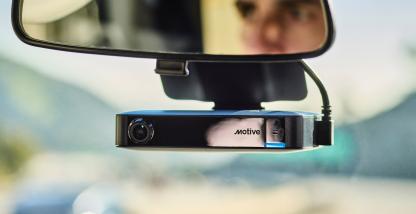
The answer lies in early intervention. Motive AI Dashcams can detect risky behaviour like distraction or tailgating before it becomes a roadside incident. Combined with automatic hours reporting, they give transport managers valuable oversight and a defence if a driver is wrongly accused.
Transport manager accountability
The report spells it out: A Certificate of Professional Competency (CPC) on the wall means nothing if the transport manager isn’t actively engaged. Commissioners disqualified multiple transport managers this year for failing to exercise “continuous and effective control.” Operators relying on paper qualifications without actual management were found unfit.
In many smaller fleets, the transport manager is a name on paper, sometimes part-time, sometimes split across multiple operators. The lesson here is that operators must empower transport managers with data and authority. If the transport manager isn’t in control, the licence itself is at risk.
Motive helps by centralising inspection logs, driver behaviour data, and maintenance histories. A transport manager can show the commissioner that the fleet practices real oversight and doesn’t just put forth a certificate. There is a difference between something truly being repaired, versus simply certifying it has been repaired when it hasn’t been.
Fair competition
The report notes a rise in insolvency abuse, sham driver arrangements, and “fronting” licences. One operator was caught paying most drivers through service companies to dodge obligations, while another concealed insolvency and prioritised suppliers over tax.
Drivers and compliant fleets feel the strain. Those investing in safety, training, and reliable systems often compete in a market where standards and oversight vary widely.
At the end of the day, fairness relies on visibility. Accurate records of drivers and vehicles give fleets the proof they need when compliance or safety is called into question.
Motive provides electronic audit trails, AI dash cam footage, and driver assignment tracking that give fleets clear, verifiable records — the kind of transparency regulators and customers expect.
Bridge strikes
The report counted 1,532 bridge strikes in 2023-24, the lowest in five years, but still devastating. According to Traffic Commissioner Richard Turfitt’s guidance, there is still more that can be done now and in the future. One operator lost its licence after a strike tipped it below financial standing.
Too often, these incidents trace back to the same root causes: incomplete route planning, unreliable satellite navigation (sat-navs), or pressure to “make the lorry fit.” Many drivers rely on memory rather than systemised data, and when a strike happens, it’s not just about damage — it’s about the reputational and regulatory fallout.
Preventing bridge strikes means giving drivers tools that can accurately detect and alert to risk right when it happens. One misjudged route can end a career or a company. Motive can help prevent that with real-time route data, geofencing, and AI Dashcams that identify risk in real time — documenting what really happened if signage or conditions are unclear.
Driver conduct
In 2024-25, more than 15,600 vocational driver conduct cases were heard. The Commissioners expect professional drivers to be held to a higher standard. That means one careless overtake or mobile phone offence can result in suspension, even when the courts give only points.
Fleets can’t afford to wait until the DVSA raises an issue. Proactive coaching is the only way to protect both drivers and operations. Motive helps by identifying risky behaviour such as distraction or tailgating before it leads to a roadside incident. With built-in coaching tools, drivers get immediate feedback that helps them avoid conduct hearings and stay in good standing.
Compliance as survival, visibility as defence
The Commissioners’ 2024–25 report highlights ongoing pressure across the haulage industry. Rising costs, tight schedules, and uneven competition continue to test operators. The report makes it clear that the law depends on systems, records, and consistent practice as the basis of compliance, not on intent or circumstance.
That’s where Motive UK steps in. From AI Dashcams to digital inspections and maintenance tracking to telematics, Motive gives fleets the tools they need to prove they’re doing things the right way — before the Commissioner even asks the question. Because when the regulator comes knocking, it’s not about what you meant to do. It’s about what you can prove.