


If you’re on the hunt for ways to maximize the operational efficiency of your fleet this year, one of the best ways is to implement an asset tracking solution.
Any fleet-based organization with a wide mix of assets distributed across locations can use an asset tracking solution to work smarter: Teams gain the visibility they need to make strategic decisions, get more out of their existing investments, and avoid wasting job time searching for lost equipment.
Learn how an asset tracking solution works and how to find the most effective solution for your organization.
What is an asset tracking solution?
An asset tracking solution is a combination of hardware and software used to continuously record and monitor where critical assets are, how they’re being used, and their current status.
How does an asset tracking solution work?
Asset tracking solutions contain a wide range of technologies with unique purposes for different industries. For example, in operational asset tracking (such as when a fleet manager needs to find a specific trailer), active tracking solutions use hardware on assets to transmit location data back to a central dashboard.
Other industries that don’t require active location tracking, such as e-commerce or food retail, use passive tracking technology like barcodes and QR codes to scan inventory in and out.
Common industries using asset tracking
Organizations across industries can use asset tracking to gain visibility and grow ROI, including:
- Agriculture
- Construction
- Oil and gas
- Trucking and logistics
- Commercial repair
- Home repair
- Heavy construction
- Utilities
- Landscaping
Agriculture. Monitor where trailers, tanks, and field equipment are so nothing sits idle between jobs.
Construction. See which machines, tools, and attachments are on each job site and redeploy underused assets.
Oil and gas. Monitor the location and status of high-value field equipment and keep critical units working safely.
Trucking and logistics. Spot trailers, containers, and pallets in real time to maximize utilization.
Commercial repair. Locate service vehicles and portable equipment so repair teams always have the right tools on hand.
Home repair. Keep tabs on vans, ladders, and toolkits and reduce time lost hunting for gear.
Heavy construction. See how often dozers, cranes, and other heavy equipment run so you can schedule work and maintenance.
Utilities. Monitor trucks, generators, and specialized tools across service territories for faster outage and emergency response.
Landscaping. Find mowers, trailers, and small tools quickly so crews can move efficiently between jobs.
Types of technology used in operational asset tracking solutions
In operations, asset tracking solutions commonly use these types of location-based technology:
- GPS tracking. Continuously collects location data with GPS receivers.
- Assisted GPS. Uses internet data to help GPS receivers identify the best satellites.
- Cellular tower triangulation. Uses terrestrial cell towers to calculate the most probable location of an asset when GPS is completely unavailable.
- Bluetooth low energy (BLE). Uses bluetooth to locate nearby equipment for close-range tracking.
Common features of asset tracking solutions for operations
What capabilities do asset tracking solutions provide?
- Real-time location technology
- Utilization data
- Automatic pairing
- Long battery life
- Industrial-grade rated enclosures
- OEM integrations
- Automatic maintenance reminders
- Equipment diagnostic trouble code (DTC)
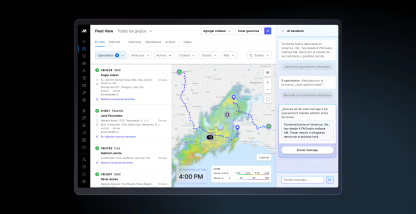
Real-time location technology. In operations, asset tracking solutions provide a way to locate the asset in real time. For example, Motive provides multiple layers of technology into its GPS asset tracking so that customers have deep support even in hard-to-track locations.
Utilization data. Details like engine hours and active vs. idle time provides helpful insight into existing assets and how they’re being used.
Automatic pairing. Vehicles and assets and groups of assets traveling together are connected into units so that they’re easier to track and manage.
Long battery life. A long battery life makes it realistic to track assets at scale without constant maintenance or replacement.
Industrial-grade ratings. Industrial asset tracking typically requires industrial ratings (such as IP67/IP69K and HazLoc) to survive rugged conditions such as pressure washing, dust, and harsh weather.
OEM integrations. For assets like reefers or heavy equipment, look for asset tracking hardware that integrates with OEMs. Bringing this manufacturer data back into the same platform helps make upkeep painless.
Automatic maintenance reminders. Some asset tracking hardware can generate maintenance reminders based on time or usage thresholds, so teams don’t miss service windows.
Equipment diagnostic trouble code (DTC). An asset tracking solution that connects to your equipment’s diagnostic port and sends engine fault codes to a central dashboard helps catch issues early.
3 questions to help you choose the right asset tracking solution for your fleet
To determine the right type of asset tracking solution for your fleet operations, ask yourself these three questions:
- Do you need asset tracking coverage across a mix of asset types (both high- and low-cost?)
If you’re tracking both high‑value, low‑volume assets and lower‑value, high‑volume equipment, look for a provider that offers tiered hardware so you’re not overpaying for coverage.
For example, Motive combines the GPS‑powered Asset Gateway Mini — typically used on higher‑value assets like trailers, reefers, and heavy equipment — with the BLE‑powered Motive Beacon for numerous small, lower‑value assets like containers, toolboxes, and generators.
Together, they let you invest in the right hardware mix while still getting visibility into every operationally-essential asset.
- Does your fleet include a wide mix of assets with different tracking needs?
When your fleet spans asset types, such as trailers, generators, and climate‑controlled units, you may need different levels of tracking data across types — not just different price points.
For example, the Asset Gateway Mini delivers precise GPS location and telematics data on engine hours, utilization, and maintenance insights, and can also integrate with many OEMs (AEMP, Thermo King, Carrier). These qualities make it a strong fit for powered, high‑value assets that drive most of your operating cost and risk.
Motive Beacon then fills in the gaps by bringing last‑seen visibility and movement history to all the small, unpowered assets that are still critical. Data from both types of hardware shows up together in the Motive platform.
- Do you operate in challenging environments for traditional GPS tracking?
Urban canyons, covered storage, and remote locations can all create GPS blind spots. If you operate in these conditions, look for asset tracking that combines all four of the location tracking technologies (GPS, assisted GPS, cellular, and BLE). This ensures reliable location tracking even in challenging conditions.
Motive’s Asset Gateway Mini uses Advanced Location Services and Locate My Asset so you can request fresh locations even when GPS is obstructed. Motive Beacon taps into the Motive Mesh Network to update last‑seen locations.
5 tips for evaluating asset tracking solutions
When you’re comparing asset tracking solutions, find the most effective solution with these tips:
1. Insist on durable, purpose-built hardware. Choose hardware that’s rugged, flexible, and designed for your operating environment, not consumer-grade — especially if you work in an industry like oil and gas, construction, utilities, or field services.
2. Verify coverage and reliability in your environment. If your organization operates in challenging conditions for GPS, look for hardware with multiple layers of location technology.
3. Look for unified visibility, not a point solution. Integrated operations platforms that combine safety, compliance, maintenance, and asset tracking in one place create more efficiency than separate tools that are stitched together.
Unlike other fleet management technology providers, Motive enables us to manage our whole fleet on a single platform. Now we can see all our operations in one place, whether it’s compliance or safety, maintenance or asset tracking. Having 360-degree visibility into our operations saves us time and improves productivity.
4. Evaluate vendor support and training, not just features. When evaluating a vendor’s asset tracking solution, don’t forget about strong support and training. A good partner is supportive and makes sure that you’re realizing the ROI you were promised.
5. Use ROI as part of your buying checklist. Ask for customer stories that highlight ROI from recovered stolen assets, right‑sizing fleets, and time saved from manual work.
How to optimize asset tracking with Motive
With the right asset tracking solution, your organization can gain the visibility you need to maximize the operational efficiency of your fleet.
For example, Agmark, a global bulk liquid logistics company, was facing what they thought was a chassis shortage. New chassis were on backorder, so they decided to invest in asset tracking to find out exactly where their chassis were located and how long they sat idle. With Motive, they discovered that many of their chassis weren’t being utilized. They redeployed chassis to meet the shortage and ultimately even decreased their chassis count by 11%.
“We’ve been able to decrease the size of our fleet and still operate effectively, because we’re able to get better visibility of the chassis that are sitting for a long time and utilize them so much better,” Chris Jaffe, their senior vice president of technology, said.
Want to learn more about Motive’s asset inventory management capabilities? Check out the Asset Gateway Mini or discover the new Motive Beacon.