


AI is no longer just about dashboards and reports. For modern fleets, AI agents — also called agentic AI — are starting to monitor risk, make decisions, and trigger workflows on their own. Instead of asking a human to sift through alerts, AI agents can watch your operation 24/7, then step in with the next best action when something changes on the road or in the field.
Let’s break down what AI agents for fleet management are, how they work, and how Motive’s agentic AI tools help fleets run safer, more efficient, and more profitable operations.
What are AI agents (agentic AI) in fleet management?
AI agents are autonomous AI systems that can manage tasks, learn from interactions, and make real-time decisions with minimal human supervision. Think of them as intelligent teammates that:
- Perceive what’s happening using data from telematics, cameras, weather services, and business systems
- Decide what needs to happen next based on rules, models, and historical context
- Act by sending alerts, updating routes, kicking off workflows, or blocking risky transactions automatically
That’s a big shift from traditional fleet software, which mainly:
- Collects data (e.g., GPS, engine fault codes, video)
- Displays that data in dashboards and reports
- Relies on humans to notice an issue and manually follow up
Agentic AI closes this gap. Instead of stopping at visibility, AI agents help complete the loop from insight → decision → action.
How AI agents work across the fleet lifecycle
Before the trip: planning and maintenance
Agentic AI can use historical and real-time data to prepare vehicles and routes before a driver ever starts the ignition:
- Predictive maintenance: AI analyzes sensor data, fault codes, and usage patterns to predict failures earlier and recommend or schedule maintenance before a breakdown sidelines a vehicle.
- Smart scheduling: By combining maintenance needs with trip schedules, shop capacity, and technician availability, AI agents can help optimize when and where vehicles are serviced.
- Dynamic route planning: AI analyzes traffic, weather, time windows, and fuel impact to propose the safest and most efficient routes for each load.
The result is less unplanned downtime, fewer last‑minute scrambles, and more predictable operations.
On the road: safety, coaching, and disruption management
Once drivers are on the road, AI agents monitor real-time data streams to reduce risk and keep loads moving:
- Real-time driver coaching: AI-powered cameras detect risky behaviors like distracted driving, close following, or drowsiness and deliver instant in-cab alerts that help drivers self-correct in the moment—without waiting for a weekly review.
- Accident and incident detection: When a collision occurs, AI can detect the event with high accuracy, capture video evidence, and alert managers within seconds so they can support drivers and manage claims.
- Weather and hazard alerts: AI agents can monitor live storm data, match it to current vehicle locations, and flag drivers at risk so fleets can re-route or pause operations before conditions turn dangerous.
Instead of monitoring multiple dashboards and news sources, operations teams get a prioritized list of risks — and recommended actions — delivered by AI.
In the back office: fraud control, compliance, and analytics
Agentic AI also reshapes the back office by taking over repetitive, rule-based work:
- Fraud detection and spend control: AI compares card transactions with vehicle and telematics data to spot suspicious fuel or spend patterns in real time, then flags or blocks them automatically.
- Compliance workflows: AI helps automate document tracking, timekeeping, and safety workflows so teams spend less time chasing paperwork and more time on strategic improvements.
- AI-powered analytics: Instead of manually building reports, AI surfaces patterns and outliers—like routes with persistent safety violations or locations with excessive idling—so managers can act on the insights right away.
Across all of these areas, AI agents help teams move from reactive firefighting to proactive, data-driven decisions.
The benefits of AI agents for fleet management
When fleets adopt AI agents at scale, they typically see impact in four key areas:
- Safety: Real-time detection and coaching reduce risky driving behaviors and help prevent collisions instead of just reviewing them after the fact.
- Productivity: Automated workflows free up operations, safety, and finance teams from low-value tasks like manual monitoring, data entry, and follow-up.
- Profitability: Fewer crashes, reduced downtime, lower fuel waste, and better spend controls all add up to measurable ROI for fleets that deploy AI effectively.
- Driver experience: Real-time, targeted coaching and faster support after incidents can help build trust, improve morale, and support a stronger safety culture.
Because AI agents continuously learn from data, their performance—and your benefits—improve over time.
Agentic AI tools for fleet management
Motive’s integrated operations platform is built with AI-powered automation at its core, giving fleets a unified way to apply agentic AI across safety, fleet management, equipment monitoring, spend management, and workforce management.
Here’s how Motive brings AI agents to fleet management today.
Motive AI Assistant: your fleet’s command-center agent
Motive AI Assistant is designed to act as an AI agent embedded in your fleet management workflows. It continuously monitors live operational data and surfaces the issues that need your attention most.
With Motive AI Assistant, fleets can:
- Monitor severe weather and critical faults: The assistant tracks live weather conditions and critical vehicle issues, then pinpoints which drivers and trips are at risk.
- Get recommended actions: It suggests the best next step—such as calling a driver, sending a message, or adjusting dispatch—along with recommended language for the outreach.
- Act in one click: From within Fleet View and the Motive platform, managers can notify all affected drivers with a single click, dramatically reducing response times and manual coordination.
Unlike tools that only provide visibility, Motive AI Assistant helps perceive, decide, and act — turning real-time data into automated, guided workflows.
Agentic driver safety: AI Dashcam Plus and automated coaching
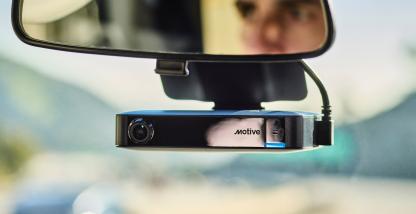
Motive’s AI Dashcam Plus is a core building block of agentic AI for fleet safety. It uses highly accurate computer vision to detect unsafe driving behaviors in real time and trigger immediate interventions.
Key agentic capabilities include:
- Real-time risk detection: The dashcam detects more than 15 unsafe driving behaviors, such as cell phone use, close following, and drowsiness, with up to 99% accuracy.
- Instant in-cab coaching: When risky behavior is detected, the system delivers instant alerts in the cab so drivers can self-correct before a near miss becomes a crash.
- Automated coaching workflows: Safety events and video clips are logged automatically, allowing supervisors to review patterns, schedule coaching, and recognize positive driving behaviors at scale.
Instead of relying on manual video reviews, AI acts as a continuous safety coach for every driver, on every trip.
Preventative maintenance and telematics-powered automation
Motive’s fleet telematics and maintenance capabilities help turn raw vehicle and engine data into automated actions.
Agentic AI supports:
- Proactive maintenance scheduling: AI analyzes fault codes, engine performance, and utilization patterns to surface vehicles that need attention before a breakdown, then supports scheduling those jobs at the right time.
- Context-rich alerts: By combining data from the AI Dashcam Plus and the Vehicle Gateway, Motive gives managers full context around events like harsh braking or engine faults so they can respond faster and more precisely.
This reduces unplanned downtime and helps fleets keep more vehicles in service with fewer surprises.
Collision detection and automated incident workflows
In the seconds after a collision, speed and accuracy matter. Motive’s AI-powered collision detection acts as an agent focused on post-incident response.
It can:
- Detect high-severity collisions with high accuracy
- Capture and preserve critical video footage and telematics data
- Alert managers quickly so they can support drivers, gather evidence, and manage claims more effectively
By automating detection and evidence collection, Motive helps fleets protect drivers and streamline one of the most high-stakes workflows in fleet operations.
AI-powered fraud detection and spend management
Motive’s Spend Management solution and the Motive Card use AI to act as a real-time agent for your fleet’s spend.
Capabilities include:
- Real-time anomaly detection: AI compares transaction data with vehicle location, trip status, and historical patterns to identify potential fraud or misuse.
- Automatic blocks and alerts: Suspicious transactions can be flagged or auto-declined in real time, stopping losses before they add up.
- Proven savings: In early deployments, Motive’s AI fraud detection saved customers hundreds of thousands of dollars by blocking unauthorized transactions within just 30 days.
Instead of auditing statements after the fact, AI agents help manage spend as it happens.
Workforce management and AI-powered analytics
Finally, Motive’s workforce management and analytics tools help scale agentic AI beyond the vehicle.
- Workforce management: AI helps automate document tracking, qualifications, timekeeping, training, and coaching across large distributed teams, reducing manual back-office work.
- AI analytics: Motive Analytics turns massive volumes of safety, fleet, and spend data into clear, actionable insights—highlighting where AI agents can have the biggest impact next.
Together, these capabilities help fleets centralize data, standardize workflows, and scale AI agents across the entire operation.
How to get started with AI agents in your fleet
If you’re exploring AI agents for fleet management, you don’t have to transform everything at once. A practical rollout typically follows a few steps:
- Clarify your top problems. Start with 1–2 high-impact areas — such as crash reduction, fuel fraud, or weather-related disruptions — where automation could make an immediate difference.
- Centralize your data. AI agents work best when they can see everything. Consolidate safety, telematics, spend, and workforce data on a single, AI-powered platform.
- Deploy your first agentic workflows. Begin with targeted use cases like AI-powered driver coaching, collision detection, or fraud prevention, then expand to more complex scenarios like severe weather agents and AI assistants.
- Measure and iterate. Track KPIs like crash rate, preventable incident rate, downtime, and fuel or spend savings, and refine your policies and thresholds over time.
See how Motive brings AI agents to fleet management
Agentic AI is moving from theory to reality. Fleets that put AI agents to work today are already:
- Preventing more accidents
- Responding faster to disruptions
- Cutting fraud and waste
- Freeing their teams from manual, repetitive work
To dive deeper into how AI agents and automation can transform your operation, explore the 2026 Guide to AI in Fleet Management and see how leading fleets are using AI to move from reactive to proactive fleet management.
When you’re ready to see these agentic AI tools in action, you can also request a Motive demo and explore how AI agents fit into your safety, fleet, and back-office strategy.