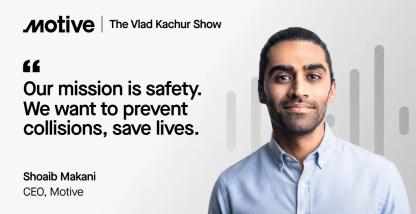



Motive CEO Shoaib Makani joined The Vlad Kachur Show discusses full-stack AI, the shift from insight to action, and what a decade of real-world driving data has taught him about people.
Much of AI is built for desk work. Motive builds AI for the half of the economy that operates on roads, at job sites, and in the field. Motive CEO and co-founder Shoaib Makani joined Vlad Kachur on The Vlad Kachur Show to talk about how Motive grew from a trucking-industry idea into an AI platform serving nearly 100,000 customers, why physical operations demand highly accurate AI, and what changes when a platform can act on a problem instead of just reporting it.
How did Motive start?
Makani founded Motive after seeing how underserved trucking was. During his time in venture capital at Khosla Ventures, he looked for large markets that technology had passed over and kept coming back to the same one: an vast amount of economic activity flowing through trucks, very little tooling, and a workforce that was essentially offline. Drivers, trucks, and equipment weren’t connected, which made it difficult to manage safety or efficiency at scale.
Then the problem got bigger. “Pretty quickly I realized the problem was not unique to the trucking industry,” Makani said. “It applied to any organization that does physical work.” Construction, energy, manufacturing, agriculture all have similar needs. What looked like a vertical product became a horizontal platform for the physical economy, which makes up roughly half of GDP.
Why is AI for physical work different from AI for knowledge work?
Chatbots and agents that draft emails can afford to be wrong sometimes. AI that watches the road cannot.
“The accuracy threshold is very, very high,” Makani said. “You have to have near perfect precision and near perfect recall.” A false positive erodes driver trust. A false negative is a missed risk. And the models can’t lean on massive cloud infrastructure: they run on the edge, inside vehicles, in thermally and compute-constrained environments. “We have to compress the knowledge of the world into a few million parameters and port those models to be performant on the edge.”
That’s why Motive runs its own data annotation and labeling teams and continuously validates models in the field. Makani pointed to fatigue detection as an example, describing precision of roughly 97–98% on the edge — high enough that when the system says a driver is fatigued, the driver is fatigued.
What breaks when operations run on five different systems?
Makani sees two problems with fragmented tooling. The first is visibility: when driver, vehicle, equipment, and spend data live in separate systems, no one can see the whole operation. “You’re not gonna be able to identify that driver who’s unsafe, non-compliant, and is wasting fuel. It’s kind of impossible to stitch that together.”
The second is that fragmentation blocks automation entirely. An AI model can’t observe across five disconnected systems and take action on what it sees. If the next frontier is AI-driven automation — and Makani argues it is — fragmented data means sitting that frontier out.
What does “insight to action” look like in practice?
At Vision 26, Motive framed the next era of the platform as a move from insight to action. Makani made that concrete on the show.
Detecting a fatigued driver and notifying a safety manager is an insight. Having an AI voice agent start a conversation in the cab — confirming the driver is fatigued and getting them to pull over — is an action. “That is the difference between an accident that happens and an accident that’s prevented,” Makani said. The same logic applies to maintenance: instead of letting a piece of equipment with a critical fault run to failure, the platform can trigger an intervention before an expensive repair is needed.
The pattern echoes what drivers experience with real-time alerts. Makani said the most consistent thing he’s observed in customer trials is that drivers, once made aware of unsafe behavior in the moment, want to improve and do. “The vast majority of these drivers, they want to be great.”
Why does Motive own the hardware, the software, and the AI?
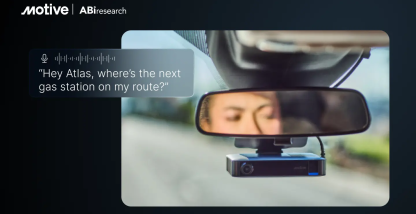
Necessity, Makani said. Delivering connectivity and automation required hardware with enough compute to run AI models on the edge. He pointed to the AI Dashcam Plus: two forward-facing cameras — one wide field of view, one HD zoom — that together support stereo vision for better depth perception and distance estimation. Two noise-canceling microphones and a speaker support a live in-cab assistant through Atlas, Motive’s intelligent AI assistant.
Owning the full stack also future-proofs the investment. Customers can upgrade capabilities in software without being constrained by yesterday’s hardware.
What results are customers seeing?
Makani walked through outcomes from across the platform:
- Customers that deploy Motive dual-facing AI Dashcams reduce collisions by up to 80%, cutting accident, litigation, and insurance costs.
- Real-time fuel interventions — telling a driver in the moment that idling is costing money — can reduce fuel waste by up to 10%.
- Workflow automation reduces time spent on screens and manual tasks for the work that matters most.
“ROI is really central to the Motive story,” Makani said.
Where is Motive headed?
Makani was direct about Motive’s vision: connect and automate every physical operation in the world. Motive operates across the US, Canada, and Mexico, is live in the UK, and is expanding into continental Europe. “Every single country, every market in the world is dependent on physical operations,” Makani said. “We believe we can bring every single one of them online.”
He closed with a lesson about scaling underneath it all: great products, a big market, and aggressive distribution — in that order. “The prerequisite is exceptional products that solve a meaningful problem.” Everything else compounds from there.