Equipment monitoring tracks the location, utilization, and health of powered and unpowered assets an operation owns: trailers, heavy equipment, containers, tools, refrigerated cargo. In this article, “Top respondents” means the top 25% of respondents to Motive’s 2026 ROI Report based on their reported “return on investment” in dollars.
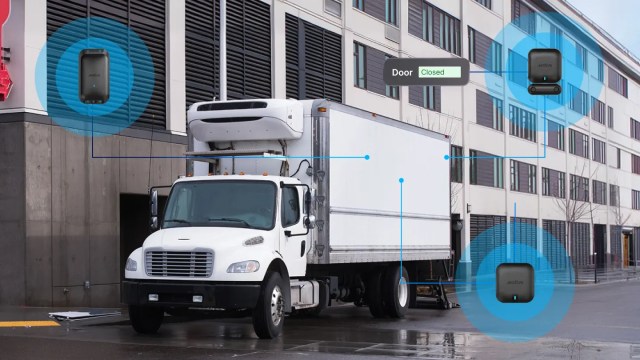
For organizations operating fleets, the return on equipment monitoring investment comes down to two things: putting idle assets back to work, and protecting the assets already paid for.
In a survey of hundreds of customers on ROI, respondents reported an average 18% increase in vehicle uptime after adopting Motive, and the top quartile reported cutting asset theft by 45%.
So what creates those numbers? How do you actually improve uptime and cut theft across your fleet with equipment monitoring?
Equipment outnumbers vehicles, and the record never catches up
Most organizations know exactly where their trucks are. Ask about trailers, generators, light towers, pumps, and other equipment behind those trucks, and the answer can be more vague.
Equipment moves between job sites, storage yards, and service locations, which makes it hard to track and easy to lose. When managers can’t locate assets, projects stall, labor is wasted, and downtime can become costly. The loss can be hard to identify because it shows up as crews waiting around, a rental invoice for a tool the company already owns, jobs pushed back, or time spent searching.
At EnerCorp, one manager is responsible for more than 1,500 assets and 200 fleet vehicles. That’s seven pieces of equipment per truck, working across well sites and hundreds of miles of West Texas roads. That ratio is normal in construction, energy, and field service — and so is the blind spot the ratio creates.
EnerCorp handled the vehicle side first, installing Motive AI Dashcams across the fleet. Within two months, cell phone use was down 25%. The company then piloted Asset Gateways on trailers and Beacons to extend visibility beyond the cab.
STEP Energy Services also operated without a reliable picture of their assets for years. Word of mouth was the only method the team had for keeping track of assets in the field, and equipment went missing as a result. Their hydraulic fracturing, nitrogen pumping, and coiled tubing equipment is expensive, and works across dozens of customer locations at a time.
Motive Asset Gateways closed the gap. STEP can now schedule work based on asset location, move equipment site-to-site, and route for preventative maintenance. When something breaks in the field, the team can find the nearest replacement instead of calling around. DOT Manager Jayme Borgstrom summarized the step change: processes are faster, smarter, and automated, and the company makes better use of time and equipment.
Survey numbers back up the pattern. Across all survey respondents, 42% ranked operational inefficiencies among their biggest challenges, including mismanaged assets and poor visibility into operations.
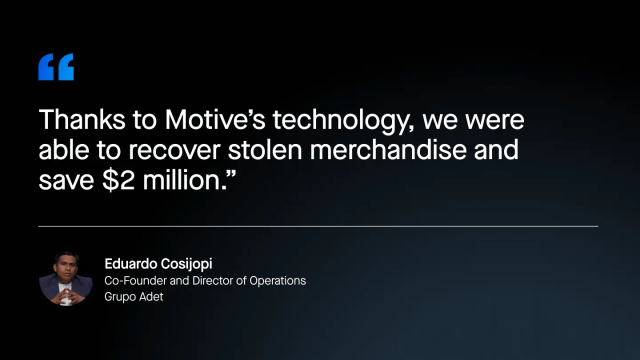
Then there’s outright theft. Between $300 million and $1 billion in construction equipment is stolen from job sites every year, and less than 20% of it is ever recovered, according to Construct Connect and the National Insurance Crime Bureau. Cargo losses are climbing on the same curve: CargoNet reported theft losses surging 60% to nearly $725 million in 2025, with the average value per theft up 36% to $273,990.
What does equipment monitoring track?
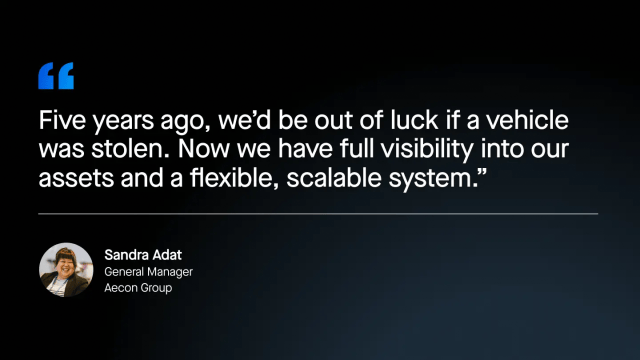
Equipment monitoring tracks three things about every asset: where it is, how much it’s being used, and what condition it’s in. Motive customers get complete visibility into the location, utilization, and health of their equipment, so managers can see what’s available and how it’s being used. Automated workflows connect equipment managers, dispatchers, and maintenance teams, which makes it easier to put idle assets to work and send the right equipment to the right job.
Customers often point out four main areas:
- Location data for different asset power sources. Cable-powered Asset Gateway Minis send minute-by-minute location updates. In battery mode they check in on a schedule, configurable from every 8 hours to every 48 hours, and Locate My Asset lets a manager request an immediate position in one click rather than waiting for the next check-in. Advanced Location Services combines Assisted GPS and cell triangulation so location data holds up across jobs and sites. For tools and small equipment, Motive Beacon uses Bluetooth to send the asset’s last-seen location through the Motive Mesh Network.
- Automatic asset-to-vehicle pairing. Motive is the only platform that automatically pairs vehicles, assets, and drivers. Travel Groups shows drivers, vehicles, and trailers moving together, so teams can confirm the right equipment is going to the right place and reroute when it isn’t.
- Utilization data that supports accurate billing. See what percentage of time an asset runs versus sits dormant, and invoice rentable equipment on true engine hours.
- OEM telematics in the same view. Motive integrates with John Deere, Komatsu, Volvo, and other OEMs through the AEMP 2.0 standard, so heavy equipment stops living in a separate dashboard.
How do you increase equipment utilization?
Utilization improves when a team can see which assets are running, which are dormant, and where the dormant ones sit. Utilization is the quieter half of equipment ROI and often a more impactful one. A machine sitting in the wrong yard for weeks costs the same as a machine that runs, and it can also trigger an unnecessary rental to keep the work moving.
Teams can identify underutilized equipment and strategically redeploy it, using engine hour insights and dormancy monitoring rather than guesswork. Available equipment inside a geofence shows up in a single view, which can make capacity planning more efficient. For operations spread across regions, assets can be grouped by site or business unit and filtered by utilization to rebalance quickly. Agmark Transportation reports a 10% increase in equipment utilization.
Better utilization can support higher uptime. All survey respondents reported an average 18% increase in vehicle uptime after adopting Motive. Every additional hour a vehicle or machine spends working is another delivery completed and another job finished.
How can asset tracking reduce equipment theft?
Top respondents in the 2026 Motive ROI Report reported a 45% average reduction in vehicle and asset theft or misuse after adopting Motive, with losses virtually eliminated in some cases.
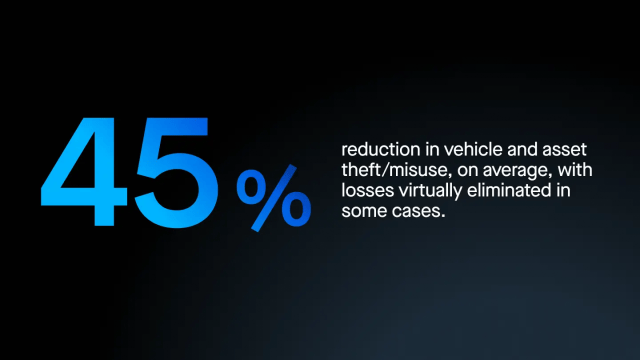
Top-performing organizations in the survey reported a significant reduction in equipment theft, and what they have in common is earlier visibility into asset movement.
Geofencing creates a virtual boundary around any location that matters and generates a real-time alert the moment an asset enters or exits it, with recipients configurable for SMS, email, and in-app. The same alerts can help teams confirm deliveries once equipment reaches its destination. And location history supports recovery and investigation after the fact.
Four steps worth having in place before anything goes missing:
- Deter. Install trackers visibly and label assets with signage.
- Detect. Turn on geofencing, movement alerts, and on-demand pings.
- React. Use real-time location, history, and alert logs to coordinate recovery.
- Document. Use those same logs and reports to support insurance claims.
Why switching now beats switching later.
For organizations weighing a provider change, deployment math matters as much as feature comparison.
- Surveyed Motive customers reported a return on investment in an average of 2.5 months for fleets with 1,000-plus vehicles, and five months overall.
- Interviewed organizations in the 2026 ROI Report who switched to Motive report reaching value faster than they did with their previous provider: more than 2x faster coming from Samsara, 1.9x from Verizon Connect, 1.5x from Geotab, 1.4x from Lytx, and 1.3x from Omnitracs (the average difference in time to first ROI, across all respondents rather than top respondents).
- Motive ranked #1 on the mid-market Asset Tracking Implementation Index in G2’s Fall 2026 reports, one of ten #1 rankings that quarter. Fleet Tracking customers report going live in 1.67 months with a 90% ease-of-setup score.
- Enterprise fleet management customers reported reaching ROI about 40% faster than Samsara customers, 5.7 months against 9.44.
Installation is deliberately straightforward. Beacon attaches to most surfaces with adhesive or screws, no wiring required. The Asset Gateway Mini offers cable and battery configurations on the same device, which matters for high-volume inventories where cabling isn’t practical. At All Chemical Transport, COO Anthony Coruccini reports installation taking about 20 minutes per truck, done in-house, saving $52,000 in installation costs and at least 180 hours.
Key takeaways and frequently asked questions.
- Equipment monitoring tracks the location, utilization, and health of assets an operation owns but nobody drives: trailers, heavy equipment, containers, tools, and refrigerated cargo.
- Utilization is usually the larger return, and the one most often missed. Idle equipment still carries ownership costs and may lead to unnecessary rentals.
- All survey respondents in the 2026 Motive ROI Report reported an average 18% increase in vehicle uptime after adopting Motive.
- Top quartile respondents reported cut asset theft and misuse by 45% on average, with losses virtually eliminated in some cases.
- Coverage matters more than any single spec in a mixed operation. Vehicle Gateways handle vehicles, Asset Gateway Minis handle trailers and heavy equipment in cabled or battery mode, and Motive Beacon handles tools and containers over Bluetooth.
- Deployment is short enough to matter before a renewal window closes. Motive customers report ROI in as little as 2.5 months at 1,000-plus vehicles, and G2 Fall 2026 ranked Motive #1 on the mid-market Asset Tracking Implementation Index.
How much does equipment monitoring reduce theft?
Top respondents in the 2026 Motive ROI Report reported a 45% average reduction in vehicle and asset theft or misuse, with losses virtually eliminated in some cases.
Can Motive support mixed operations with heavy equipment?
Yes. Motive hardware is designed to work on all types of equipment, from unpowered assets like dumpsters to powered equipment like skid steers, plus reefers and trailers. Heavy equipment telematics from John Deere, Komatsu, Volvo, and other manufacturers comes in through the AEMP 2.0 standard, so OEM data and Motive-tracked assets appear in the same platform rather than separate dashboards.
What is the difference between Motive Beacon and Asset Gateway Mini?
The difference is power source and data frequency. Asset Gateway Mini is a dual-mode GPS tracker: cable-powered, it provides minute-by-minute location updates and advanced telematics; in battery mode, it checks in on a schedule the admin sets and can be pinged on demand. Motive Beacon is a battery-powered Bluetooth tracker for smaller, high-volume equipment like containers, attachments, and tools, and uses the Motive Mesh Network for cost-effective location monitoring.
How long do the batteries last on Motive asset trackers?
Asset Gateway Mini is rated for five years of battery life at its default check-in interval. Longer check-in intervals extend battery life and shorter ones reduce it. Enabling Locate My Asset also reduces expected battery life — by roughly 25% on AG-31.2 and later devices, and roughly 40% on AG-31.1. Motive Beacon uses a replaceable battery built to last up to four years.
Does someone need to be near a Motive Beacon for it to be located?
No. Any device on the Motive Mesh Network can help locate a Beacon, and only the owning organization can see its location in the Motive Fleet App and Fleet Dashboard.
How does geofencing work for equipment tracking?
Geofencing creates a virtual boundary around a yard, job site, or customer location, and Motive generates a real-time alert whenever an asset enters or exits the geofenced area. Alerts can be customized by asset and by trigger, with recipients set for SMS, email, or in-app notification. The same alerts confirm a delivery once equipment reaches its geofenced destination.
Can Motive flag equipment health issues before they cause downtime?
Yes. Teams can tag defects, add notes and photos, and get alerted to fault codes that require action, with customizable inspection forms and a view of completed and pending tasks. Preventative maintenance alerts can trigger on engine hours, distance, or time.
How long does it take to deploy equipment monitoring?
Fleet Tracking customers reported going live in 1.67 months with a 90% ease-of-setup score in G2’s Fall 2026 reports. Installation varies by hardware: Motive Beacon attaches with adhesive or screws and needs no wiring, while Asset Gateway Mini can be deployed in battery mode without cabling or hardwired for engine hours and continuous updates.
Are there privacy or labor considerations when tracking shared or operator-owned equipment?
Yes. Use role-based permissions, asset-focused tracking, and group-level access controls to restrict access to worker, vehicle, and equipment data. Document policies, provide appropriate notice, and align usage with union agreements and internal data governance.