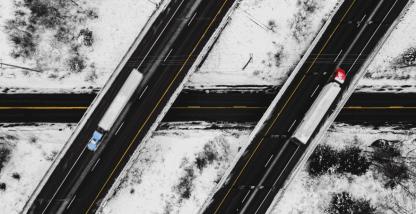


Winter in colder locations changes the risk profile of driving. Drivers face slick roads, reduced visibility, and winter-specific hazards. The Federal Highway Administration estimates that 21% of vehicle collisions occur during freezing precipitation. While seasonal driving conditions are often unavoidable for commercial fleets (especially for essential services like food transportation, mail delivery, and passenger transit), drivers can still stay safe with effective coaching.
These winter driving tips will help fleet and safety leaders prepare their teams for winter conditions.
7 safety tips for commercial drivers on icy and snowy roads
Fleet and safety leaders can use the checklist below to prepare drivers for wintry weather.
1. Add “winter weather” items to inspection checklists
2. Slow down and increase following distance
3. Use brakes properly
4. Use safe steering to maintain control on icy roads
5. Watch for winter‑specific hazards
6. Use caution around snowplows
7. Practice safe winter driving habits
1. Add “winter weather” items to inspection checklists
When a driver inspects a vehicle before or after a trip, make sure they review the parts of the vehicle that are especially important for safe winter driving. Ensure that:
- Front and rear lights and hazard flashers are operational.
- Wiper blades are unstuck and working well. For fleet managers, consider upgrading to winter blades that can cut through snow and ice.
- Washer nozzles can spray freely.
Motive allows you to customize your inspection forms if you need to make updates for the winter months.
2. Slow down and increase following distance
The faster a vehicle is going, the longer it will take to stop — especially on icy and snowy roads. Colorado State Patrol data shows that speeding contributed to about 23% of winter collisions in Colorado — nearly 1 in 4 incidents.
Fleet managers should encourage drivers to:
- Decrease speed and leave at least three times more following distance to stop safely.
- Anticipate slower driving and leave time to reach their destination safely.
- Prepare for turns, stops, and lane changes well in advance.
- Remember that four- and all-wheel drive doesn’t make it easier to stop. Extra drive power helps a vehicle to get moving, but these vehicles are often heavier and may require even more braking distance than regular vehicles.
3. Use brakes properly
Drivers need to know how to brake on snowy and icy roads to avoid skidding. They should:
- Brake gently. If the wheels lock, ease off the brake.
- With an anti-lock braking system (ABS), apply firm, consistent pressure. Drivers will feel the pedal pulse.
- Without an ABS, drivers should pump brakes gently to maintain control rather than slamming the brakes.
4. Use safe steering to maintain control on icy roads
Icy roads require special steering techniques. Advise your drivers to use these methods when conditions are icy:
- Move the steering wheel in a smooth motion, negotiating corners slowly and precisely without jerky movements.
- Use gentle impulses. For example, accelerate gently, turn slowly, and brake carefully and early.
- Avoid unplanned quick movements (with longer following distances, slower driving, etc.) that could put a vehicle into a spin.
If the tires begin to slide, steer the vehicle fully and avoid overreacting to keep control of the vehicle. Follow the tips below based on which wheels are skidding:
- Rear wheel skid. Take your foot off the accelerator and steer in the direction you want the front wheels to go. If the rear wheels start sliding the other way as you recover, ease the steering wheel toward that side. You might have to steer left and right a few times to get your vehicle completely under control.
- Front wheel skid. Take your foot off the gas and shift to neutral, waiting to steer until the vehicle has regained traction. As the wheels skid sideways, they’ll slow the vehicle and it will regain traction. Then steer in the direction you want to go. Put the transmission in drive and accelerate gently.
5. Watch for winter‑specific hazards
Winter introduces hazards that drivers don’t face in other seasons. Coach drivers about what to do in these specific situations:
- If it’s the first snow. When the first snow falls, other drivers often forget to slow down and adapt. Reinforce with your team that they need to reduce speeds and leave larger gaps between vehicles.
- When there’s a possibility of black ice. Roads that look dry may actually be slick. High‑risk areas include intersections, off‑ramps, bridges, and shady stretches. Take these stretches slower than normal just in case.
- When visibility is limited. Snow and sleet reduce visibility, along with salt, sand, and dirt. Stay attentive, reduce speed, and clean off windshields and lights during stops.
- If there is snow and ice on a vehicle. Before the trip, clear snow and ice from every part of the vehicle. Chunks of snow and ice on a vehicle can turn into road hazards for the driver and surrounding vehicles.
- When trees or power lines are down. Heavy snow and ice can snap branches or bring down utility lines. Drivers should stop well in advance of downed trees or wires on the road and avoid passing under branches or wires that may catch a high-clearance vehicle.
6. Use caution around snowplows
Drivers should exercise extra caution around snowplows. Plow operators have restricted fields of vision, and it’s likely that your drivers will see them before being seen. Advise drivers to:
- Give plows plenty of room to work. These wide vehicles may cross centerlines or shoulders.
- Don’t pass plows or sanding trucks unless absolutely necessary. If a driver needs to pass, they should do it carefully and beware of the snow cloud that plows create.
- Expect snow plows to travel below the speed limit. Be patient and allow extra time to slow down.
7. Practice safe winter driving habits
Drivers can improve safety by practicing these winter driving habits:
- Keep phones charged, and carry a phone charger in the vehicle, so that drivers aren’t left without a way to communicate.
Tip: Even if a driver’s phone loses power, dispatchers can still use Motive to see the vehicle’s location, whether it’s moving, and how long it has been stopped. From there, they can contact local emergency services or roadside assistance and share the vehicle’s exact GPS coordinates, so responders can be directed to the driver’s location even if the driver can’t make the call themselves.
- Don’t use cruise control on icy and snowy roads to prevent skidding.
- In bad weather, drive with lights on and keep them clean to ensure you can see and be seen.
- On icy roads, use lower gears as a mechanical stabilizer to maintain traction and save brakes, especially going up and down hills.
Winter makes unsafe driving behaviors even more dangerous. The Motive AI Dashcam Plus can detect and record events like close following, speeding, and forward collision warnings. When it detects a safety event, it uploads a video and alerts the driver and manager so that drivers can self-correct and managers can intervene or coach.
Bonus: What to do if drivers get stranded.
If a driver does get stranded in winter weather, dispatchers can use live vehicle location in Motive to quickly coordinate the right tow truck or roadside service to reach a stranded driver — even in remote or hard‑to‑reach winter conditions.
While waiting for help, drivers should:
- Run the engine only a few minutes each hour to conserve fuel and battery while staying warm.
- Keep the exhaust pipe clear of snow to prevent carbon monoxide buildup; crack a window slightly for ventilation.
- Use road flares (one at each end of the vehicle) and brightly colored cloth on the antenna to attract attention.
- Eat small amounts of high‑energy food (hard candy, granola, nuts, dried fruits) to stay alert.
What to put in a winter emergency kits for commercial vehicles
In the event of a breakdown, each commercial vehicle should have an emergency kit that contains the items below.
Vehicle care
- Ice scraper and snow brush
- Shovel
- Sand or traction aid (sand, cat litter, gravel, salt)
- Tow rope or chain
- Booster/jumper cables
- Road flares or warning lights, reflective triangles, brightly colored cloth
- Gas‑line antifreeze
- Flashlight and batteries
- Properly inflated spare tire, wheel wrench, jack
Personal safety and comfort
- First aid kit, fire extinguisher, small tool kit
- Candle, small tin can, matches in waterproof container
- Compass
- Exterior windshield cleaner
- Extra clothing and footwear; heavy wool mittens, socks, cap, blankets
Food and water
- Non-perishable, high‑energy food: chocolate, granola bars, nuts, dried fruits, hard candy; water and instant hot drinks (coffee, tea, soup)
How to create a coaching program for safe winter driving
To encourage safer winter driving, back up best practices with coaching. Your coaching program should include these elements:
- Alert drivers to unsafe driving behaviors in the moment. The Motive AI Dashcam Plus detects 15+ safety events with up to 99% accuracy, and alerts drivers and managers in real time.
- Coach drivers on unsafe winter driving behaviors. In Motive, you can automatically send drivers personalized feedback with AI-generated coaching videos.
- Reward drivers for practicing safe behaviors. Motive automatically identifies positive driving behaviors such as safe distancing and alert driving.
- Enable drivers to self-coach. Drivers can use the Motive Driver App to review their own safety events.
- Track driver performance over time with the Motive Safety Score.
- Manage driver fatigue. Winter weather delays may mean drivers may spend more time in traffic, at shipper yards, or crawling through snow than they planned. Motive’s ELD automatically tracks HOS to help drivers stay compliant even when winter conditions cause delays.
Overall, teach this rule for safe winter driving: Ice and Snow, Take It Slow.
As a carrier, we have different responsibilities for the public and we’re doing our part to keep roads safe. We need to be able to identify those high-risk driver behaviors proactively instead of reactively. I’d say the best thing about all of it is that Motive gives us the ability to objectively identify risk and change behavior on the front end, rather than the back end.
Is the weather too bad to drive? Making the call
Sometimes the weather is too dangerous for drivers to risk a trip. According to Virginia Tech Transportation Institute expert Thomas Dingus, driving when both visibility and traction are impaired by the weather increases the risk of a collision by 70% to 80%.
In Motive, managers can layer live traffic and weather conditions directly onto maps to see a route’s upcoming weather. With this data, they can reroute drivers or make the best decision for their safety, based on accurate, live information.
Tom Grille, a dispatcher at All Chemical, recalls a time when one of his drivers was headed toward a tornado zone. He said, “After looking at the weather overlay in Motive, I gave one of our drivers a heads up that he should take cover. That weekend, my driver called to thank me because later he saw the damage from the tornado. He was safe at home at the pool with his grandchildren.”
Ice and snow, take it slow
While best practices are always useful, real-time alerts and data-based coaching are more effective for increasing safety. Help drivers keep themselves and others safe during the winter by implementing powerful technology like Motive.