


At Motive, AI is built for the real world—where safety, reliability, and performance matter every second. From fleet safety to real-time insights, the company’s products are designed to process massive volumes of data and turn it into meaningful action for the people powering the physical economy.
For Eden Yeh, Engineering Manager on the Manufacturing team, that mission starts at the hardware level.
Eden works at the intersection of manufacturing, hardware validation, and AI infrastructure—ensuring that the devices collecting data in the field are precise, reliable, and capable of supporting the advanced systems Motive is building.
“Motive’s AI acts as a proactive safety co-pilot, processing real-time data at the edge to help prevent accidents before they occur,” Eden explains. “Because these systems operate in high-stakes environments, hardware quality is critical. Our AI needs to work precisely in situations where safety is non-negotiable.”
For engineers like Eden, working to help those powering the physical economy brings a unique level of impact. Unlike purely digital systems, the products Motive builds interact directly with vehicles, drivers, and the real world.
“That’s what makes it exciting,” he says. “Our work has a tangible impact.”
Building AI Through Hardware–Software Co-Design
A core part of Motive’s AI philosophy is pairing hardware and software together.
Rather than treating devices and AI models as separate layers, Motive engineers design them in tandem to ensure the system performs reliably in real-world environments.
Eden describes this approach as hardware–software co-design, where sensors, firmware, and AI models are developed with the same end goal: delivering accurate insights in unpredictable conditions.
“Our devices don’t operate in controlled lab environments,” Eden says. “They operate on real roads, across different climates, industries, and driving conditions.”
To make that possible, Motive prioritizes a real-world data–first approach. Devices deployed across customer fleets feed data into an edge-to-cloud feedback loop, allowing AI models to continuously learn from billions of miles driven.
This constant stream of real-world insights helps engineers refine models so they perform reliably at scale.
What Makes Motive’s AI Different
Another key differentiator is Motive’s unified ecosystem, which integrates identity, location, and safety intelligence into a single platform.
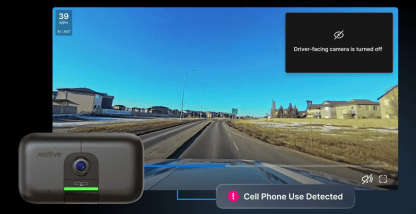
At the center of that ecosystem is the company’s AI Dascham Plus, which processes complex AI alerts locally with ultra-low latency.
Because Motive designs its own hardware, engineers can ensure the devices are capable of running increasingly sophisticated AI capabilities directly at the edge.
“Processing alerts locally allows fleets to receive insights immediately,” Eden says. “That speed is critical when it comes to safety.”
The AI Dachcam Plus platform also provides fleets with immediate value, including improved driver exoneration and safety insights, while creating a foundation for future AI advancements.
Building Trust Through Accuracy and Scale
When AI is used in safety-critical environments, accuracy and reliability aren’t optional—they’re essential.
Eden explains that trust begins during manufacturing.
Every device undergoes extensive validation to ensure sensors are properly calibrated and hardware functions are thoroughly tested before leaving the production line.
But hardware precision is only part of the equation.Motive’s AI models are also trained on one of the world’s largest labeled datasets in fleet safety, allowing the technology to learn from millions of real driving scenarios across diverse industries.
By combining high-quality hardware with massive real-world datasets, Motive engineers are able to build AI systems customers can trust.
Turning AI Into a Safety Co-Pilot
While AI can sometimes feel abstract, Motive’s approach focuses on practical outcomes for drivers and fleet managers.
Eden says the goal isn’t to replace drivers—it’s to support them.
“We think about AI as a co-pilot,” he explains. “The goal is to provide real-time coaching that helps drivers stay safe.”
Rather than overwhelming customers with data, the system surfaces the most important safety insights, helping fleet managers focus on meaningful coaching moments.
That shift—from analyzing data to building a proactive safety culture—can have a real impact on fleets and the people behind the wheel.
Engineering AI for the Physical Economy
For Eden, the most rewarding part of the work is knowing that Motive’s products impact people’s lives.
Building AI for the physical economy means designing systems that perform reliably in unpredictable conditions at massive scale.It also means helping protect drivers and communities on the road every day.
“At the end of the day,” Eden says, “the products we build are about making the real world safer.”