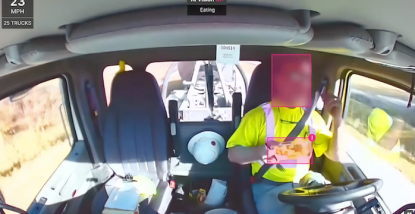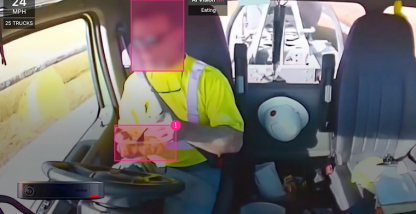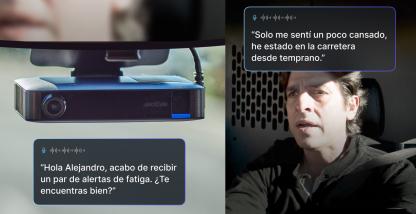



Most dash cams can tell when a driver looks at their phone. Far fewer can reliably detect when they are eating behind the wheel, and even fewer do it accurately enough that safety teams trust the alerts.
The habit of “dashboard dining” is a significant contributor to road risk, particularly for fleets navigating dense motorway networks or narrow A-roads. When a driver eats, they often experience cognitive tunnelling, a state where their mental focus narrows so intensely on the secondary task (like unwrapping a meal or managing a spill) that they lose peripheral awareness of the road. This can increase reaction times by up to 44%, making it nearly as dangerous as driving under the influence.
By adding accurate AI-powered Eating Detection to its Dual-Facing AI Dashcam and AI Dashcam Plus models, Motive enables safety leaders to tackle one of the most common and underestimated forms of distraction, without the friction of false positives.
Eating is “normal” — and that makes it dangerous
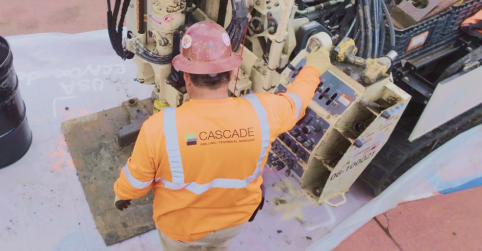
For frontline drivers and equipment operators, eating on the move feels routine. Long shifts, tight delivery windows, and remote jobsites leave little time for proper breaks. But “normal” does not mean safe.
Eating behind the wheel or at the controls:
- Pulls eyes, hands, and attention away from the road or worksite.
- Often happens at speed, in traffic, or near vulnerable road users.
- Is harder to spot than obvious violations like phone-in-hand or an unbuckled seat belt.
When incidents happen, safety leaders are often far away, trying to reconstruct what went wrong without clear video evidence of what the driver was doing. Eating may never show up in an incident report, but it can still sit at the root of unexplained rear-ends, lane departures, near-misses, and serious collisions.
Inaccurate AI makes the eating problem worse
While AI dash cams promise to close visibility gaps, unreliable systems often create more noise than value. Inaccurate detection leads to:
· Review fatigue: Managers lose hours dismissing false positives like taking a sip of water.
· Eroding trust: Drivers feel penalised for benign behaviours, damaging the safety culture.
· Unmanaged risk: When alerts are noisy, teams stop paying attention, leaving true dangers unaddressed.
This is especially critical in high-stakes industries where supervisors rely on video to coach drivers operating around pedestrians and live traffic — and need eating alerts they can trust.
How Motive detects eating accurately — and filters out the noise
You need detection that captures real risk and filters out everything else.
Instead of flagging every instance involving food, Motive detects eating only when all of the following are true:
- A visible food item is present.
- The vehicle is traveling above 25 mph.
- The behaviour lasts 5 seconds or more.
- The behaviour is not drinking.
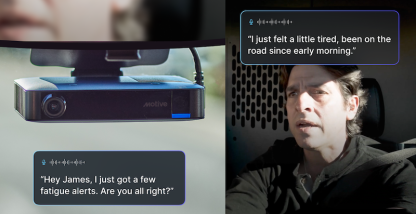
Because AI detection runs on device, your drivers can receive real-time in-cab alerts, helping them correct behaviour in the moment before it leads to an incident. Detected eating events are then validated to remove false positives before they reach you in the Motive Dashboard, so your drivers are never punished for mistakes they didn’t make.
When you see an eating event, you can trust that it is real and coachable. You can:
- Identify drivers with recurring events
- Prioritise targeted coaching
- Automatically deliver AI-generated coaching videos through the Motive Driver App.
This helps you reduce risk without adding hours of manual work.
Later in Q2, you will also be able to set custom thresholds for event detection capture and in-cab alerts.
Why this matters when you are evaluating AI dash cams
If you are evaluating AI dash cams now, eating detection should not be a checkbox on a feature list. It should be a capability you can rely on.
Ask potential providers:
- How do you detect eating, and how do you distinguish it from benign movements?
- How do you measure the accuracy of eating detection?
- How many false positives should my team expect, and what tools do I have to manage them?
With Motive, eating is no longer an invisible risk. It is a specific, high-frequency distraction that your teams can detect accurately, coach consistently, and manage at scale.
Ready to see it in action? Take a tour of the Motive AI Dashcam Plus and Driver Safety solution today.