


IFTA stands for the International Fuel Tax Agreement. It’s a fuel tax agreement among the lower 48 United States and the 10 Canadian provinces, designed to simplify fuel use tax reporting and payment for fleets driving between states and provinces.
Before IFTA, staying compliant with fuel taxes was actually a bigger administrative hassle than it is now. Companies would have to obtain a fuel tax permit, keep individual records, and file quarterly tax reports — separately for each state or province.
To fix this problem, Congress mandated in 1991 that by 1996 that the 48 U.S. states must start using IFTA. By 1996, all 10 Canadian provinces had also joined.
What does IFTA mean in trucking?
IFTA in trucking reduces administration for fuel tax compliance across states and provinces. Because trucking companies are frequently crossing borders, they are a primary beneficiary of the simpler IFTA process. IFTA means less paperwork than before for fuel tax management when routes pass through many jurisdictions.
How does IFTA work? A simple explanation
The core idea of IFTA is to remove the administrative burden from fleets for fuel tax compliance, while making sure jurisdictions still get the fuel taxes they’re owed.
Here’s how IFTA works:
- Fleets get IFTA licenses from their base jurisdiction. To comply with IFTA, fleets have to get an IFTA license from their base jurisdiction.
- Carriers file quarterly reports. Commercial fleets file a single quarterly fuel tax report with their base jurisdiction. This report shows all miles traveled and fuel purchased in each participating state or province. They either make payments or are due refunds.
- Base jurisdiction collects or pays out. After the reports are filed, the base jurisdiction calculates the net fuel tax or refund due to each of the 58 IFTA member jurisdictions. Then, the jurisdiction collects or pays out the amounts.
This way, each state or province receives its fair share of the fuel taxes based on the fuel consumed within its borders.
Who needs to file IFTA fuel tax?
Any fleets with qualified motor vehicles that regularly pass through different jurisdictions will need to comply with IFTA. In plain language, this tax system is for the long-haulers and those who regularly cross borders. If you don’t cross jurisdiction lines, you aren’t required to comply with IFTA.
A qualified motor vehicle:
- Has two axles and a gross vehicle weight (GVW) or registered GVW exceeding 26,000 pounds (11,797 kilograms).
- Has three or more axles, regardless of weight.
- Is used in combination with another piece of equipment (e.g., truck and trailer), and the gross combination weight (GCW) or registered GCW exceeds 26,000 pounds (11,797 kilograms).
- Used for business, not recreation.
How to calculate your quarterly IFTA tax
To file IFTA reports, you will need to calculate the distance traveled and fuel purchased by jurisdiction for each qualified vehicle in your fleet.
| How to calculate your quarterly IFTA tax payment | |
| Track total miles driven. | Keep accurate records of all miles driven by your qualified vehicles in each state/province during the reporting quarter. |
| Record fuel purchases. | Record all fuel purchases, including:Date.Location (state/province).Fuel type.Number of gallons.Price per gallon.Amount of fuel tax paid at the time of purchase. |
| Calculate overall fuel mileage. | Divide your total miles driven across all jurisdictions by the total gallons of fuel purchased. |
| Determine fuel consumed per jurisdiction. | Calculate the amount of fuel consumed in each state/province using your overall fuel mileage. |
| Apply the jurisdiction’s tax rate. | Multiply the fuel consumed in each jurisdiction by its current IFTA fuel tax rate. |
| Reconcile tax paid and tax owed. | Subtract the fuel tax you already paid at the pump in each jurisdiction from the calculated fuel tax required for that jurisdiction. |
| Calculate total net tax. | Sum the net fuel tax owed or credited from all jurisdictions to determine your total IFTA tax liability or refund for the quarter. |
Common challenges with filing the IFTA tax
While it’s easier to stay compliant with fuel regulations under IFTA, filing can still be an administrative burden. Common IFTA challenges are outlined below.
Monitoring quarterly tax rate updates
States and provinces can set their own fuel tax rates. IFTA requires them to publish their current fuel tax rates quarterly. Even if rates don’t change every quarter, there’s always the possibility that they could. When you do quarterly IFTA reporting, you have to make sure you’re using the latest rate, or you could be at risk for an audit – and possibly failing it.
Scaling time and resources as fleets grow
IFTA filing takes time for any fleet. And the bigger the fleet and the more borders being crossed, the more time it takes to do IFTA reporting. For example, Cascade Environmental, the largest drilling, site characterization, and remediation contractor in the U.S., had to hire a small team to manage IFTA reporting for their fleet size of 765.
“All of the drivers had to fill out reports every day, listing how much fuel they’d bought and how many miles they’d driven in each state,” said Alex Amort, vice president of risk and compliance at Cascade. “Now multiply that by several hundred drivers and factor in the administrative staff we needed to verify all of them. We’d have to calculate everything to come up with the IFTA report.”
“When we switched to using Motive to complete IFTA reports, we calculated time savings of more than 800 hours a month just from trip reports,” Amort explained.
Keeping track of paper receipts
Recording all fuel purchases isn’t easy when processes are paper-based.
“Before Motive, we actually had paper fuel envelopes in all units that had to be handed in monthly, and we had to wait for those to come in,” explained Jayme Borgstrom, DOT manager at STEP Energy Services. “Some would get lost and some wouldn’t make it to the office.”
With Motive, STEP Energy Services has automated IFTA filing, saving valuable time. “With Motive, our professionals can upload their fuel receipts right into Motive,” Borgstrom said. “It’s so much faster and easier to track and do our reporting.”
Dealing with inaccurate reporting
Inaccurate spend reporting, whether from manual data entry or fleet card issues, can lead to even more time spent on IFTA reporting. Even worse, it can lead to incorrect submissions that flag you for an audit.
Architectural Surfaces, a natural stone, quartz, and tile product company, found that their fleet card’s transaction reporting and billing didn’t match. “That made for long days and nights trying to figure out the accuracy of our spend reporting,” said Mike Meeker, fleet manager and environmental health and safety specialist at Architectural Surfaces. Fuel reporting irregularities “created a lot of chaos for our IFTA reporting, and ended up costing us when it came time to file,” he added.
Architectural Surfaces now uses the Motive Card, so they can create IFTA reporting directly from their Motive Fleet Dashboard. The Motive Card’s accurate spend reporting means Meeker no longer has to spend his weekends figuring out billing.
Cascade Environmental also values the increased accuracy they’ve gotten with Motive. “On our last state of Oregon routine fuel tax audit, the data from Motive for the selected months had zero errors in it, compared to previous months’ manual data entry, which had mistakes that had to be fixed retroactively,” Amort said.
How to make IFTA reporting easier
While IFTA was designed to reduce fleets’ administrative burden,, t it’s still a challenge to calculate and file IFTA reporting and taxes every quarter.
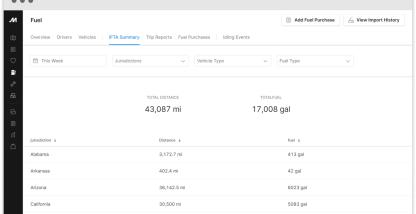
Make IFTA reporting easier by using fleet management software with built-in IFTA fuel tax reporting. For example, with Motive, you can quickly improve your IFTA reporting process and save time. You can:
- Use the Motive Vehicle Gateway to automatically record state- or province- border crossings and calculate jurisdictional mileage.
- Use the Motive Card for fleet expenses, and create IFTA reports directly from the Motive Fleet Dashboard.
- Allow drivers to upload fuel receipts directly to the Motive dashboard.
- Automate and calculate IFTA reporting.
See how Motive makes it easy to manage the IFTA reporting process.