


In physical operations, AI must meet a higher bar. Accuracy, transparency, and reliability directly impact driver safety, investigations, and fleet performance.
In this AI Spotlight, Rakesh Prasanth, Applied Science Manager at Motive explains how Motive builds safety-critical AI, why system-level thinking matters, and what customers should look for when evaluating AI for real-world operations.
Q: What is your role at Motive, and how does it support fleet safety?
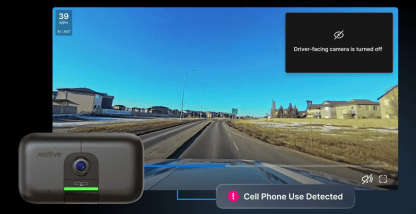
A: I lead a team building AI for Safety & Telematics at Motive. We develop and deploy machine learning models that power safety capabilities like collision detection, unsafe driving behavior detection, and deeper understanding of dashcam video.
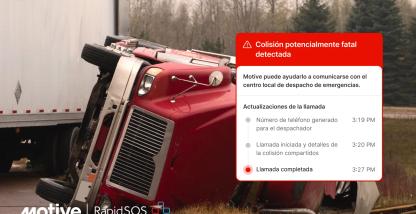
Our work starts from real safety problems—such as detecting low and high-severity collisions quickly—and combines telematics, computer vision, and generative models. We validate everything rigorously and partner with engineering and product to ensure these models work reliably at fleet scale.
Q: How is Motive’s approach to safety AI different from others in the industry?
A: Two things differentiate us: system-level thinking and precision in the real world.
We don’t treat AI as a standalone model. We design the entire safety system—from vehicle sensors and on-device models to cloud pipelines, dashboards, and coaching workflows. A model isn’t successful unless it delivers timely, accurate, and actionable insight to safety teams and drivers.
We also invest heavily in measurement and human feedback. Through controlled testing and large-scale annotation, we tune models to minimize false positives—prioritizing driver trust over shipping features quickly.
Q: What are common misconceptions about AI in fleet safety?
A: One is that more data automatically means better AI. In reality, data quality, labeling, and clear problem definition matter more.
Another misconception is relying on lab benchmarks. Real-world safety AI must perform across messy sensor data, edge cases, and changing driving conditions.
Finally, AI can’t be bolted on after the fact. Safety workflows, hardware, and data systems must be designed together, or results become unreliable.
Q: How does Motive ensure higher accuracy in safety-critical AI?
A: We’re very intentional about what accuracy means for fleets. For in-cab alerts, we prioritize precision—drivers shouldn’t be overwhelmed by false alerts they learn to ignore.
Accuracy shows up in how we build and validate models:
- Multi-stage testing, from offline experiments to controlled field rollouts
- Multimodal signals, combining video, motion, and GPS to reduce ambiguity
- High-quality human review focused on rare and ambiguous cases
- Deep analysis of long-tail scenarios before any model is considered production-ready
If we can’t prove accuracy improvements with data, we don’t ship.
Q: What should fleets look for when evaluating AI safety solutions?
A: Start with outcomes, not features. Look for measurable improvements like fewer collisions, faster investigations, and reduced manual review.
Ask how accuracy is measured and validated, and whether vendors can run side-by-side trials in real conditions. Safety AI should be transparent, configurable, and designed to fit into existing safety programs—not replace them.
Q: What’s next for AI in fleet safety?
A: Safety AI is moving from reactive alerts to proactive risk prevention.
We’re seeing progress in richer scenario understanding, where systems can explain why an event happened—not just that it occurred. Predictive safety, such as fatigue and near-miss detection, will allow fleets to intervene earlier. And more intelligence will run directly on vehicles for real-time response, with the cloud enabling deeper analysis and long-term improvement.
At Motive, our work in collision detection, fatigue, video intelligence, and next-generation cameras is building toward this future.
Bottom line: Safety-critical AI must be accurate, explainable, and proven in the real world. That’s the standard Motive builds toward—every model, every release.