
In our personal lives, we rarely tolerate one-size-fits-all experiences anymore. Open Amazon and your homepage reflects your habits, history, and preferences, not some average shopper. Spotify and Netflix do the same, tailoring what you see and hear to how you behave. These products don’t just function. They feel like they’re working with you, and as a result, they work better.
That same expectation is showing up in enterprise software in a big way. Leaders are no longer choosing platforms based only on what they can do. They’re choosing platforms that can flex around how the business actually operates. In safety, that kind of customization matters more than almost anywhere else.
For Gautam Kunapuli, engineering manager at Motive, customization is how AI-powered safety becomes most impactful for fleet-based organizations that operate in radically different conditions.
“There is no one-size-fits-all,” he says. “Customization really helps Motive customers tune safety alerts to their own needs.”
Customers’ expectations have already changed
Customization has become a baseline for modern product design, because people expect technology to meet them where they are. That principle carries real weight when AI is responsible for detecting imminent risk and shaping coaching.
With so much at stake on the road, AI-powered safety should be tailored to each fleet’s unique needs. Fleet-based organizations need systems that reflect their environment, their policies, and the ways drivers actually behave on the road. Motive built its AI-powered platform with that reality in mind, giving organizations the ability to tune in to what matters, when it matters.
Why one-size-fits-all AI fails on the road
The gap shows up clearly in physical operations.
Kunapuli points to two customers with vastly different use cases — a last-mile delivery fleet and a long-haul trucking or logistics operation.
A last-mile delivery fleet operates in urban or suburban areas where speeds are lower, stops are more frequent, and pedestrians are part of the daily reality. Compare that with a long-haul fleet that operates at highway speeds, where tailgating, fatigue, and sustained attention shape risk in different ways.
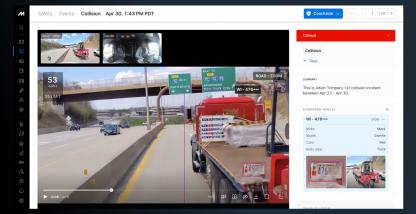
“On paper, both operations take place on the road,” Kunapuli says. “In practice, what safe, normal driving looks like in those two environments is completely different. And that matters when you’re relying on AI-powered safety features that detect behaviors such as close following or cell phone use.”
A single configuration can’t serve both organizations without tradeoffs. Alerts can miss meaningful risk if settings are too high. Driver trust can erode if settings are too sensitive and the system floods the vehicle with unnecessary warnings. Customization is how AI aligns with the way each fleet operates.
By allowing customization, we allow customers to tune our products to their own needs. That’s the big picture.
Geography, density, and the reality of physical operations
Even within the same industry, geography and environment change what risk looks like.
Operating in New York comes with dense traffic and pedestrian activity. Operating in Wyoming or the Pacific Northwest brings different road conditions, weather patterns, and elements of risk. A rigid standard setup can’t adapt to those extremes.
Customization makes safety alerts feel accurate in each context.
“Motive gives fleet-based organizations the ability to fine-tune when behaviors trigger based on factors like speed and duration,” Kunapuli says. “They can adjust thresholds so the system best aligns with their own safety priorities, rather than forcing the organization to adapt to default settings.”
Configuration can also go deeper than the fleet level. Motive settings can be applied at the vehicle level, or even the driver level, reflecting differences in routes, equipment, and risk exposure across the organization.
Why to customize your safety program — from Motive customers who’ve done it:
The value of configurable Safety Scores
One of Kunapuli’s favorite examples of meaningful customization is the Motive Safety Score.
Behind that single number are many unsafe behaviors such as cell phone use, close following, speeding, harsh braking, stop sign violations, and more. How those behaviors are weighted shapes driver coaching, incentives, and how fair the system feels to drivers.
Motive gives fleet managers the ability to customize how much each behavior impacts the Motive Safety Score.
“Customers can customize exactly how much weight each of these affects drive score for their fleets,” Kunapuli says. “Our customers have vastly different expectations on which behaviors and thresholds are critical, and they can address each behavior however they choose.”
Some fleets have zero tolerance for cell phone use. Others care more about tailgating on freeways. Others focus heavily on speeding. Custom weighting turns the Motive Safety Score into a direct expression of a fleet’s safety policy and culture.
When drivers see that the score reflects the behaviors leadership actually prioritizes, trust increases. Coaching becomes more consistent. Incentive programs hold more credibility.
“Organizations have an opportunity not just to create a policy, but also to enforce a Safety Score that is concretely reflective of that policy,” Kunapuli says.
Listening to the details, from LEDs to thresholds
Not every customization is about AI detection. Some of the most meaningful examples are small, human details.
Kunapuli points to LED brightness on the AI Dashcam as a customer-driven story that shaped the in-cab experience, especially for night driving. Customers shared that the lights were too bright in dark cabins at times. Motive responded by adding controls so organizations could adjust brightness to match actual operating conditions.
“The Motive platform today is really awesome,” Kunapuli says. “It gives customers the ability to fine-tune product behavior, for example, by setting a minimum speed at which a certain behavior triggers, or determining how long a behavior must be happening before an alert is triggered.”
Those controls help businesses strike the right balance between catching risk early and avoiding alert fatigue. Combined with fleet, vehicle, and driver-level configurations, the result is a platform that adapts to the real world.
Why customization matters
“There is no one-size-fits-all,” Kunapuli says. “Customization really helps customers tune and get the perfect product experience that matches their expectations.”
AI safety only works when customers believe the system understands their world. Customization is how that belief gets built. Motive gives organizations practical control over how safety is measured, how AI behaves, and how drivers experience it.The result isn’t more settings for the sake of settings. The result is technology that feels like it fits. That’s where real AI adoption begins and safety outcomes follow. Check out our Driver Safety page to start customizing your program today.