


At Motive, our AI team is building technology that transforms how the physical economy operates — making fleets safer, smarter, and more efficient. In this AI Spotlight, we feature Avinash Devulapalli, a Senior Product Manager on the Safety Team, who shares how his work connects cutting-edge AI with real-world impact.
Tell us about your role at Motive and what it entails.
As a product manager on the Motive Safety Team, I lead the development of AI-powered models that cut across data sources like telematics and vision. These models detect incidents using our Vehicle Gateway and AI Dashcams. Since joining Motive in 2024, I’ve helped improve existing models and ship new ones that work reliably at enterprise scale — helping companies in the physical economy operate more safely.
How is Motive’s approach to AI different than others in the industry?
“In the age of machine learning, humans will evolve into learning machines.” This philosophy shapes Motive’s distinctive approach to AI. Our success comes from a collaborative loop between humans and machines: customers provide feedback, our safety review team amplifies it, and our models evolve rapidly to meet real-world needs.
Motive’s AI stands apart through:
- Obsession with solving customer problems
- Relentless application of emerging technologies (ML, GenAI, etc.)
- The scale and diversity of data from IoT devices — dashcams, vehicle gateways, and asset trackers
- Safety experts who continuously train our models to handle long-tail, unpredictable scenarios
This unique combination lets us deliver trustworthy, differentiated AI solutions.
What are the industry’s biggest misconceptions about AI?
That AI must be flawless from the start, or that it can replace humans entirely. In reality, AI is best at augmenting human expertise. For example, our systems flag potential risks so safety managers can take decisive action — not eliminate their role.
How has your view of AI — and how customers use it — evolved?
At first, I was focused on precision and building cool models. But hearing a safety manager describe how an AI alert prevented a fatal crash completely shifted my perspective.
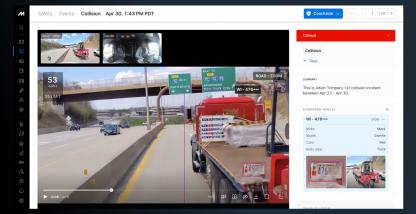
Now, I think as much about ease of use, edge cases, and customer trust as I do about accuracy. For example, Motive automatically detects 99% of high-severity collisions within seconds and uploads video immediately. In severe collisions, our First Responder feature provides managers a priority line to local emergency services, getting drivers life-saving help faster.
Customers, too, now see AI as more than automation. They use it to make better decisions: coaching drivers, handling claims faster, and reacting quickly when incidents occur.
How do we make our AI more accurate than others in the industry?
Accuracy starts with diverse real-world data, handling data noise, and relentless iteration based on customer feedback.
- Example: our new on-edge speeding algorithm corrects for GPS inaccuracies, giving drivers timely alerts they can act on immediately.
- Example: for low-severity collisions, telematics alone can fall short — so we’re piloting a computer-vision layer to improve detection.
Every tweak we make comes from re-examining data sources, piloting with customers, and rapidly iterating — ensuring insights that fleets can trust.
What advice would you give to those evaluating AI for physical operations?
Ask: “Does this AI solve my specific problem in my environment?” Don’t settle for demos on ideal roads. Look at real-world performance data, especially in edge cases.
Also, demand explainability: can you understand why an event was triggered, and trust it in a coaching conversation? The best AI earns trust, not just attention.
What’s next for AI in physical operations?
AI is evolving from spotting isolated incidents to delivering contextual understanding over time. By analyzing incidents in sequence, our models provide richer insights that improve driver coaching and safety outcomes. This kind of temporal awareness is a leap forward for operations where conditions can change in seconds.
Why is AI especially useful for large enterprises?
Managing a large fleet means countless moving parts — far too much for humans alone to monitor. AI is the only practical way to ensure safety and consistency at scale.
Motive’s AI has helped fleets reduce accidents, lower insurance costs, and speed up investigations. By combining dashcam video, telematics, and context, we give customers not just alerts, but actionable insights.
For enterprises, AI isn’t just a nice-to-have — it’s leverage.
Join the movement
Motive’s AI is already helping fleets work safer, smarter, and faster.Explore open roles on our Careers Page