

Meet Kartik Aiyer, a Software Engineer on Motive’s Connected Devices team. His work helps power the AI and safety features behind our AI-powered camera products, making roads safer and fleets smarter.
What’s your role at Motive?
I develop software for our camera products. I started in 2020 when we launched the AI Dashcam — Motive’s first edge AI-enabled camera — where I built the software for video capture, retrieval, and AI features.
Today, I lead New Product Introduction (NPI) efforts for Motive’s AI Omnicam. My role encompasses the entire product lifecycle — from architecture and implementation to launch — while collaborating with cross-functional teams and driving innovation in AI and computer vision.
What drew you to Motive?
I wanted to apply my experience in embedded camera software to a field where it could have a real impact. Fleet management is a field where uptime, safety, and liability have a direct impact on success.
During interviews, Motive’s commitment to building real AI products stood out. The team combines academics and industry experts. We partner with a trusted vendor specializing in AI vision. Reviewing the AI Dashcam roadmap, I found myself mentally designing solutions and got excited. Motive’s decisive, data-driven approach is what keeps me here.
How do you stay current and competitive as AI technology evolves so quickly?
I focus on two things:
- Hardware platforms: track the latest silicon releases, looking for compute platforms that best support AI innovation.
- AI fundamentals: study AI techniques, not as a researcher, but to understand the computational demands behind them.
This helps our team choose the right hardware to keep our AI products competitive.
How do our AI models work for customers?
Motive’s AI models are designed with a customer-centric focus, continuously refined based on real-world performance data and feedback and input from customers. They leverage both AI and computer vision technologies to deliver highly accurate detection of unsafe driving actions.
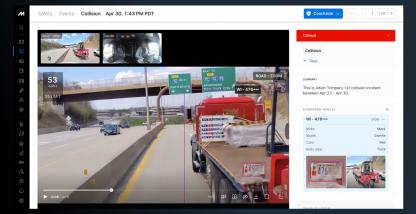
Our dual-camera system delivers critical safety features like:
- Close-following detection
- Cell phone usage identification
- Drowsiness detection
- Unsafe lane changes
- Lane swerving
- Stop sign violations
Real-time alerts help drivers correct behavior immediately. Fleet managers use the data to coach drivers and reduce incidents, protecting their operations and cutting costs.
What’s next: Our new AI Omnicam platform will bring features like pedestrian detection, backup assistance, and wide-turn alerts, offering a 360° view around vehicles.Even better: We push new AI capabilities to existing devices through over-the-air updates.
Favorite project so far?
The AI Dashcam. I developed the framework for video recording and AI features. It was lean, fast, and collaborative across the entire company.
Nothing beats spotting our cameras in vehicles during road trips — seeing real-world impact is why I love what we do.
What makes Motive’s AI different?
We build AI with purpose, not buzzwords. Here’s how:
- Customer-first: We solve real-world challenges based on real feedback and input from our customers.
- Efficiency: We build for strong ROI. Giving real people time back in their day.
- Expertise: We blend academic rigor with real-world know-how.
- Continuous improvement: We refine models based on real performance data.
The results speak for themselves: fleets using our AI have seen 22% fewer accidents and 56% fewer safety incidents.
How do we ensure AI accuracy before launch?
We’re metric-obsessed. We iterate, refine, and only launch when it’s ready. Each product is measured for precision, reliability, and device health.
We follow a phased launch:
- Internal testing: Employees use it first.
- Alpha customers: Small group tests for metrics and hardware performance.
- Beta customers: Wider release to test reliability and service-level agreements (SLAs).
Why it matters: It ensures the AI works in real-world conditions, minimizes false positives, and earns customer trust.
Kartik Aiyer and the Connected Devices team are driving Motive’s vision for a safer, smarter, and more efficient future. By designing every aspect of our AI stack in-house and relentlessly focusing on accuracy, we’re setting new standards for how AI can improve safety and productivity for businesses operating fleets. Interested in helping unlock the potential of the physical economy? Apply today at gomotive.com/careers.