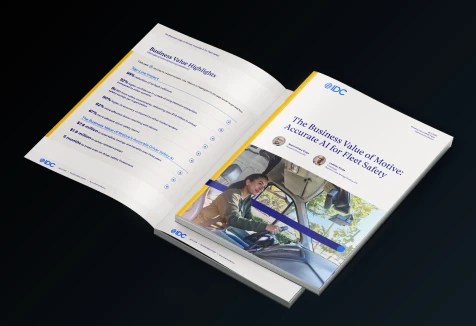


What fleet spend fraud actually costs, what an integrated card returns, and what customers report in the 2026 Motive ROI Report.
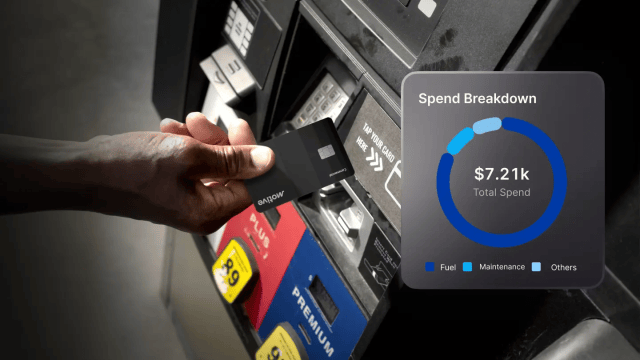
Fleet spend management covers everything an operation buys to keep vehicles moving — fuel, maintenance, repairs, roadside service — and the fraud that can drain resources from all of those things. Organizations can find savings in two places: capturing what would otherwise be missed, and stopping fraudulent or unauthorized transactions before they clear.
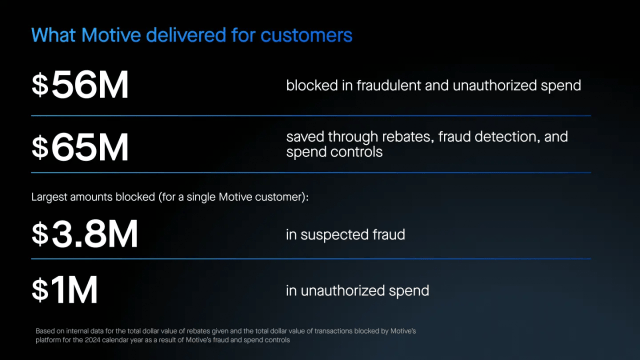
In 2024, Motive blocked $56M in fraudulent and unauthorized spend for customers, who also saved $65M overall through rebates, fraud detection, and spend controls (based on internal data). Leaders are often uncertain how much of their current fleet spend is lost to fraud. In the ROI Report, respondents estimate it’s up to 19%, with construction leaders putting it even higher, at 22%.
Where fleet money leaks
Fleet spend often disappears through three channels, and most operations only watch one of them:
- Unclaimed rebates. A fill-up at a non-partner station or at a partner station without the right fleet card could be a discount left at the pump.
- Fraudulent and unauthorized transactions. Skimmed card numbers, personal purchases on company cards, fuel pumped into the wrong tank — these can be small individually but really add up in the aggregate.
- Administrative time. The cost of hours spent reconciling receipts, chasing exceptions, and correcting errors by hand, often to only catch errors long after the transactions have posted.
In the ROI Report survey, fraud is a top concern for 18% of all respondents, and decreased costs rank as the single biggest growth opportunity, cited by 54%. The money is on the table; the tooling to pick it up is what’s usually missing.
What makes an integrated fleet card different?
An integrated fleet card shares data with the telematics platform so teams can compare transactions with vehicle activity. Where a standalone card sees only a purchase, an integrated fleet card can also connect it to the vehicle’s location, when it happened, and how much of the purchased fuel actually reached the tank.
When card and telematics data sit in the same platform, teams can automate fraud detection so action happens immediately instead of at month-end reconciliation.
“Motive has a feature that shows what you pump and compares it to what actually shows up in the tank. We get a real-time alert whenever there’s a discrepancy. We’ve caught three people who have conducted fuel fraud, and we’ve terminated those individuals, so they can’t do it anymore. That was our auto-decline. We terminated them.” — Jonathan Keyes, Senior Director of Operations Infrastructure, Hawx Smart Pest Control, in the 2026 Motive ROI Report
How much can you save on fuel?
An integrated fleet card with a physical operations platform designed to identify and act can be a strong source of fleet fuel savings. As an example, Motive rebates can reach $0.21 per gallon across a savings network of 38,000+ locations, including more than 4,000 major truck stops. You pay the retail price at the pump, and the rebate is applied once the transaction posts.
Three tools help drivers find and use those savings:
- Savings Finder shows drivers nearby partner locations, fuel prices, and Motive Card discounts in the Driver App, with navigation to the discounted station.
- Missed Savings identifies the fuel savings a fleet didn’t capture — including opportunities worth up to 5% of fuel spend.
- Roadside Assistance, powered by the National Automobile Club, covers the US and Canada around the clock at savings of up to 20%, with another 5% off when paying with Motive Card.
Pre-negotiated direct discounts with fuel merchants can usually be carried onto the card, so existing deals aren’t lost in a switch. For one example of what’s possible: one Motive customer reported saving up to $500K on fuel in a single year.
How does fleet card fraud detection work?
Fraud controls compare each transaction with fleet rules in real time and can decline purchases that fall outside them. Managers set limits for individuals or groups of cardholders, freeze cards, and auto-decline transactions that fall outside policy. Spend Profile categories keep purchases aligned with fleet policy by role.
The telematics layer adds checks a standalone card can’t make: whether the gallons pumped match what reached the tank, and whether fuel is being bought outside working hours. As Senior Director of Operations Infrastructure at Hawx Pest Control Jonathan Keyes stated: “We control when drivers get fuel, restricting it to hours of operation. So if they try to get fuel after hours or on the weekends, we can control all of that.”
Leaders across the industry understand the need for exactly this kind of automation. Motive’s 2024 Physical Economy Outlook reported that 38% of them are looking to AI to help with fraud detection and prevention.
Fraud protection at platform scale
In 2024, Motive blocked $56M in fraudulent and unauthorized spend for customers, and customers saved $65M through rebates, fraud detection, and spend controls (based on internal data).
Most striking? The distribution behind those totals. The largest amount blocked for a single customer was $3.8M in suspected fraud, plus $1M in unauthorized spend for another.
Additionally, top respondents in the 2026 ROI Report — the top 25% of the 351 surveyed customers by reported ROI — reported $1M in average business savings per organization across the Motive platform, savings which could include fuel costs and other fraudulent transactions.
Spend management is one section of the 2026 Motive ROI Report, which covers driver safety, fleet management, and equipment monitoring alongside it. Motive’s Integrated Operations Platform brings Driver Safety, Fleet Management, Equipment Monitoring, Workforce Management, and Spend Management together in one place.
Frequently asked questions about fleet spend management
How do rebates with Motive Card work?
You pay the retail price at the pump, and a rebate is applied once the transaction posts on the Motive Dashboard. The discounted amount appears when the charge processes rather than at the pump.
Where can you use Motive Card?
Motive Card is a Mastercard, so it works anywhere Mastercard is accepted, for any purchase type the fleet approves. Managers control spending with Spend Profile categories so transactions stay aligned with fleet policy.
How many savings network locations are truck stops?
The Motive Card Savings Partner Network has over 38,000 locations, including more than 4,000 major truck stops. The Savings Finder tool helps drivers locate the best discounts among them.
Can an existing direct fuel discount carry over to Motive Card?
In most cases, yes. A pre-negotiated direct discount with a fuel merchant can usually be integrated into Motive Card, while keeping Motive’s spend management and security features on top of it.
How does Motive Card detect fuel fraud?
By comparing the transaction against what the vehicle actually did. Motive compares what’s pumped with what shows up in the tank and sends a real-time alert on any discrepancy, as Hawx Smart Pest Control describes in the 2026 ROI Report. Managers can also set per-cardholder limits, freeze cards, and auto-decline transactions that fall outside policy.