
Webinar On-Demand
From Insights to Impact: AI Trends Redefining Fleet Management in 2026
Duration:
Transcript
Welcome everybody to a Motive webinar. Thank you all for joining. A couple of housekeeping items before we jump in. This webinar will be recorded and will be sent to your inbox, in the next few days.
So, and then we wanna hear your questions. You can submit your questions anytime throughout the discussion by adding them to the q and a box. If you don’t have enough time to get through your questions during this presentation, you’ll be sure to have someone follow-up with you.
And then if you have more questions or prefer one on one support, you can click on get started, and we will have someone follow-up with you shortly after this session. For now, we truly appreciate everyone taking time out of their day to learn more with us.
We’re always inspired by your needs and feedback, so please feel welcome to interact with us today. But first, let’s start getting off. Let’s start off by getting to know our speakers.
So, yeah, please introduce yourselves, Jonathan.
Hey. Thanks, Gautam. I’m I’m super excited to be here live today. Jonathan Keyes, senior director of operations infrastructure.
I’ve had a a fun career. I’m I’m coming from you, to you from Ogden, Utah, just north of Salt Lake City, and I’ve had a great career. I started in the oil field with telematics, and then I moved into the mining space. And I was in the mining space for about ten years.
And in the mining space, focused on telematics as well as fatigue technologies, collision avoidance, and finished off my career in mining with automating dump trucks with robotics, and that was kind of really fun. And now I’m in the pest control world. So I’ve left the global market, and I’m I’m now just based here in the US full time. And and I love my role here, and and and I’m in charge of our fleet, our risk management, our insurance, and and maintain the vehicles as well as our IT. So I’ve got quite a few hats, but love love love to talk about AI and and and some of the changes that it’s it’s done to help us.
That’s fantastic. Thank you. Thank you, Jonathan. Really great to have you here. Sean, please go ahead.
Excellent. Thank you, Gautam. Hello, everyone. My name is Sean Martinez. I’m outside Seattle, Washington, and I’ve been in safety for over twenty years.
Safe driving is a a passion of mine, and I currently am the safety director for CoolSys, an HVAC refrigeration and construction company headquartered out of Brea, California. We’re a nationwide company.
We have approximately thirty seven hundred employees.
We have the Motive AI dash cams deployed in approximately thirteen hundred of our fleet vehicles, and I’m extremely excited to talk today about how we’ve leveraged AI to transform our ops leaders into effective safety coaches to ensure that everyone makes it home.
That is brilliant.
Thank you, Sean. Very warm welcome to both Sean Martinez and John. He’s here. I will be your host for this afternoon or, you you know, morning, wherever you’re calling in from. My name is Gautam Kunapoli. I’m the director of AI and ML at, Motive, and I’m calling in from New York City. But that said Safer, more productive, and more profitable.
Motive is the only fully unified integrations operations platform.
Integrated operations platform that brings together driver safety, fleet management, equipment monitoring, spend management, workforce management, and AI vision into one seamless solution.
Our platform eliminates data silos, and it creates a single source of truth. And that empowers you to operate more efficiently. With fewer vendors to manage and less strain on IT teams, Motive simplifies operations so you can focus on what matters the most, running your business.
And over the last couple of years, AI development has moved incredibly fast. And right now, we’re she we’re seeing a big shift.
AI advancement is no longer about experimentation or headline grabbing breakthroughs. Right? It’s it’s leaders in the physical economy are asking a much more practical question. Does this actually work in the field? You know, in the cab, on the job site, under real operational pressure?
And that evolution is shaping the next wave of AI. One centered it’s it’s it’s it’s a shape it’s a wave of AI that’s centered on automation, AI agents, copilots, and these are things that don’t just surface information but can actually help teams execute.
For the last few years, AI has, helped organizations see more, better detection, better reporting, accurate alerts. But visibility alone doesn’t change outcomes. In twenty twenty six, AI, as you can probably feel, is moving beyond insights and into action. It’s helping leaders step in earlier, make faster decisions, run day to day operations with a more proactive mindset.
And that’s what today’s discussion is about. We’re gonna break down what that shift looks like across safety, operations, finance, all the things that matter to you. Because when AI is applied in the moments that carry the most risk and cost, the impact, it really does show up very, very quickly.
And then there’s many industries that are moving the physical economy forward. And, you know, we have two great leaders here today from those industries and a bunch in the room too, no doubt. Transportation and logistics, construction, energy, field services, all of these operate in high stakes, high cost environments where safety, efficiency, and profitability are constantly at risk. And that’s why the ROI story is playing out differently in the physical economy. For knowledge workers, value from AI investments has been slow to emerge. In one survey, nearly two thirds respondents said they hadn’t yet started scaling AI across their enterprises.
But physical economy leaders don’t need any convincing about the value of AI.
They, you, have seen rapid returns that AI is creating for their organizations, and now they are fully invested.
So because so because of this, every day in physical operations, you know, it carries real consequences. And the proof of AI’s value is all there in the numbers.
Motiv’s twenty twenty six ROI report based on a survey of three hundred and fifty one customers across industries in North America shows that physical operations leaders are seeing measurable gains across the board in safety, productivity, profitability, up to two x, twice as fast as in the past. And they’re seeing results like, you know, one million dollars in average savings per fleet organization or twenty five hours saved each week on average and up to five hundred thousand dollars saved in fuel costs single year alone. If last year was about proof, then this year is going to be about scaling that impact even further. And that’s what we’ll dig into next, what this looks like in real operations, and how leaders such as Jonathan and Sean are turning AI into measurable outcomes at scale.
And this is basically, you know, a bit of an outline of some the topics we’re gonna cover today. Right? When we when you look at organizations that are seeing these results, some clear patterns that are emerging, and I wanna talk about that.
So first, the dashboard era is over. Leaders expect instant answers to easy to understand in, you know, to easy to in easy to understand language. You know? You wanna talk and get results quickly instead of drowning in data that’s difficult to make sense of.
Second, automation becomes operating leverage, so less manual work and helping teams execute faster and more consistently. Third, edge AI, on device AI is gonna shift management focus, right, from from reactive to proactive stances. And fourth, AI vision, expands operational awareness beyond driver behavior and into day to day field execution.
And fifth, as AI extends across more vehicles and assets and workflows, the returns compound. So these are the trends shaping fleet management today.
And so without further ado, let’s get right into it. We’re gonna hear what this actually looks like inside inside real operations. So here’s a good topic to start with, AI as a daily operating layer. So let me set this up, Jonathan and Sean.
Right? So as AI has moved from something that teams check after the fact to something they can rely on throughout the day, You know? And you’ve you’ve seen the shift in your organization. So how does AI show up in your day to day operations now?
And and how has it changed how quickly your teams can can make these decisions? Maybe start with you, Jonathan.
So I think it’s it’s incredible. The the future has arrived. Right? You know, I feel like we’ve in just a few short years, I was telling the team before, you know, I had heard that AI was gonna change the landscape of everything and then it would be almost instantaneously overnight. And we’re seeing that. Like, these things are exponentially changing and adapting and and learning algorithms is just with these supercomputers is just incredible rate. And so for us, we’ve been trying to be early adopters of that because we don’t wanna become irrelevant.
We are in pest control, obviously, and and, you know, there’s multiple pest control companies throughout the United States. So how do we diversify? So we’ve been adopting AI at a very, very fast rate.
One of the things that we’re we’ve been working on currently is route efficiency.
And so we’re using AI to build a route based upon the the employee skill set, what the customer needs are, and their availability. Like, if they call in sick, then we have to readjust all that. So we’ve done that. You know? And and and part of that has actually helped us to qualify for an NPMA award that’s actually a sustainability award because we we through this route efficiency and, obviously, we’re we’re monitoring idle time, we’ve used through AI analytics, through Motive, actually, we’ve reduced our carbon footprint significantly. We’re we’re we’re we’re idling less than ten percent.
We’re when we started, we were at thirty percent idle time, which is just ridiculous. But AI is impacting everything, including, you know, how we write emails. Like, I’m a pretty deep thinker. It takes me a while to be able to, you know, process how do I wanna write to this group.
And so now I can write a few words into Gemini, which we use the Google platform, and and it could crank out an an an email in in very short order, very professional. In fact, sometimes I get a little emotional. I I I get a little angry at some of our suppliers, not motive, of course, but but I get a little upset. And so I throw a lot of anger into my emails, and then Gemini cleans all that up and presents the facts, and we off we go.
So these are some of the things that we’ve we’ve been doing.
That that’s really great. Sean, why don’t you weigh in here?
Yeah. Jonathan, I’m glad that you’re working on your soft writing. Well, it it it is amazing how AI AI driven tools, AI in general, has moved into our daily working lives here at CoolSys. We use AI for recruiting.
We use predictive analytics for new hires to determine risk level.
And, of course, the Motive AI dash cams have had and I I’ve I’ve said this many times, and I’ll keep saying it’s had a profound impact on our driving behavior.
And it’s a it’s a complete system that I honestly don’t know what one can do in terms of impacting driving behavior at scale unless you have the the dashcam and the AI and the alerts, etcetera.
Of course, with the system, we have coaches that are looking at events and looking at data every day.
But with the Motive AI dashcam system, the alerts themselves are coaching our drivers and impacted what we found was that that’s had the greatest impact on our driver behavior. The coaches and the ops leaders have an impact, they have an important role in the entire system.
But, really, it’s the it’s the in cab alerts based on that AI detection that has had the greatest impact that allows for drivers to self correct. And I honestly think that there’s less stress, less anxiety once the system is adopted for a large part.
I think that it allows leaders to do what they’re focused on in terms of financial KPIs or or whatever they wanna do otherwise.
And they don’t have to coach on every incident that occurs because the system allows for the driver to self correct. So that’s what I like about the system is that it’s so efficient and easy to use.
Well, that’s that’s great. Thank you. So AI I mean, that that’s really great to see how AI is just kinda showing up in so many different areas of of ways in which you operate, you know, profitability, safety.
And I think most importantly, helping clean up Jonathan’s email is always, you know, a good one. So it’s I would put that on top of the list of of good applications. Right? So that’s great.
That actually brings me to, you know, you as users.
We we understand your perspective for yourselves and for your organizations. But let’s talk about drivers and technicians as well, right, the the other core group of people that are also, you know, that we think about in our space that use AI frequently.
And you guys have already mentioned this AI powered coaching, using of AI avatars or AI agents, as they’re called now, you know, to coach drivers proactively can feel very different from, you know, after the fact reviews. Right? And Shadi, we’re just talking about this kind of coaching and the impact over there as well on overall safety. So how has AI powered coaching impacted your ability to coach at scale and bring a better, culture of behavior and trust to your organizations?
So yeah. Go ahead, Jonathan.
So yeah. Thank thanks, Gautam. I like what Sean said, actually.
I I think I think overall AI coaching, like, with what Motive actually provides a great a great feature, by the way, it’s saving time for the the general managers and and and the field field leads out there. Right? Because they’re they’re not having to do as much mining on the data. They’re not having to go through all the events and say, okay. What’s pertinent? What’s not?
The coach is actually providing a summary. And so we’ve actually used the avatar that Motive has as an AI coach. In fact, I’ve been been trying to get the president to take enough time out of his busy schedule so we could build an a an avatar around him and then they actually hear from him, which I think is most impactful. Right?
Honestly, with how the avatar is, you would never know that it’s an avatar. That’s that’s the power of AI today. You you can’t really tell what’s what’s real, what’s not, but I think very impactful to have the actual president of the company coaching the people. So we’re we’re hoping to implement that this year.
But but I’m I’m with Sean all the way. Like, this this has allowed the GMs to be focused in on the stuff that matters most.
We we ended up, removing dismissing from the GMs because we wanted them to be focused on on other things. And so the AI is actually marking things as coach, so we’re we’re we’re we’re improving the behavior. We we had our scores dip just a little bit on our driving behavior, but now they’re starting to level back up, and and we’ve seen huge benefits from some of this.
So Yeah.
So what we’re doing yeah.
Sorry.
Sorry. Please. Go ahead. Go ahead.
Yeah. So we’re we’re currently testing the the Avatar AI coaching system.
After about a month, what we’re gonna do I already know that the ops leaders whatever we can do to take something off their plate and allow them to focus on what they wanna focus on and make the system far more efficient with either the same or the great amount of impact, then the it’s easy to get buy in from from the ops leader. So we’re gonna wait and see. We’re gonna get some feedback. We love the idea of the the whole automated coaching directly to to the driver.
I we love the way how it’s laid out in terms of being very positive, very constructive. So it follows that transformational style leadership that’s really motivational and inspirational. So as long as it’s as long as it has that angle, then we’re very pleased with it. So we’ll find out more later on.
Well, I mean, if I I mean, I’m saying Good, Tom.
Like, Sean and I were talking earlier. You know, Sean and I are in different total different industries, obviously, and, you know, he’s got more of a a union type environment whereas I don’t. And so, you know, adoption is critical.
And Sean’s deploying some really cool methods to be able to make that adoption as seamless as possible. We’ve we’ve had to be a little more aggressive in throwing out things that that, because we were in a desperate need where we wanted to make sure that we reduced our incidents. And so we’ve been a little more aggressive, but I I I love the approach that Sean’s taken to be able to to to survey and make sure that that they get the adoption? Because I I think it’s gonna be critical as we move forward to to get people to adopt these technologies or else they will fail.
Yeah. Absolutely. I think, broadly, trust in AI, which we’re gonna talk about a little bit later, is is is kinda the core focus of all of this. Right? So it’s it’s one thing to be able to operationalize or automate all of these things. It’s it’s a question of how quickly we get everybody to accept it as well.
So just a quick segue before we move on to our next topic, curiosity.
Rotram, excuse me.
If we can if I could just add something to Please do.
So the the one common denominator with Jonathan’s company and and ours is that we have loan workers who are out in the field essentially all day long. So in terms of our leaders and and the contact with those workers, it may be a week or maybe two weeks before they before they see that worker again. So having some type of automated system that you can trust, that’s reliable, that’s accurate.
Again, I keep bringing up the efficiency and the ability for the system to allow the leaders to focus on other things, but that’s critical. With loan workers, it’s entirely different, as you know, than a a factory, for example. So in in our line of work, I I think that this type of system is critical.
Great. Awesome.
Thank you. So talking about conversations and trust, let’s talk about conversational AI right now. Right? So conversational AI is turning fleet data into instant plain language answers. So leaders can move faster without living in dashboards and relying on data analysts.
So, how is your team’s relationship with data changed since, adopting AI? And, what’s different about the way these questions get answered today?
So so thank you.
Yeah. I mean, honestly, before AI, we were spending a tremendous amount of time just pulling reports.
And when you’re pulling those reports, it’s it’s a drain. It’s a drain on your time and and the ability for you to actually strategize.
And so then you gotta dump it in a spreadsheet. And and if you’re like us, you have we we support Microsoft, we support Google, which is just wonderful because then you’re trying to figure out which tool do I put it into. Right? So so but you gotta put it into a spreadsheet, and then you gotta you gotta make sure that the sources are correct. So there’s just there’s just so much validation that goes into this and knowing what data to look for. With with an AI tool, you can literally type or say, in some cases, what it is that you’re looking for.
And if it’s in the in the native database, it’s looking exactly very pinpointed at that answer as you talked earlier, Gautam.
And so I I I think it’s just saving us oodles of time.
And to your point is you started off, like, we’re, you know, we’re not looking at a dashboard trying to identify what it is. We can actually ask the question to the AI to say, why does this dashboard look the way that it does?
And so one thing that I’ve just loved with all of our partners, every software entity that I’m looking at, because I’m in charge of our software negotiation and and acquisition, I’m always asking them, what are you guys doing with your analytics?
Do you have an AI analytics tool? And and Motive to me I’m actually using Motive. Again, I know we’re talking about fleet management here, but Motive to me has been the gold standard of what I’m actually promoting. You know, we we changed out our fleet management, maintenance software this last year, and they have a very similar AI analytics capabilities. But that is saving us time because we lost our our analysts last year, and we didn’t replace them because of the software providers that we’re working with, including Motive. We’re able to have analytics capabilities right at our fingertips.
That’s great. Sean?
Yeah. So with the AI dash cams, in terms of embracing data, leveraging data, utilizing data, In in my opinion, from the frontline perspective, one has to get that buy in. That AI is beneficial. It’s not a monitoring sheriff.
It is something that’s extremely useful that will help each frontline employee make it home successfully. And so in terms of the whole AI dashcam program implementation, one of the first things that we did was ensure that we communicated exactly what the system provided in terms of accuracy, immediate information, and then, again, had to get that buy in for that AI. There’s a little bit of anxiety when you start talking about AI in the workplace with certain employees. From the corporate and the safety perspective, it’s easy for us to say, yeah.
Let’s go with this. But getting that buy in on the in the from the frontline is is critical. It’s important. It there has to be a strategy centered around that.
Once that comes into play and oftentimes, that may not take place until you show the videos, until you show the the accuracy. And you can do that in in almost immediately after an event. In fact, at our company, what we we have ops leaders who take videos from that morning or the previous day or the previous night, and they’ll show them in the safety meeting the next day. Now what we do is we’ll download the the videos without the driver being in the being revealed in the in the video itself. But it’s very easy for us to discuss lessons learned and different points of our safe driving program by by sharing those videos almost as soon as as we receive those. So to me, it it begins with trust on the on the AI side. Once you have that and once you can prove that with the with the data and the and the videos, then you’re gonna have widespread embracing of the of the data.
That’s really great. I mean, what I’m getting from, you know, this discussion and and really great points that both of you have made is really how you’re able to remove that barrier of of just accessing and conveying that data to wide variety of stakeholders here. Right? There’s there’s the execs and the leaders. There’s the actual people who are working in the ops, the drivers, the fleet managers, and and so across the board. So that is that is really great insight.
So we’re talking about a couple of forms of automation or maybe even just efficiency here. Right? So let’s let’s stay on that track. Right?
So as we move through these, you know, physical operations beyond insight into automation, you’re basically talking about reducing the manual work done. Right? So, hey. We had an analyst now.
You know, I can do some of these myself, or it saves my team valuable time so that we just sit down and look at all the results together. So there’s a lot of efficiency here. There’s a lot of speed, more scalability. So in your organization, Sean, for ex like, where have AI and automation helped reduce manual work or follow-up?
How is that kinda you know? And and, of course, that would free up some time. So how has it freed up time to focus on some high impact priorities? Yeah.
Sean, please.
Yeah. So it it based on what Jonathan just described with the with the older telematics and pulling reports and the Excel sheets and then forwarding them to to managers and making sure that they coach. Yeah.
It’s it’s so hard to believe that that’s what we used to do, but we did. And oftentimes, in those situations, the coaching of the drivers took place as long as ten days after the incident. So with the AI dashcam system, the coaching is nearly immediate. There were times where I would see a critical event.
I would call up the I I would get an alert in my in my email. I would see it. I would call the the ops leader. The ops leader would be out changing the compressor somewhere at a customer location.
But still, he took the time to see that and contact his employee by the time that I called him. So that’s that’s immediate. And there’s research out there that shows that when coaching takes place in a timely fashion, it has a greater impact. So if you multiply that out, know, and compare that to the number of drivers we have, then And if you have that accurate system that people trust and people leverage, then you’re gonna have a a far greater impact on that driving behavior, and that’s exactly what we’ve experienced.
That’s awesome. Jonathan, what are your thoughts?
Yeah. I love I love what Sean just said there. Like, getting stuff in real time is just it’s a game changer because now we’re we’re able to be much more proactive. I think as it relates to automation and AI, like like, I’m automating everything. Like, anything and everything that I can automate, I I I’m doing. You know, we we got we got acquired by private equity in twenty twenty one, and so we had a lot of cash coming into the business. And so we we actually needed to automate like crazy because manual tasks like, in twenty twenty two, we grew, like, by seven hundred percent.
Well, our HR team was onboarding everybody manually. We had, like, a team of, like, six HR professionals.
And so as a result, it was just it was clunky. It was inefficient, and and they weren’t getting onboarded in a timely manner, above and beyond the resource requirement. And so now we have fully automated onboarding systems. Right? You get the software as soon as you get through the the HRIS system, then you start getting access to all of your software and all of your licensing that you need.
And so those kind of things are just total game changers. You know? We we reduced that HR team by three, and I see Peter Derisa’s in the in the chat here. He’s he’s got a question regarding that. And, I I I see a shift from the the old roles that we had into the new roles. And so, yes, we’re gonna lose some of the skill sets in some of these older roles, but I think we’re gonna gain new and different talents in these more technological roles. And so I think it’s important for us to be teaching our children technology in in the schools and all the rest of it because if they’re if we’re gonna stay relevant for the future, we gotta stay relevant.
You know, you take the computer. The computer came in to to the workplace many, many years ago, and we didn’t lose a lot of jobs. And, obviously, we are seeing some some loss of jobs in some of these industries.
But I think to curb that, we’re gonna need to to learn new skills with this AI and and become a lot more technical. And it’s gonna be those people that learn AI that are gonna stay relevant and be able to really take advantage of the weight that’s gonna hit us here.
I I really love the way both of you framed the two comp complementary parts of this. It really does, at the end of the day, come down to trust and also just, you know, adapting to evolving technology. Right? You you’re there was there was the computer, then there was the Internet, then there’s AI. You know, the world moves on, and it’s about developing new skills to to embrace the change and becoming more efficient and just, yeah, really embracing the progress in a in a manner that’s impactful on on our organizations. That’s really well put.
So let’s switch gears here a little bit.
We’ve talked a lot about Cloud AI. We’ve talked about, you know, the impact of automation. I wanna talk a little bit about Edge AI for a for a moment.
AI that is deployed directly on devices like smartphones, you know, other sensors, cameras, including dashcams, and how this has shifted operations from maybe after the fact review to real time intervention in the cab.
So we’re talking about prevention instead of of reaction. So how is having real time visibility and control kinda change the way you manage risk on the road or in the field? Let’s start with you, Jonathan.
What’s interesting is is I’m reviewing this question a bit more. Lot lot comes more to mind than we talked previously.
You know, we it it’s changing everything in the cab. Sean did a very good job talking about real time. Right?
But for us, like, having that real time in the cab, you know, we we we deal with walking around people’s homes and spraying their their homes with with product to be able to control to pests and so on. And so, you know, we we get a number of, injuries that occur just from walking around the home.
And, you know, it’d be great we’ve learned so much about, the the in cab experience, both we’ve been exonerated. Right? So, like, we’ve had scenarios where we were completely exonerated. We handed the footage over to the police, and they exonerate us because we were doing what we need to do. I mean, I I got a call one time from the sheriff department down in new North Carolina, and he said, hey. We we we we’ve got your vid your your truck on video that there was a theft at at Walmart. And I said, well, officer, let me pull the video footage.
And sure enough, it wasn’t us. Thank goodness. But we were able to exonerate ourselves. And so for me, I’m like, how can we how can we use AI in the field?
And I I don’t know if I wanna go as far as body cams. Right? But because that’s got a whole mess. But how cool would it be to be able to have that real time footage so that we could learn, you know, what what we don’t know about risk or or concerns?
We’ve learned so much like fatigue. We had no like, our industry is not a shift work industry.
And so, you know, we didn’t even know what a fatigue event was until we implemented AI dashcams. And so now we’re, like, going, holy crap. We have some people that have a fatigue problem.
And so now we’re saying, okay. Well, is it is it personal? Is it financial? Is it you know, they didn’t just get enough sleep, or is it physiological? And if it’s physiological, now we can actually fix the problem. We would never have that without real time visibility.
I’m curious Sean’s thoughts on this one. Yeah.
Sean, I believe you’re, muted.
Sorry. Hopefully, I got that out of the way. Yeah. So thanks. So the one thing I like about our Motive AI dash dash cam program is that so I have a safety team of a number of regional safety managers, and then we have a number of safety champions throughout the the country who also help coach.
The the one thing that’s come up with this mode of DashCam AI is operational empathy. Is the is us as safety professionals understanding the experience that our drivers go through on a daily basis and understanding that our drivers view their cabs even though it’s a it’s a company vehicle. They view their cab as a their sanctuary of some sort where they’re away from the leader, they’re away from the customer, they can call their their spouse.
The the motor program that we have, we don’t allow for any sort of audio access to audio. So people can still make phone calls, and as long as they follow the laws and our policies, then they’ll never be video recorded. So but that’s a sanctuary for for technicians. And we’ve learned to understand that, and we’ve learned to work with our frontline employees to accept the the AI that’s now in their cab.
So operational empathy to me is a critical component. And I can tell you, when when we first put in the the Motive dash cams, I was shocked at what I saw in terms of what drivers were doing, and that was with the dash cam. So, you know, we have no idea what people were doing before they put in the dashcams. And I could tell you for any fleet managers out there, any safety professionals, if you do not have a camera in that cab, you have no idea what they’re doing.
You have absolutely no idea. The risk is tremendous.
Having that AI in the cab gives us a window into our frontline employees world And so we have to be extremely careful, demonstrate that operational empathy, and do planning around that that point in my estimation.
So Thank you, Sean and Jonathan.
I really love, Sean, the way you framed this about operational empathy, and a lot of that also came through, again, in a complementary fashion. Just a different on what Jonathan was saying regards to fatigue and what you can do to empathize the driver’s situation over there, and and it’s all it’s all about safety. There’s there’s so many dimensions that you wanna see what’s going on in the cab, and and you want to, you know, take a take an overall view. My own experience when I first started Motive three and a half years ago and I looked at road facing camera footage was how often truck drivers get cut off. It just made me and and I never cut in I I slow down now when I merge. I never cut in front of trucks. It’s it’s just ridiculous how people just you know?
It’s just an interesting perspective once you start, you know, kinda seeing everything through the lens.
And yeah. So thank you for sharing all of this.
Aside from the cell phone use, the fatigue I mean, otherwise, you would not know about the fatigue. So there’s the fatigue factor that’s in a lot of our drivers, and then you also have cognitive distraction. So there may not be a phone that’s picked up or or any sort of electronic device, but the amount of cognitive distraction is is prevalent with our drivers where they just look away or think about other things. So yeah.
Yeah.
Gautam, I just had one more comment. I know this there’s lot on this one. Sorry.
Yeah. Yeah.
I was just thinking, like, with with the AI with Motive again, talking about Motive, obviously, is Motive call, but we’re we’re talking about fleet management. One of the things that has been amazing is we have the fuel card, coupled up with with Motive. And so with the AI, there’s a feature that determines how much gas is put into the tank versus how much was pumped at the pump.
And so through AI, we’re getting this alert that says, hey. You pumped nine this this employee pumped nineteen gallons, but only six went into the tank. Red flag. And then we’re able to actually pull the video footage off the camera, and sure enough, we’re able to see the employee. So we’ve actually terminated multiple people this last year because through AI to be able to determine who are the thieves in our company that that that need to be employed elsewhere.
That’s that’s great. There’s just multiple dimensions, and it’s a layered look. Right? You want you you it just enables a whole lot more that that would not have been possible without without any of this. So that’s that’s really great.
Let’s shift gears again.
I wanna start again with you, Sean, and pick your brain a little bit on ROI. And as AI expands across, you know, vehicles, people, workflows, and returns, they just tend to build. Right? You kinda alluded to that a little bit in your previous discussion. So where have you seen the biggest ROI as AI adoption has deepened across your operations?
Yeah. Obviously, ROI is extremely important for executives.
But I look at returns on three levels, the financial, the behavior impact, and the development of safety leadership in the field. And, again, I’ve stated before that the in fact, I think we have a a slide on it. I don’t if we wanna show it, but the all behaviors have had a dramatic improvement in terms of our driving behavior at our company, a a dramatic reduction.
The three that we wanted to identify because, historically, our number one type of at fault collision was rear end collision. We wanted to target cell phone use, speeding, and following too close. And indeed, every one of those were reduced by at least ninety percent across our fleet for the vehicles that had so on the behavior side, dramatic improvement. On the financial side, year over year, we’re reducing our at fault auto loss numbers by millions, and that does not include any injuries as a result of of of collision. So we’ve seen dramatic reduction in behavior all across the board, especially the specific behaviors that we wanted to target, A tremendous amount of decrease in the in the on the financial side in terms of the auto loss numbers simply because we’ve reduced the number of motor vehicle collisions, the number of incidents, and we’ve been able to reduce the the costs associated with those. So less serious collisions.
But in terms of metrics, also our our in terms of our ops leaders, far better safety leaders. Not only are they adopting AI, an AI driven tool, but they’re coaching more than they ever have.
They’re they’re becoming far better safety leaders in terms of their relationships with their employees.
And the most important metric, I think, the most important return that we’ve had since we’ve installed the AI dash cams with Motive is that everyone makes it home safely. To me, that’s the most important metric, and that’s what we’ve been able to do.
So That’s, that’s really lovely to hear, Jonathan.
Yeah. Sean, you’re you’re a great leader. I I’ve been impressed as I’ve been interacting with you last couple weeks and what you what you talk about.
I echo a lot of what Sean said, but, yeah, I think one of the things that that happened to us a few years ago, we had a a performance.
Our financial performance that year was not as not as high as it could have been and which forced us to make a few resource changes.
And because we had AI in place, we didn’t feel the impact that we would have felt without AI. And so so that that has been a a major accomplishment as my team has adopted technology and and put in additional, you know, AI, you know, tools to be able to actually move forward. It’s been phenomenal. The other thing is as as I’m looking in the chat, over and over in the chat, it’s been talking about compliance and biometrics and some of the concerns surrounding that. I mean, number one, you have to have a biometrics policy put in place if you’re going to to monitor people on on on videos. So we we have that. You know?
And so that’s critical and important, but I think in my previous life, I would have never dreamed that cameras would be in the vehicle today. In the tell you know, I’ve got twenty years in the telematics space, and having cameras in the vehicle just like it blows my mind to think that we actually been able to achieve this. But the reality is, you know, the concerns about compliance and biometrics, you know, get get get the biometric policy written properly so it protects you and protects protects the employee and the company and so on. But to what Sean said, the reduction in accidents, the reduction in premium for us, our auto and premium, you know, we have reduced almost two million dollars in insurance premium with auto.
It’s these type of technologies with AI that allow us to actually, you know, improve and reduce cost, which means better benefits for the company and the employee base. So now we’ve got, you know, more revenue coming in and we’re less expenditures going out. So now we could put in some really cool programs. And for us, we’ve invested heavily in our safety program where we’re giving out rewards on a monthly basis, on a quarterly basis.
And at the end of the year, we actually have a really cool incentive that we actually give the top driver a Ranger Raptor that’s that’s kitted out and everything. You know? So, like so I I just think AI is changing the landscape, but I just don’t I’m with Sean. Like, I don’t think we can afford not to put these type of tools in the cab to protect the company and protect and and Sean hit on the nail on the head.
Right? We want everybody to go home. Like, Sean and I have to sit in the seat of if there is a an incident of significant magnitude, we get subpoenaed or or or we get deposition, we have to take the freaking call, and it is terrible. I’m gonna tell you that right now to go through those kind of calls.
And so I’m having much less of those calls, which I love, but it’s it’s it’s it is it is a very challenging thing. And so I just think it’s brilliant for us to be able to put the right tech and get that adoption going.
Sean, anything to add to that as we No. I’d love to be a driver for Jonathan’s business, though, because I’m pretty sure That’s what I was thinking.
Rapper.
But no.
I I think that’s fantastic. So I think Jonathan spoke well on the topic.
So I think both of you really kinda brought out some really, really brilliant points that I that I found very thoughtful.
And so let’s head towards the end here. We’re about ten minutes to go.
And it really kinda piggybacking off of the last discussion where there was a lot of great points. What does that mean looking ahead? So let’s talk about twenty twenty six and then beyond. So as you think about the next phase of AI in your business, what problems are you most excited to apply apply to next? What what is that next bit of, you know, I don’t have to take that phone call level big thing that you might you might look to?
Sean, let’s start with you.
Yeah. So Jonathan said that the future is now. He said that earlier in the session.
If you’re considering the AI motive dash cams or if you have them, then you’ve already started to plant the seeds of AI adoption, which, again, is critical for the frontline employees for, all of us to have an effective safe driving program. We need to get that buy in. We need, our frontline employees to, adopt, trust, and understand exactly how AI can can be beneficial for the company, for us as a team, and for us individually. And the AI dashcam experience provides that. So we start to plant the seeds for having long term success and long term adoptions long term adoption of AI. So I I think that we’re gonna see more AI driven tools to the extent that our executives will allow us to use them.
But I I think with the Motive AI dashcam, we’ve already started. We’ve already started that process of that AI adoption, and, ideally, it’s it’s it’s successful for everyone as it has it been for us.
That’s great. Jonathan, your thoughts and thoughts?
Yeah. We’re, you know, we’re we’re constantly moving to the next phase and, like, we’re we’ve we’re implementing it into our call centers. So our call center, like, that’s summarizing the phone the the the transcripts for the calls. So we’ve actually got multiple AI tools.
One that actually records the entire conversation and puts it into transcript. Then we got another AI that actually looks at that and then summarizes it, and then another AI that actually puts it in to the notes section of our CRM. So multiple different things. But now we’re working on scoring the quality of that call to determine better better training, better, you know, performance.
Like, hey. Let’s help you with your tone. You know, you came across this a little bit more less empathetic on this one. So, like, we’re we’re doing all of that.
Right? The other piece we’re looking at is in the finance area.
Like, we’ve got many finance individuals that are that are wonderful, but how do we get them to adopt more of the technology, and how do we simplify some of this data reporting that they’re having to do in spreadsheets which which is also prone to error. And so how do we remove those manual tasks, get them into the finance get them into an an AI or or or or an automated tool that will allow them to be able to to to do less less work in in in validating and much more just making sure that everything is is is gonna work for for paying and so on. So we’re doing that. And then and then the reality is if we’re if we’re spending less time on validation, now we can actually strategize. And I mentioned that earlier in the call. Now we can actually strategize on the data instead of just spending time. Is this data even right?
We can actually say pinpoint what what do we need to do with this data and what is the problem. And now we’re we’re actually solving business problems rather than just just doing a job.
Oh, thank you. Thank you. I’ve taken some extensive notes, and I’m hoping maybe we can bring all of this back to Motive AI and bring some of this out. So let’s see if that we’ll keep that going. So, yeah, thank you very much for for this. I think we are able able to take some questions now.
Let me see.
I saw a question on the limo driver who was concerned about the light and the volume of the audio. Both of those can be what some of our drivers have done is they’ll put a piece of tape over the light so it’s not as bright. And then as I understand it, Motive can adjust the audio for any vehicle.
Okay. Thank you.
I saw a question here on coaching that I was trying to track back.
Sorry. Please bear with me one second.
I think Beth or Caitlin might have put it in Beth might have put it in the I I I have it.
Yeah. I think it’s John Brescia.
Thank you, Jonathan. Apologies. Found it.
I I get the AI sensors, but are you also using the agent to help coach when the manager has no time? So that’s that’s a really good question.
Jonathan, would you like to kick us off there? And and then we can jump over to Sean as well. Because I think we talked a lot about this, but, yeah, this is great.
And and I think Sean talked about his managers becoming leaders, and I I think that is really key. And I’ve I’ve I’ve been watching the chat a little bit, and I I think there’s there’s a lot of concern about, like, the manager or lack of training or lack of time to be able to to implement these things. None of these technologies, any of what Motive has to offer, none of them are silver bullet. So you deploy this stuff, and it really is just stuff.
Without a robust accountability system, you’re you’re never gonna succeed with any of these. And so Motive has, in my opinion, world class tools to minimize the time that a general manager or or or a coach needs to spend. In fact, that’s it’s the number one reason why we selected the Motive platform is the accountability piece is where all of these technologies fail.
A really cool tech, you know, can monitor this, this, and this, but we’re not gonna help you with the accountability piece. This AI coach stuff is so cool because it can actually enhance, if a if a coach is inadequate because not all coaches are made equally. Right? And and so I think Motive’s done a very good job of leveling out the worst the worst coach with the best because there’s some AI tools to help them. And and so it it is a hard thing. Like, we were allowing a lot of our coaches to, to dismiss events up until this year.
And and I said, you know what, coaches? You don’t know what is dismissible and what what isn’t. And so you know what? I’m gonna pull that away from you, and I’m gonna teach you this year. And you know what? The scores dipped just a bit, and now they’re climbing back up higher than they ever have.
And it’s because I’m saying that’s not dismissible. You need to coach the driver to tell them, hey. You need to apply the brake a little more softly. You know? So so I I think it’s it’s it’s it’s it will help them save time, but at the end of the day, they need to make time if they’re gonna be a leader like Sean said.
Definitely. And there are ways to be efficient within the motive program where you can coach multiple events at once. So we have a robust coach to coaching program that our fleet man fleet safety manager conducts on a regular basis with where there are opportunities. So coach to coaching and that’s a perpetual thing. That is a constant perpetual thing because you’ll get new leaders. But also, we we so we tell our drivers we don’t expect any of them to be perfect drivers.
All we ask is that they be open to improvement, and that’s the same philosophy that we use with our leaders. We want them to not necessarily be perfect leaders, but to be open to be better, to be open to be coached. And our overall safety philosophy is care and concern. And what we like about the whole Motive AI dashcam program, our leaders are in a position to make that promise and ensure that everyone makes it home.
So So just a quick follow-up on that, John.
I see there’s a question on that too. Right? So it’s it’s really hard to actually get drivers to check the videos.
So what’s your advice on this part where you actually engage driver There should be share the videos with say in safety meetings.
Share the videos with the leaders who have meetings with or one on ones with the employees. So I agree with that. It’s very difficult to to get employees to adopt that habit. So bring it up in different meetings when you are able to group the crew together or one on ones with the so leaders should be able to easily and efficiently bring up those videos. We provide those videos for our leaders.
So our so we make it very easy for our leaders to use them.
Thank you.
I see that we are about thirty seconds out from closing. So I think we will pause here for the moment. We will follow-up with all the rest of the questions towards the end. But I would like to take this opportunity to, you know, just thank, Jonathan Keyes and Sean Martinez for, just some brilliant insight into how they’re thinking about AI, in their organizations.
And I really hope that, you know, this was beneficial to all of our viewers today. And beyond that, the twenty twenty six motive guide to AI and fleet management is also available, so please follow the QR code or the link over here. Thank you all. I really appreciate that you took the time out to join our webinar today. On that note, take care, and have a great rest of your day.
Excellent. Thank you.
Webinar details
After years of rapid AI experimentation, 2026 is the year execution takes over. Leaders in physical operations aren’t looking for a new tech breakthrough — they’re demanding AI that works and learns reliably in the field, at scale, and under real-world pressure.
Join us as we explore how AI is moving beyond dashboards and alerts toward systems that prioritize risk, guide decisions in the moment, and enable more proactive operations. We’ll look at what this shift means across safety, operations, and finance — and why deep adoption of conversational, edge, and assistance-first AI signal a true competitive advantage for organizations in 2026.
You'll learn how to
- Understand why physical operations are leading the way in AI adoption and how to translate technology into measurable dollar savings.
- Transition from reactive “after-the-fact” reporting to proactive management that prevents incidents from occurring.
- Move AI vision technology beyond the vehicle to improve compliance, safety, and efficiency across your entire worksite.
- Shift toward unified hardware and conversational data that simplifies workflows and reduces technical friction for your team.
Meet our speakers

Jonathan Keyes
Senior Director of Operations Infrastructure, Hawx Smart Pest Control


Shawn Martinez
Director, Environmental Health & Safety, CoolSys

Gautam Kunapuli
Engineering Manager, Motive
Resources section
On-demand webinar
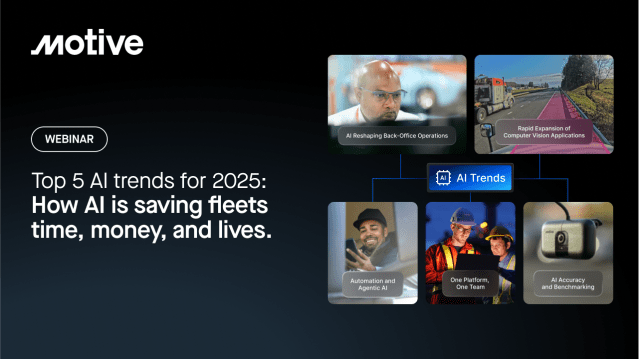
Top 5 AI trends for 2025: How AI is saving fleets time, money, and lives
For physical operations leaders, AI is no longer just a buzzword – it’s a necessity. From reducing accidents with computer vision to reducing back-office inefficiency through automation, fleets are seeing measurable, bottom-line results.